


John Healey’s first Budget this Wednesday (28 October) is widely expected to be a bit of a damp squib. Damp when you compare the scale and consequence of the two previous Budgets, where Rachel Reeves hiked taxes by £41.5bn and £26bn respectively.1
I joined the technical team at Mantic this summer after three years in No 10’s data science team. Last year I was one of a small group of advisers working on the Budget inside No 10. With that experience (read: chaos, although I did get a trip to Chequers out of it) still fresh in my mind, and given the turbulence in the global economy since the Iran war started in February, I can understand why Healey has gone for a more cautious approach.
That doesn’t make Wednesday’s Budget low-stakes, though (how could it be, with hundreds of billions of pounds moving around?). Household and public finances alike have been hit hard by the Iran war,2 and gilt yields reached their highest level since 2007 this month.3 The Bank is about to raise rates (and likely won’t stop there),4 and inflation and energy bills are rising, all amid the looming risk of another escalation in the Middle East after the US midterms next month.5 And a “quiet” Budget mostly means “delayed”, with the big decisions on tax and spending pushed to next year’s spending review.6
So what will Healey actually announce on Wednesday, and how will the markets react? How far will the Bank raise rates, and how much higher will inflation and energy bills go this winter and beyond, particularly if the war in Iran escalates again?
In this post I take each of these questions in turn, armed with forecasts from Mantic.
The Budget
The three obvious questions for Wednesday’s Budget are how much headroom it will leave against the main fiscal rule,7 how much tax it will raise, and what the main policy changes will be.
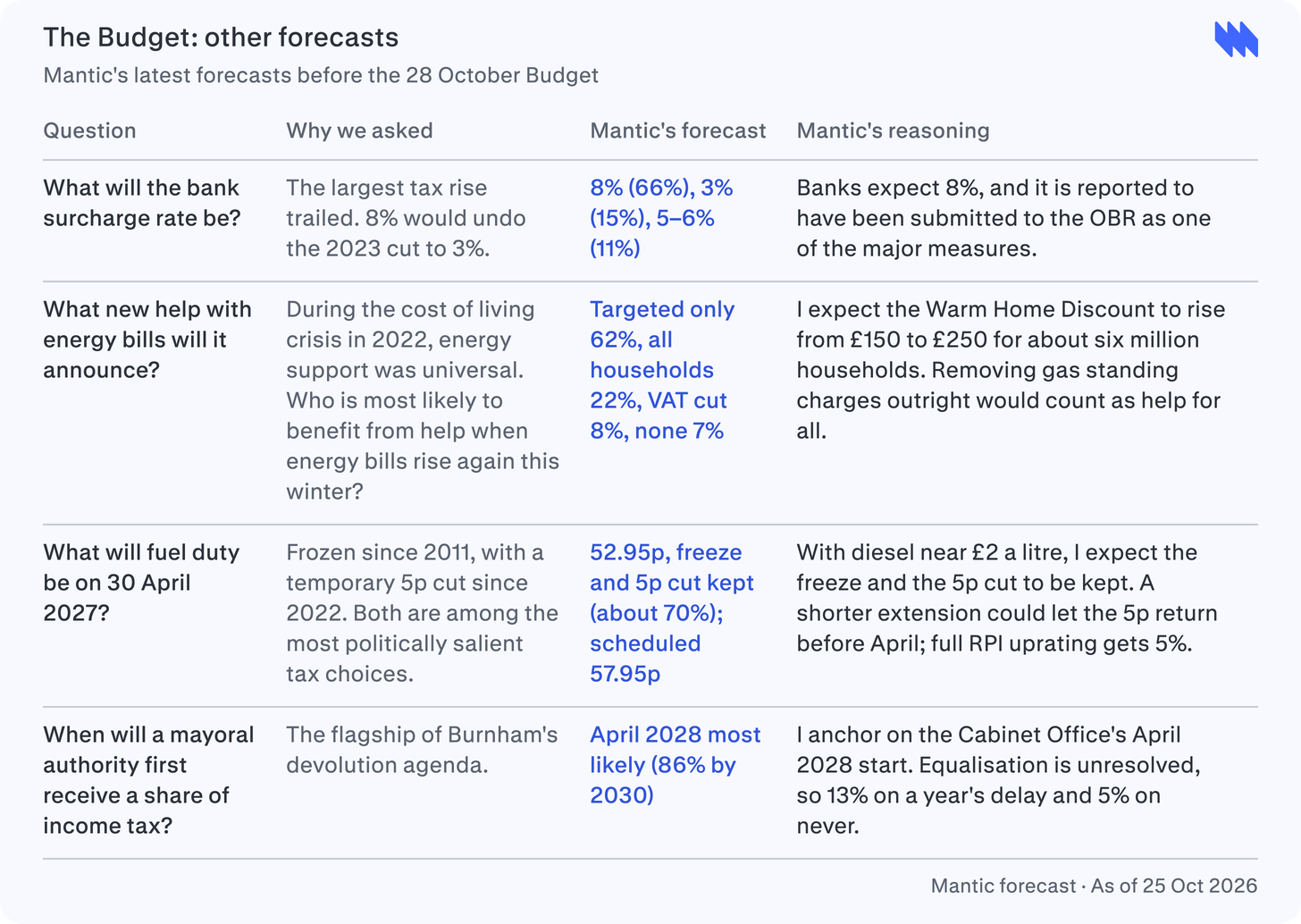
I’ve also asked Mantic for the details of any change to the bank surcharge, one of the most widely trailed tax rises, and what extra energy support households can expect this winter, with the price cap set to rise. And I’ve asked whether the 5p fuel duty cut will finally be unwound, and when mayors will get the share of income tax that Burnham has promised.
1. How much headroom will the OBR say Healey has left?
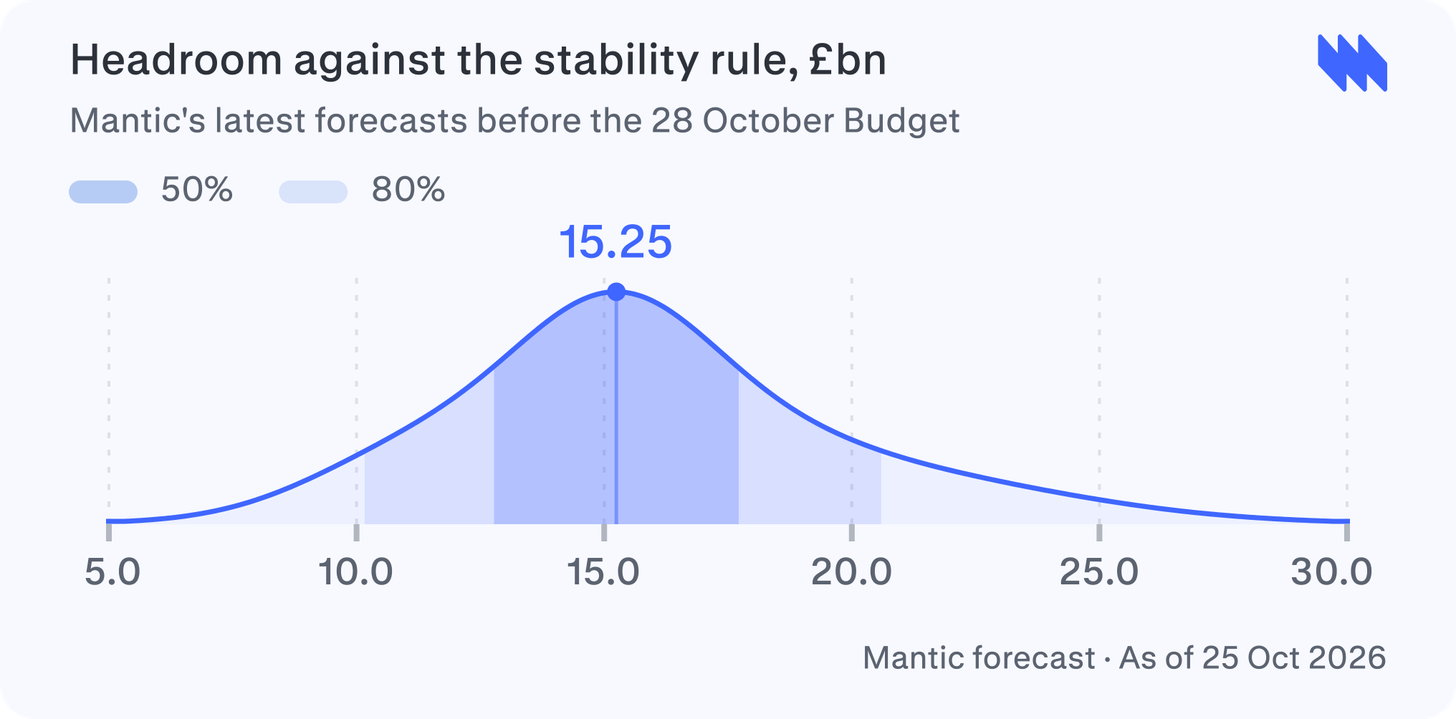
Why? The last time the OBR evaluated the government against its fiscal rules, in March,8 the then Chancellor, Rachel Reeves, had a reasonably healthy £23.6bn of headroom against the main fiscal rule.9 The OBR did this evaluation, though, before the start of the Iran war, which has pushed up gilt yields and interest rate expectations, adding c.£10bn to debt interest by 2029-30. The remaining headroom after this year’s Budget is one of the headline figures that bond markets will be watching and a key indicator of Britain’s fiscal health.
Mantic’s forecast: £15.2bn most likely (50% range £12.8–17.7bn).
Mantic’s reasoning: I build my forecast in two steps. Higher gilt yields and Bank Rate expectations add nearly £10bn to debt interest in 2029-30. Bank Rate matters as well as gilt yields because the reserves created by quantitative easing are paid at Bank Rate. Together with other forecast changes, and only partly offset by stronger tax receipts, that leaves headroom before measures at about £10–12bn.
I then estimate the buffer Healey wants. I put about two-thirds on around £15bn, in line with Deutsche Bank’s £15.7bn on 21 October and the £15.2bn median in Bloomberg’s 20 October survey of gilt dealers. I give about 17% to a return towards March’s £23.6bn and about 15% to a buffer nearer £11bn. I expect his measures to close about 90% of any shortfall against that buffer.10
2. How much net new tax will the Budget raise in 2029-30?
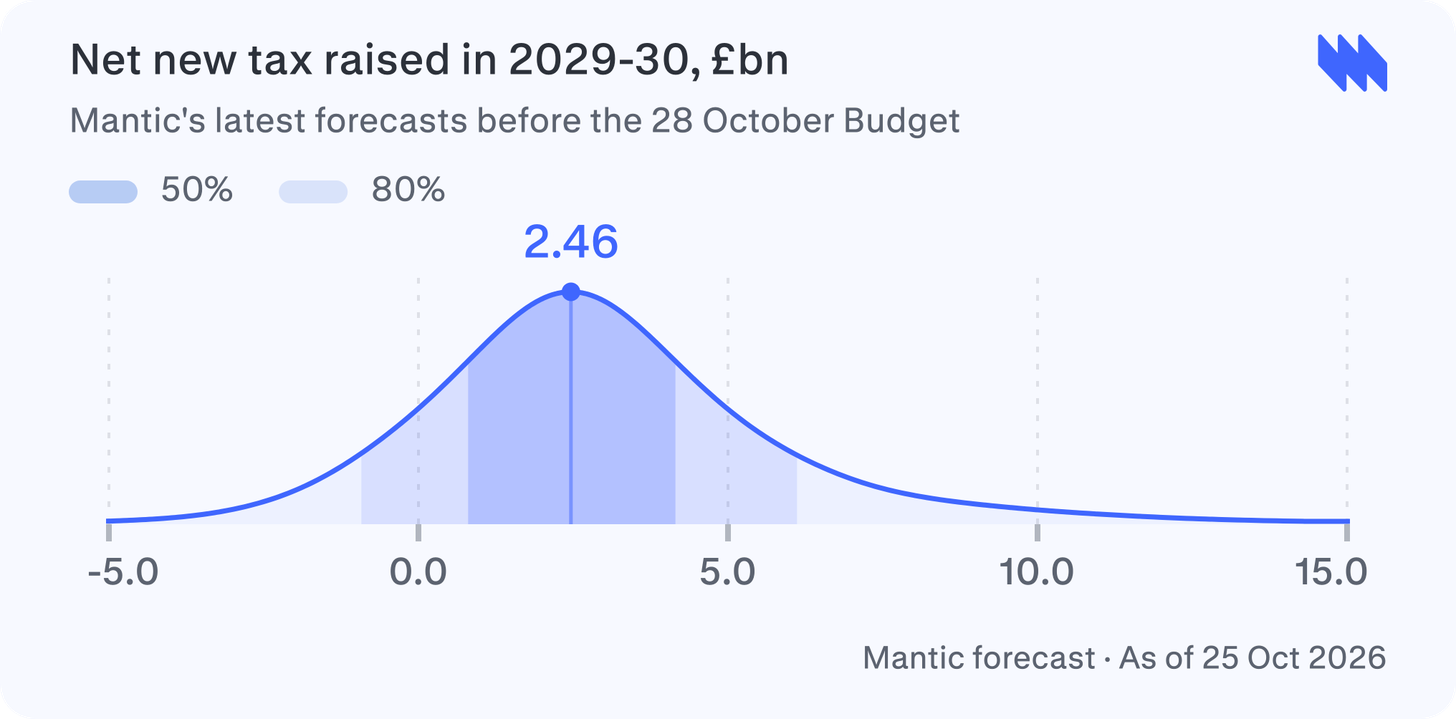
Why? Rachel Reeves’s two Budgets raised £41.5bn and £26bn a year in tax by 2029-30,11 with the headline increases coming from employer National Insurance and frozen income tax thresholds.
Mantic’s forecast: £2.5bn most likely (50% range £0.8–4.2bn).
Mantic’s reasoning: I build my forecast measure by measure, as the OBR would score each in 2029-30.
The bank surcharge rising from 3% to 8% raises about £2.3bn.
Marketplace VAT raises up to £1bn, and I net it against the business rates relief it funds.
Smaller measures add about £1.4bn.
Fuel duty is the largest swing among the known measures. A one-year freeze, at 55%, costs about £1bn. Cancelling the 5p rise for good, at 20%, costs about £3bn.12 I put a 30% probability on tax rises that have not leaked. With them, the most likely total rises from about £2bn to about £4bn.
3. What will be in the Budget?
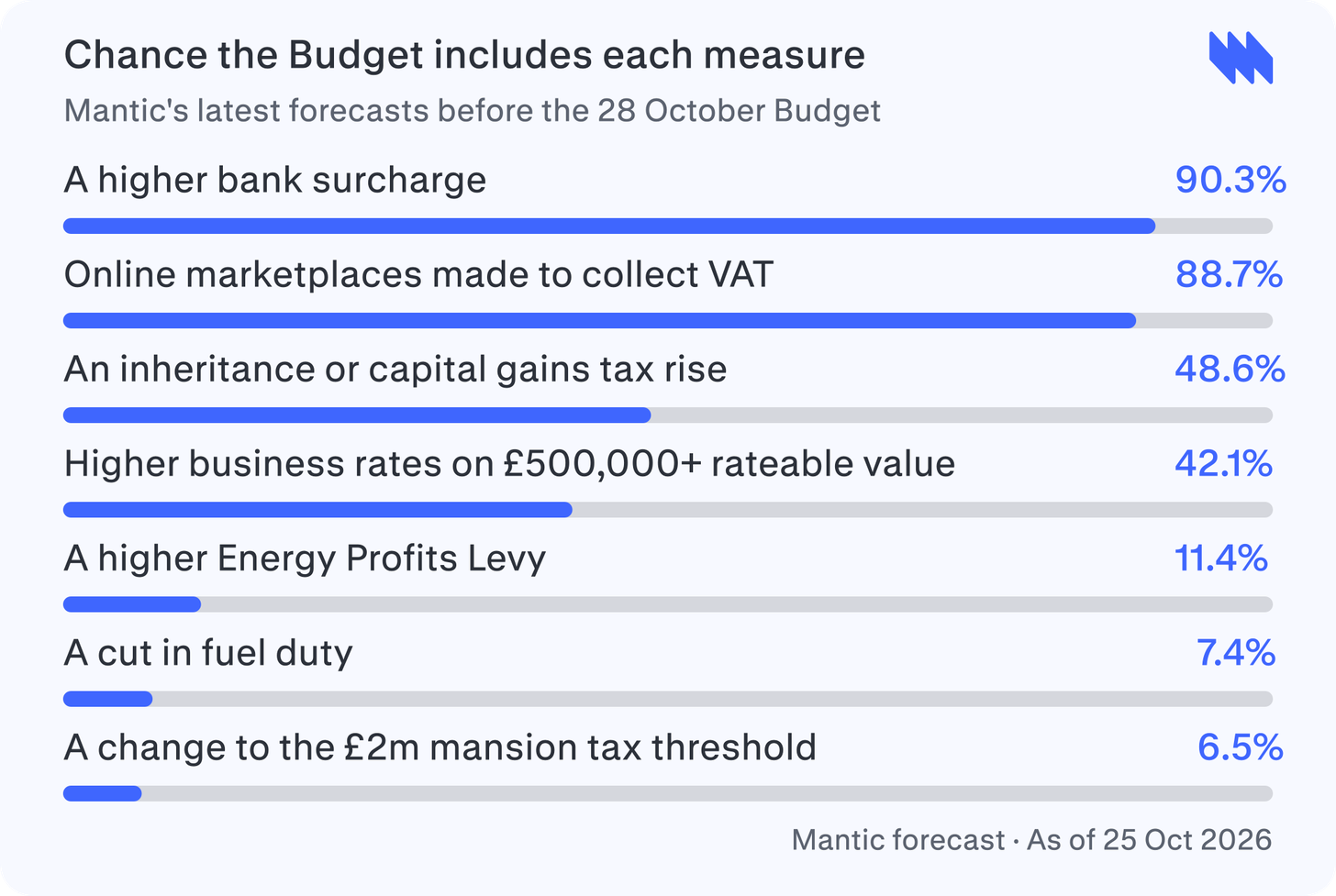
Why? Labour’s pledge not to raise the main rates of income tax, employee National Insurance or VAT still stands, so new revenue has to come from smaller taxes. This year’s Treasury kite flying has pointed at banks and online marketplaces,13 and there’s also speculation about wealth and property taxes.
Mantic’s forecast:
A higher bank surcharge (90%) and marketplace VAT (89%) are very likely.
An inheritance tax rise, most likely another threshold freeze, is 37%.
A capital gains tax change that raises money is 20% (small anti-avoidance measures rather than a rate change).
Higher business rates on properties with a rateable value of £500,000+ are 42%.
A cut in the fuel duty rate (7%), a higher Energy Profits Levy (11%) and a change to the mansion tax threshold (7%) are all unlikely.
Mantic’s reasoning: I put 95% on the bank tax plan surviving to Budget day, and 94% on it being a higher surcharge rather than another tax on banks. The Financial Times reported on 23 October that banks expected a rise from 3% to 8%. I put about 10% on marketplace VAT being signalled without a firm commitment.
I treat capital gains and inheritance tax separately. I put a capital gains tax rise at about 20%. Almost all of that is small measures, such as restricting reliefs and tightening anti-avoidance rules, rather than a higher rate. The Financial Times reported on 19 October that rates would not rise. I put an inheritance tax rise at about 37%, mostly through extending the threshold freeze beyond April 2031.14
I put 42% on the business rates premium for properties with a rateable value of £500,000 or more rising from 2.8p, most likely to 7–10p, against a legal cap of 10p. I put the chance of no change at about 70% for fuel duty, 76% for the Energy Profits Levy and 93% for the £2m mansion tax threshold.
Other forecasts
Markets
Britain’s borrowing costs are the highest in the G7. The 10-year gilt yield is hovering around 5.4%, about 1.1pp higher than when the war in Iran began, and earlier this month hit its highest level since 2007. Much of that rise reflects the war pushing up oil prices, and with them inflation and expected interest rates, as well as gilts’ close link to US Treasuries. But Britain has also paid a premium over its peers ever since Liz Truss’s 2022 mini-budget.
Here I look at how gilts will react to the Budget this week, where yields end next year and whether the gap between British and French yields narrows, given France’s own debt problems, budget stand-offs and presidential election next spring. I also look at the risk of another gilt spike, a credit downgrade and a change to the fiscal rules.
1. How will gilts react to the Budget?
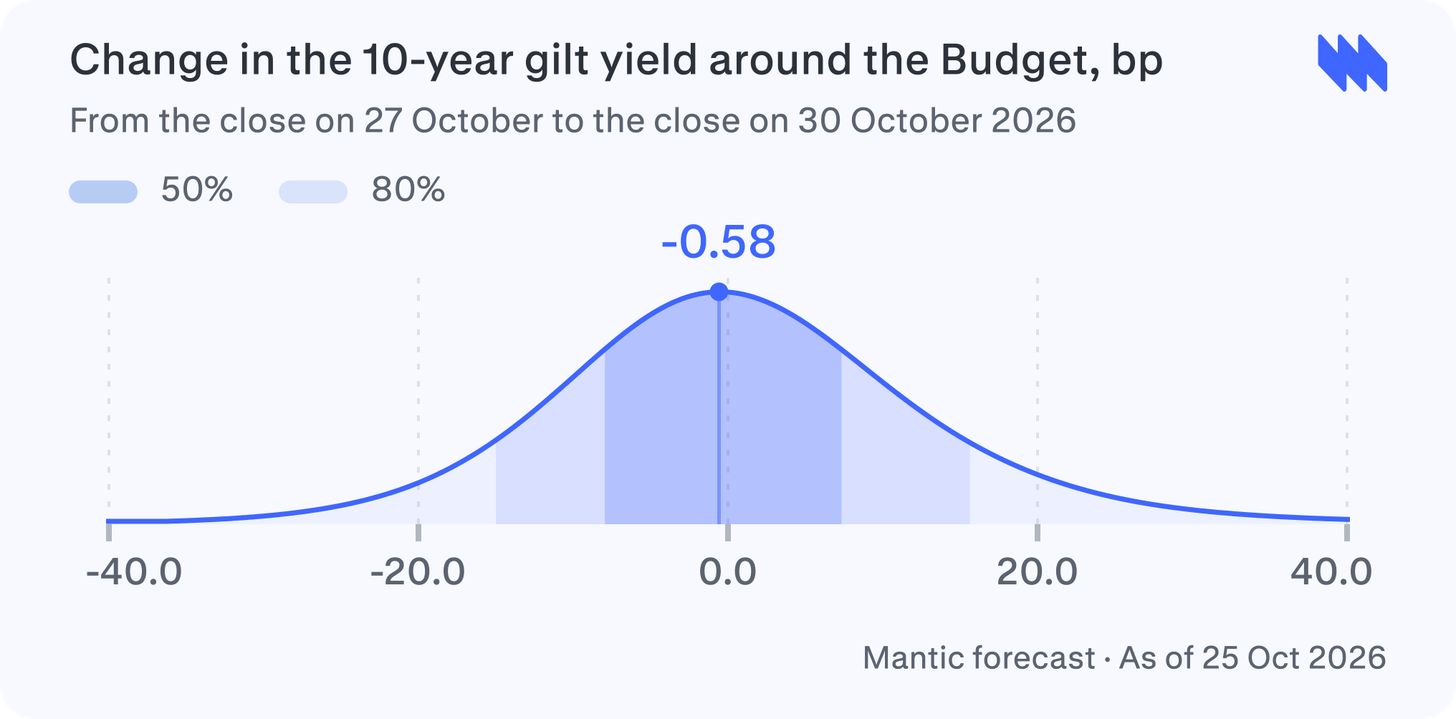
Why? After the 2022 mini-budget the 10-year yield rose about 90bp in three days. Over the same window it rose about 15bp after Reeves’s 2024 Budget and fell about 5bp after last year’s.15
Mantic’s forecast: most likely unchanged (−0.6bp), with a 50% range from an 8bp fall to a 7bp rise.16
Mantic’s reasoning: I treat the three-day change as two separate moves, the market’s reaction to the Budget itself and global market movements over the same period.
I put a 67% probability on a Budget that matches the roughly £15bn of headroom markets expect. In that case the Budget itself most likely moves yields by about 1bp.
I give about 16% to a mild disappointment, most likely adding 6–12bp, and about 14% to fiscal relief, most likely taking off 6–8bp.
I give about 3% to a credibility shock, most likely adding 20–50bp.
Global markets account for more of my range than the Budget does. A typical three-day move in the 10-year this year is about 9bp either way. Over the window, I expect US data, the Federal Reserve, the ECB and oil to move the 10-year by anything from a 14bp fall to a 15bp rise (90% range). That range is wider than any Budget outcome I expect short of a credibility shock. The Federal Reserve announces its rate decision on the evening of Budget day, inside the same window.
2. Where will 10-year gilt yields be at the end of 2027?
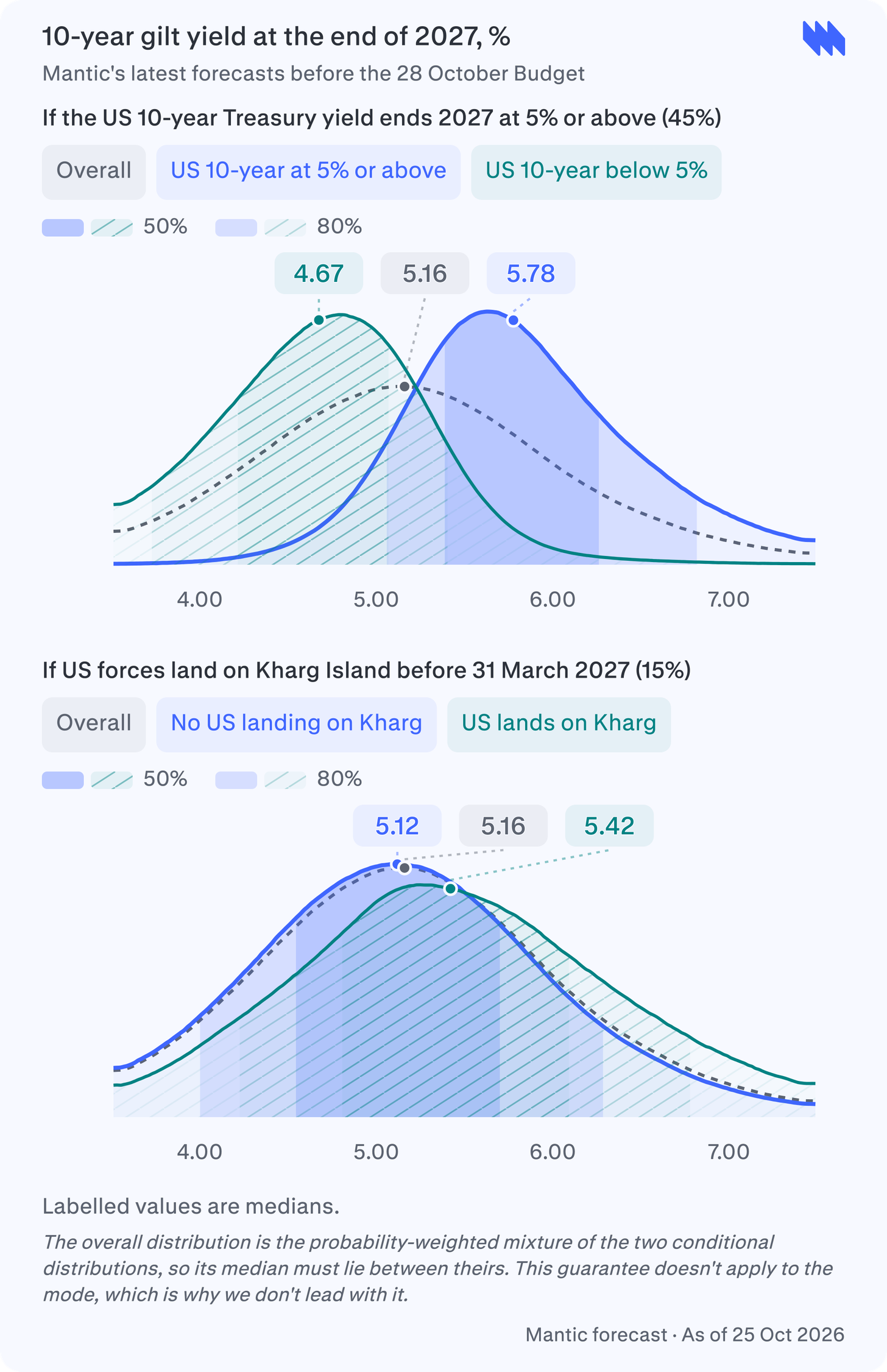
Why? Gilt yields are highly sensitive to global economic conditions, as well as to domestic fiscal policy. Any further rise would push up debt interest and eat into fiscal headroom. I’ve asked where gilt yields will be at the end of 2027, conditional on two separate scenarios. The first is the US 10-year ending 2027 at 5% or above, representing a world where the war and high oil prices keep inflation and interest rates high everywhere. The second is US troops landing on Kharg Island, Iran’s main oil export terminal, before 31 March 2027 (air strikes or naval shelling alone don’t count). I’ve selected this second scenario as a plausible (though unlikely, at 15%) but dramatic re-escalation of the conflict in Iran, driven by an increasingly erratic administration. Re-escalation scenarios are particularly pertinent given a likely Democratic sweep in next week’s midterms (which Mantic has at 65%). That would stall Trump’s domestic agenda, and could push him towards more extreme action in foreign policy, where he still has dominant authority.
Mantic’s forecast: 5.1% most likely, with a median of 5.16% (50% range 4.5–5.7%). If the US 10-year ends 2027 at 5% or above (45%), the median is 5.78%, against 4.67% if not. A US landing on Kharg Island by the end of March would lift the median to 5.42%, against 5.12% without one.
Mantic’s reasoning: I build my forecast from the global backdrop.
I put about 40% on the conflict easing and energy prices normalising. In that case the 10-year most likely ends 2027 at 4.7–4.9%.
I put about a third on rates staying high, at 5.4–5.7%.
I give about 12% to a global recession pulling yields to about 4%, and about 13% to a renewed inflation or fiscal shock taking them to 6–6.5%.
Gilts move closely with US Treasuries. US yields at 5% or above would mean the war and high oil prices had persisted, so I drop most of my de-escalation cases and my median rises to 5.78%. US yields below 5% point to energy normalisation or a slowdown, and my median falls to 4.67%. September’s 3.5% inflation and borrowing above forecast keep Britain’s premium over Treasuries from narrowing much in either case.
A landing on Kharg Island would threaten to push Brent crude above Friday’s $117 and keep inflation and rates higher. I raise my median only to 5.42%, because seizing Iran’s main export terminal could also force a quick end to the war, which would bring oil and yields down, or push oil high enough to cause a global recession. In a recession, I expect the Federal Reserve and the Bank of England to cut rates, because a deep downturn would pull inflation down once the oil spike passes. That most likely takes gilt yields towards 4%.
3. Will Britain’s borrowing costs stay above France’s?
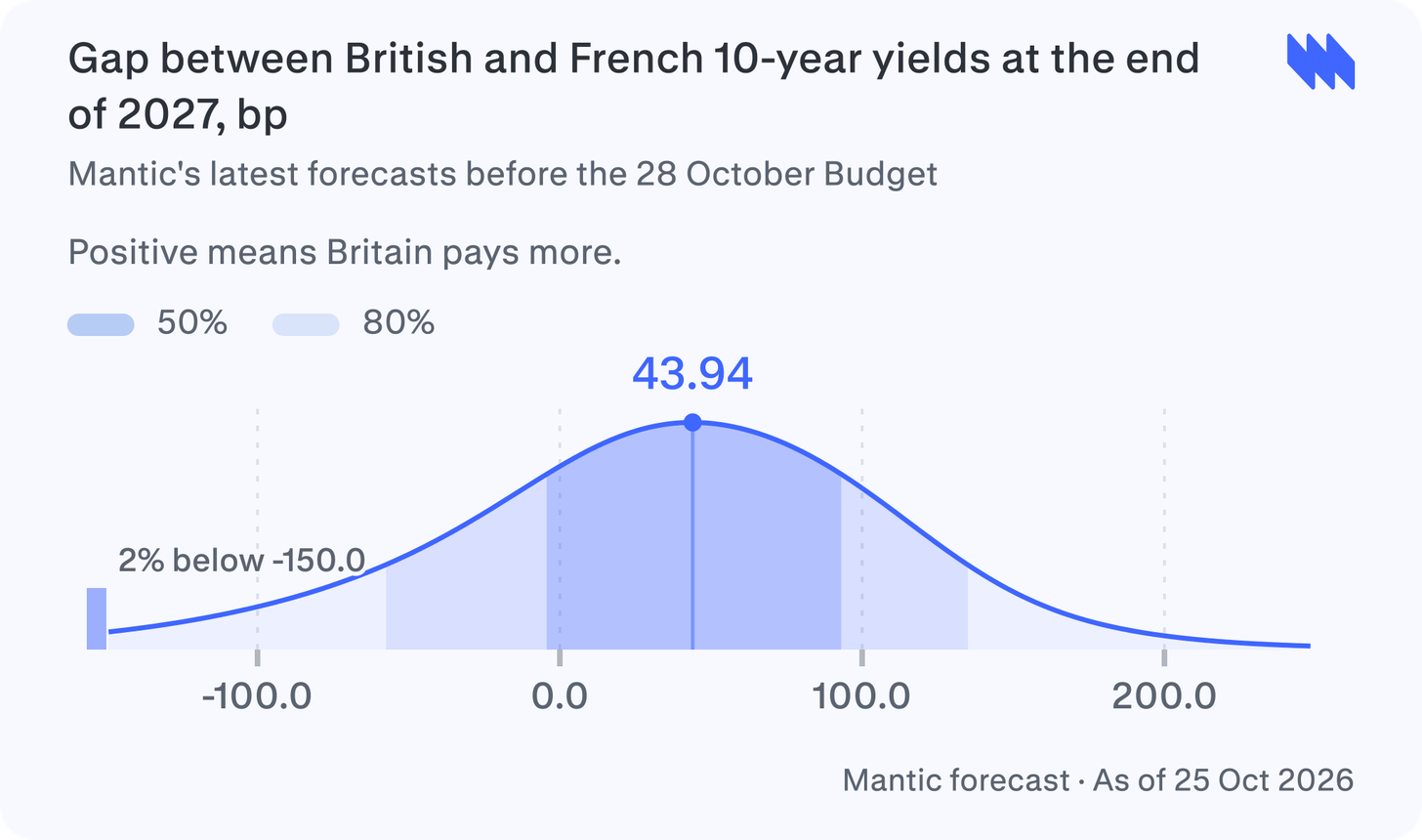
Why? France has struggled to push deficit cuts through its Parliament for years, and its debt is about 119% of GDP and still rising. Most recently, doubts over its 2027 budget pushed its 10-year yield above 5% this month for the first time since 2002. Even so, Britain still pays about 33bp more than France to borrow for ten years. The gap had typically been above 110bp from 2023 until June (121bp at the end of June), and almost all of the narrowing since has come from rising French yields. France’s spread over Germany has widened by about 100bp since June, against 13bp for Britain. Whether the gap narrows further is a good test of whether markets start to reward Britain for its comparatively healthy fiscal path, which the IMF recently highlighted.
Mantic’s forecast: British yields most likely 44bp above France’s (50% range from 4bp below to 93bp above), with a 70% probability that Britain is still paying more at the end of 2027.17
Mantic’s reasoning: I forecast the gap as Britain’s premium over Germany minus France’s. I expect Britain’s premium to edge down from about 202bp to about 190bp. The French side is less certain and depends on the presidential election.
I put about 47% on a National Rally win. In that case the gap most likely narrows to about 20bp.
I put about 35% on a centre-right win. French yields would then fall back, most likely widening the gap to about 85bp.
A Mélenchon win, at about 11%, most likely takes French yields above Britain’s.
Other forecasts
Rates, bills and inflation into 2027
The week after the Budget, on 5 November, the Bank is widely expected to raise rates by 25bp to 4%, its first rise since August 2023. Growth has been stronger than expected, but high oil prices are starting to feed through to inflation, which rose from 3.1% to 3.5% in September. Another escalation in the Middle East would leave Britain little room to absorb it, with 10-year borrowing costs already the highest in the G7 and inflation that the IMF expects to stay among the G7’s highest into 2027.
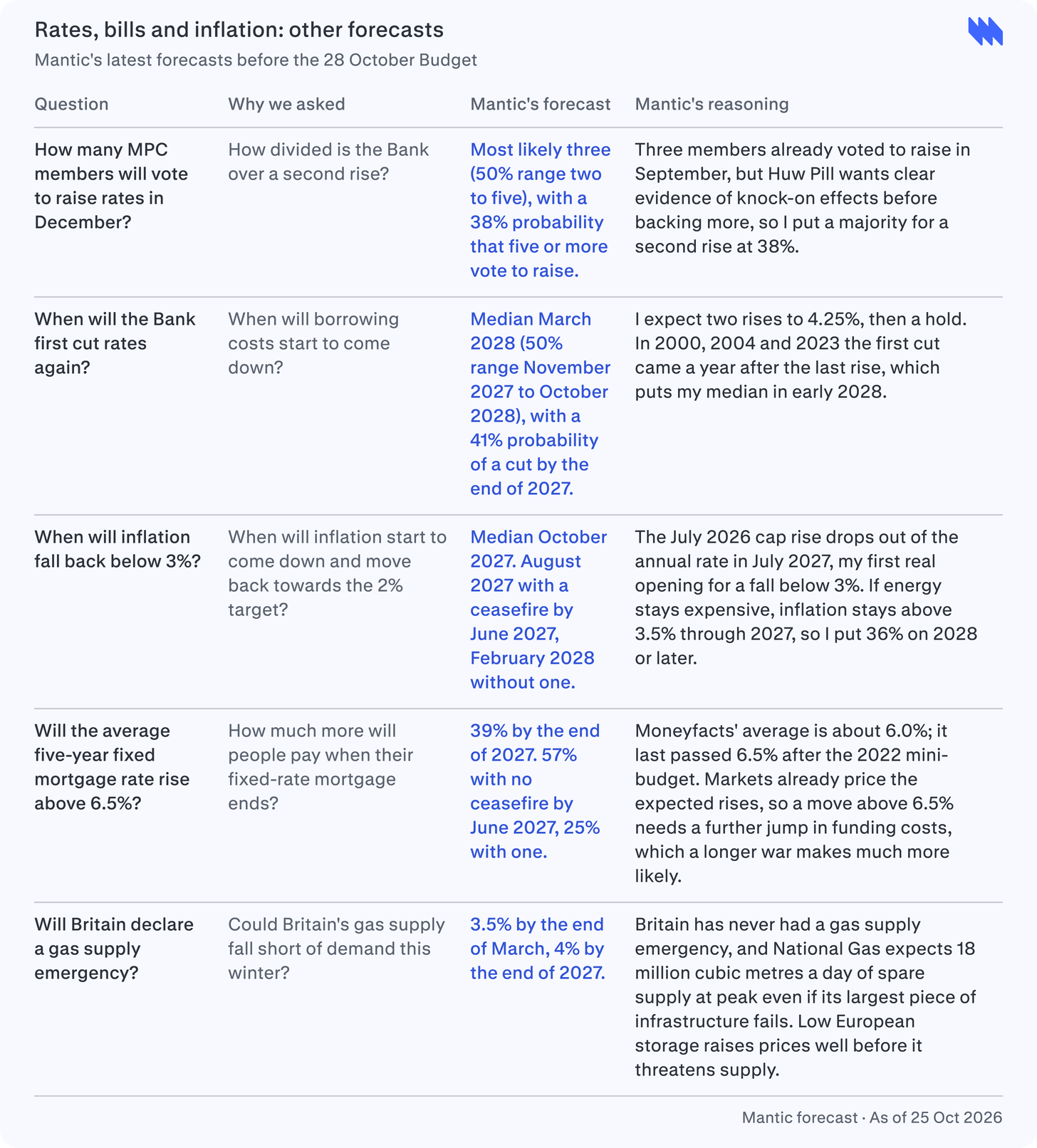
I’ve asked Mantic how far the Bank will raise rates, how high inflation will go and what the price cap will do next year. I also look at when inflation and rates come back down, whether mortgage rates pass 6.5% and whether Britain will have to declare a gas supply emergency.
1. How far will the Bank raise rates?
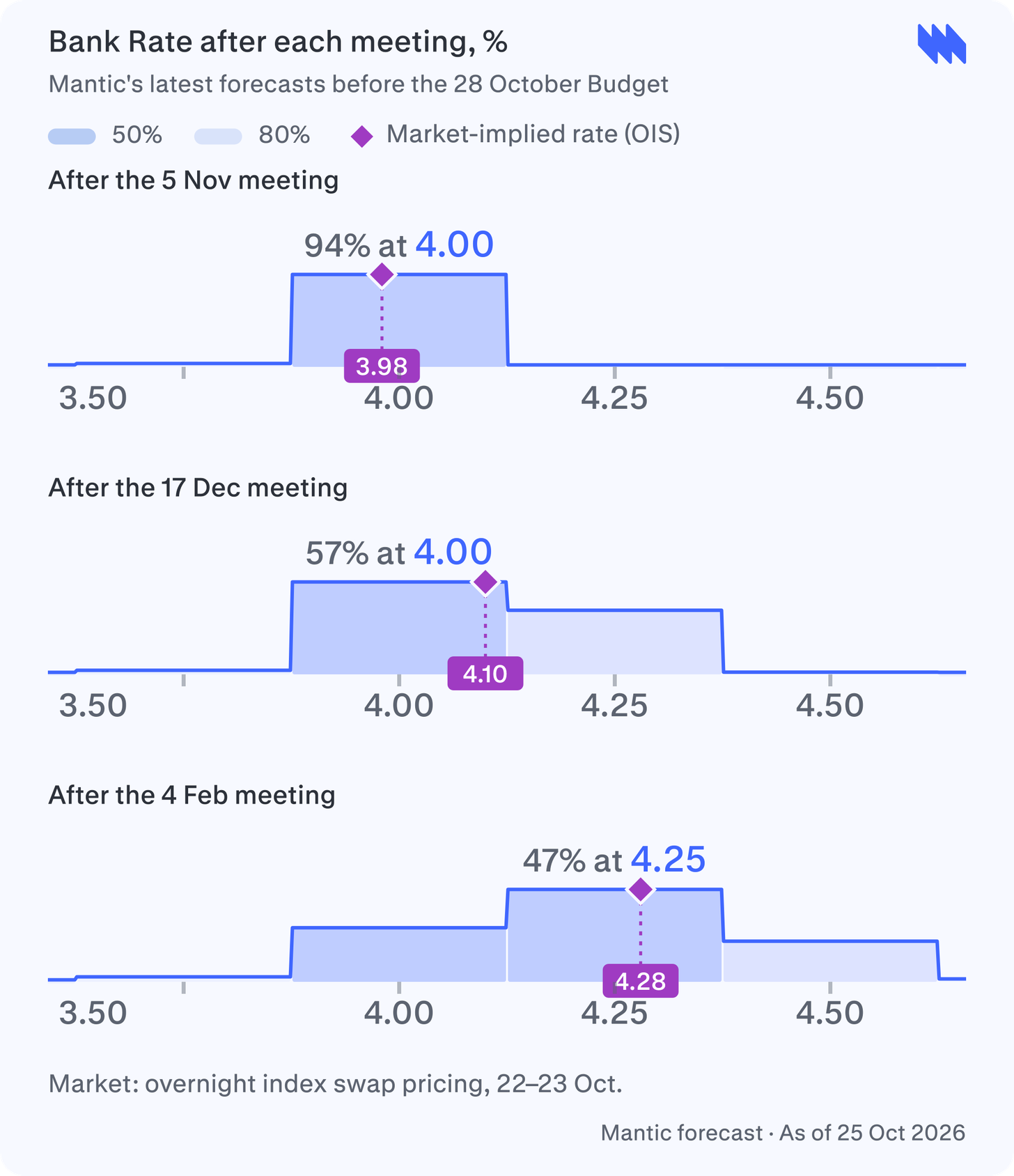
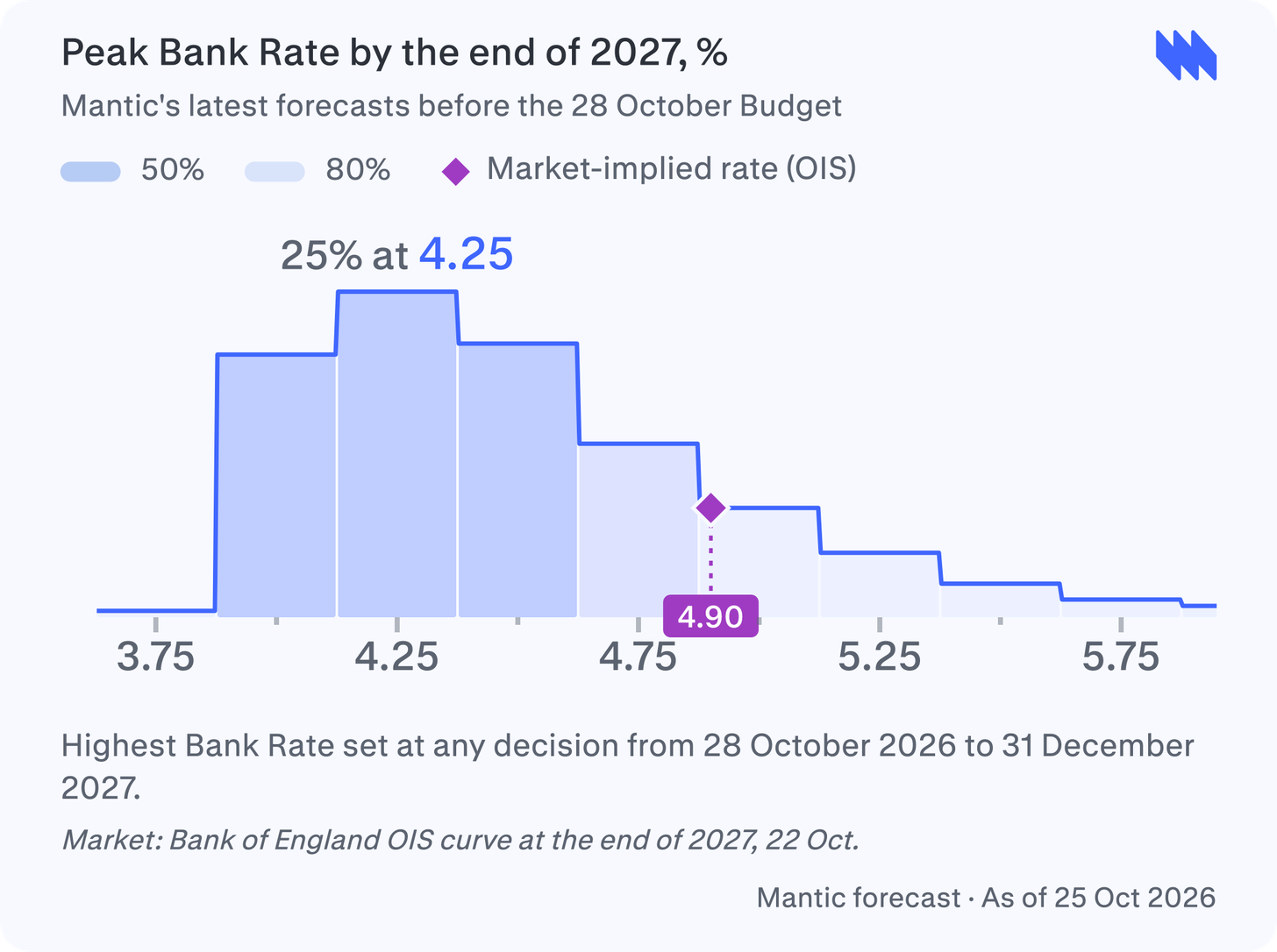
Why? Markets are pricing in four to five quarter-point rises by October 2027, which would take Bank Rate to about 4.85% (as of 22 October).18 Polymarket prices a second rise in December at only 32%.19 I’ve asked Mantic where Bank Rate will be after each of the next three meetings, and how high it will peak by the end of 2027. I’ve also asked for the peak if Brent crude averages $110 or more in the first quarter of 2027. Brent was $117 on 23 October, its highest since April, so this scenario implies a continuation of elevated prices into the new year.
Mantic’s forecast: a rise to 4% on 5 November (94%), then most likely a hold in December (57%, with 39% on a second rise) and 4.25% after February (47%). Bank Rate most likely peaks at 4.25% (50% range 4.00–4.50%), with a median of 4.50%, below the 4.85% markets imply for October 2027. If Brent averages $110 or more in the first quarter (38%), the median peak is 4.75%, against 4.25% if not.20
Mantic’s reasoning: I expect two rises, in November and around February, taking Bank Rate to 4.25%. That is also what ING, and the IFS and Barclays in the Green Budget, expect. My central case (48%) is energy staying expensive without pushing pay or services inflation much higher. The Bank’s September minutes put expected wage growth steady at 3.4%, and retail sales fell 0.4% in September, so there is little sign of inflation spreading yet. If it does spread (34%), the peak most likely reaches 4.75–5%. I sit below the 4.75–5% that markets price because even Huw Pill, who voted to raise in September, doubts the case for four rises without clearer evidence of knock-on effects.
Brent averaging $110 or more in the first quarter would mean oil staying close to Friday’s $117 through the winter. That makes a prolonged energy shock my central case. I then follow the IFS and Barclays’ estimate that Bank Rate peaks at 4.75% if energy prices stay high, against 4.25% if they fall. With inflation at 3.5% and business activity at an eight-month high, high oil strengthens the case for several more rises, so I raise my median peak to 4.75%. I stay below the 5% some market paths reach, because Huw Pill wants concrete evidence of knock-on effects before backing a fifth rise. If Brent averages below $110, the prolonged high-energy case largely drops out and I move towards the economists’ two rises, with a median peak of 4.25%. Even then, a stop at 4% is not my central case, because the Bank expects inflation above 4% early next year and that keeps a second rise likely.
2. How high will inflation go?
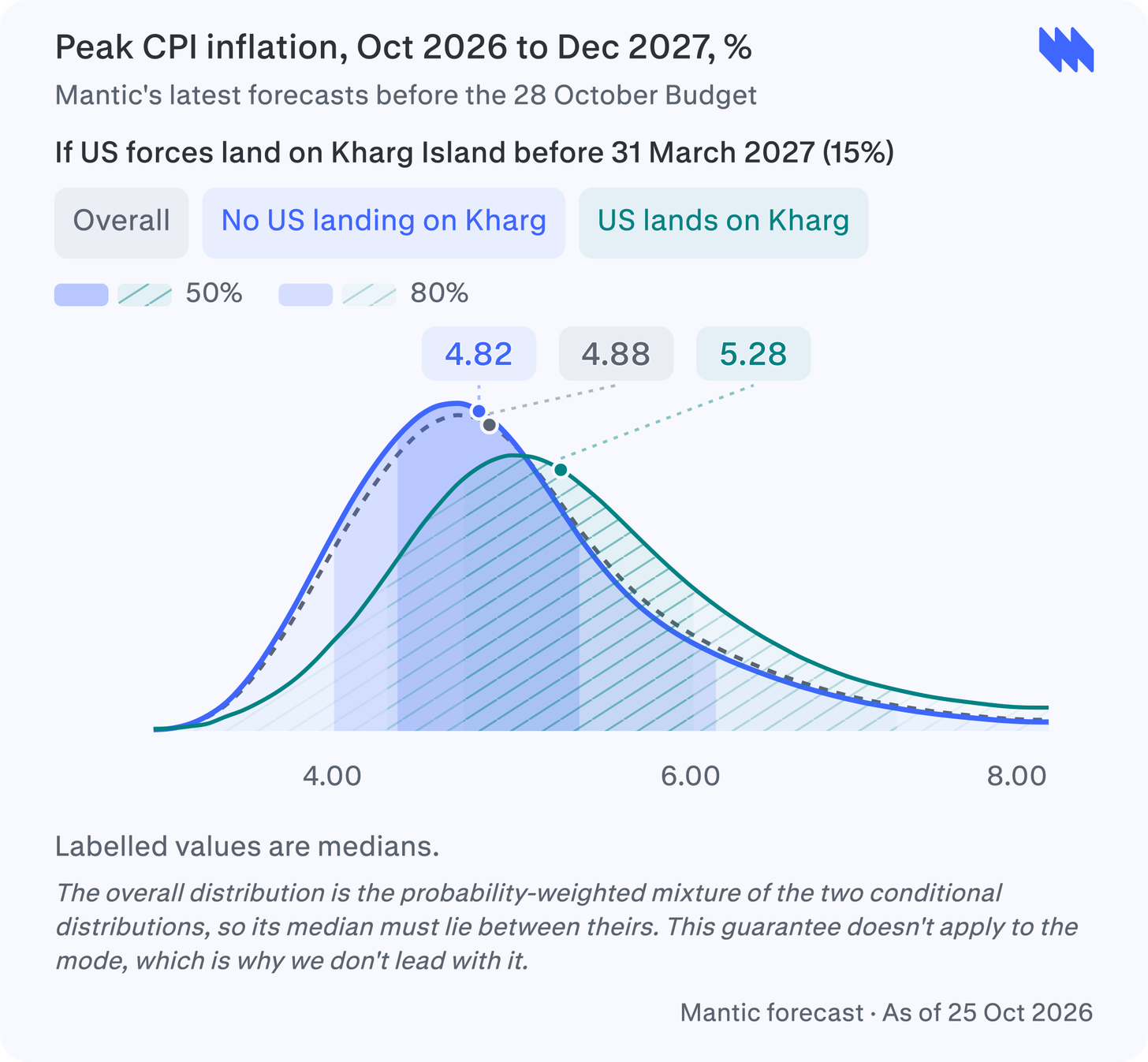
Why? Higher inflation squeezes both households and the public finances. Mantic forecasts pay falling behind prices again this winter, with a 72% probability that real regular pay growth turns negative in ONS figures published by the end of January. September’s 3.5% also sets April’s rise in most benefits. Much of the rise comes from energy (motor fuel is up 30% year-on-year, and the price cap is forecast to rise in January), so the peak is highly sensitive to events in the Middle East. I’ve asked how high it goes if US troops land on Kharg Island by the end of March, again as my illustrative escalation scenario.
Mantic’s forecast: 4.7% most likely (50% range 4.3–5.2%), with a median of 4.9%.21 A US landing on Kharg Island by the end of March (15%) would lift the median peak to 5.3%, against 4.8% without one.
Mantic’s reasoning: January’s price cap rise, which I forecast at about 24%, takes inflation to its peak early next year. Higher bills reach the inflation figures quickly, but only in part. When the cap rose 13% in July, household energy prices in the CPI rose 7%. My central case (45%) is oil and gas staying close to today’s prices, with Brent near $117 and a peak of about 4.8%. Further escalation (30%) would push the peak to about 5.5%, and a deal (25%) would hold it near 4.2%. Food inflation is still only 1.3%, so I expect the knock-on effect on other prices to build slowly.
A US landing on Kharg Island would add a new supply shock. Higher oil and gas prices would feed into the April and July caps, pushing the peak into spring or summer 2027. I expect the government to step in to limit household bills, so I raise my median peak by only 0.4pp.
3. What will the energy price cap be next year?
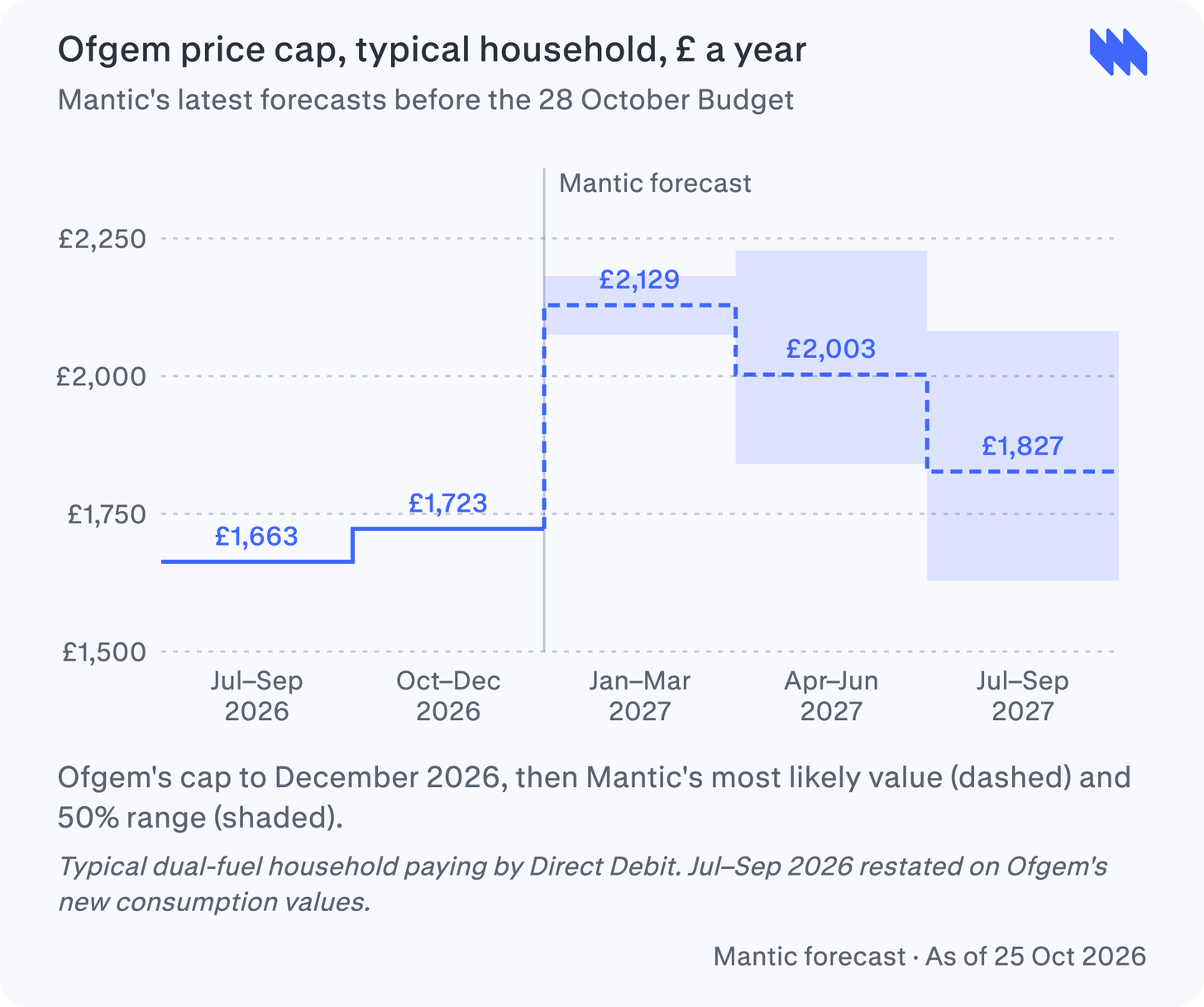
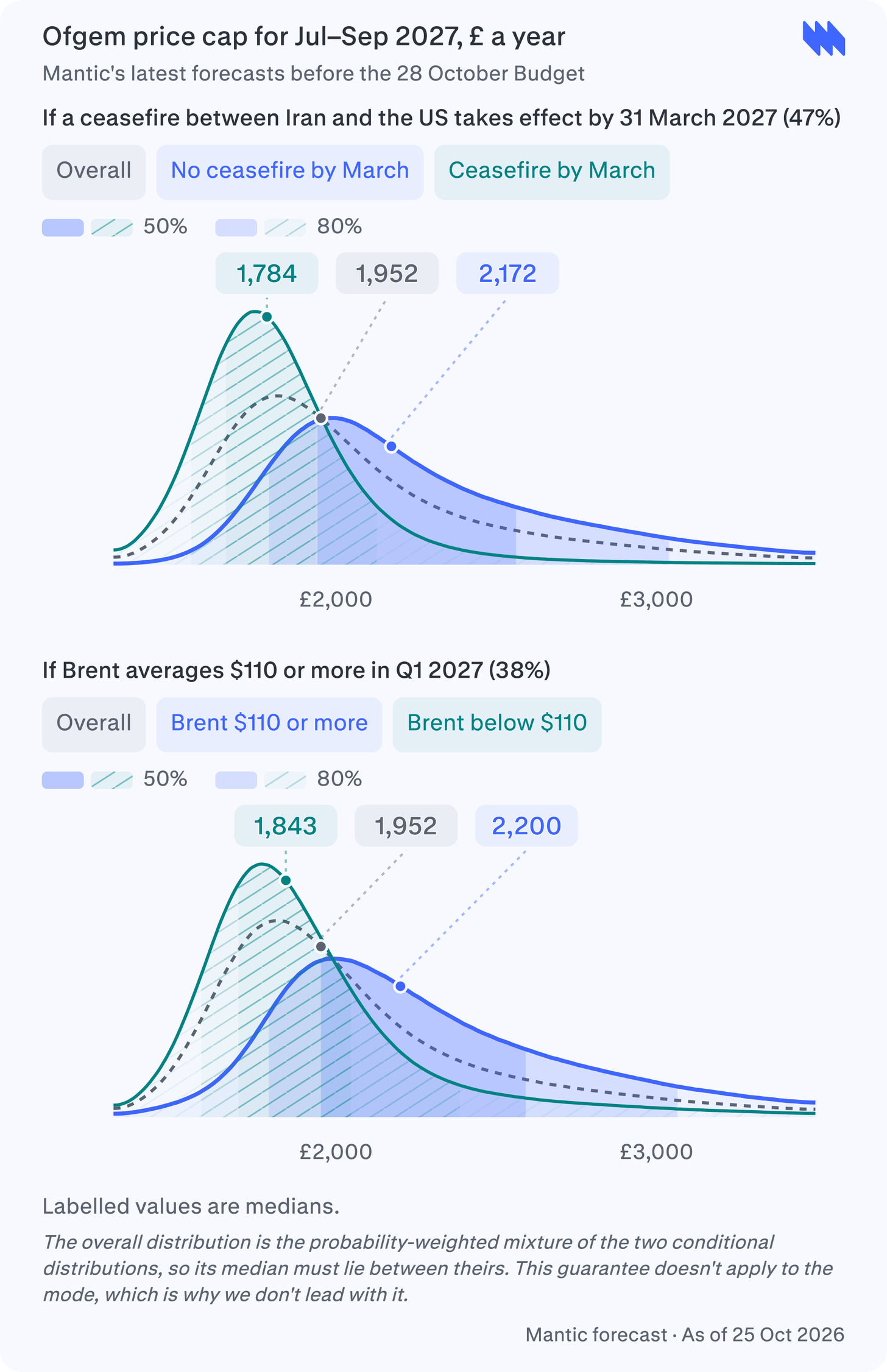
Why? The cap for a typical household is currently £1,723 a year.22 January’s cap is set on wholesale prices from mid-August to mid-November, so most of it is already locked in. The July cap is set on prices from mid-February to mid-May, so it will show how the war develops over the winter. I’ve asked Mantic to forecast the July cap under two scenarios, a ceasefire by March23 and Brent averaging $110 or more in the first quarter of 2027.
Mantic’s forecast: about £2,130 most likely in January (50% range £2,075–2,182), up 24% on today, then about £2,000 in April (£1,841–2,228) and £1,830 in July (£1,629–2,082), with a July median of £1,952. A ceasefire by the end of March (47%) gives a July median of £1,784, against £2,172 without one. If Brent averages $110 or more in the first quarter (38%), the July median is £2,200, against £1,843 if not.
Mantic’s reasoning: The July cap depends mainly on wholesale gas prices between mid-February and mid-May. Each 10p a therm on gas adds about £47 to a typical annual bill. If gas prices ease (about a third), the cap is most likely near £1,730. If they hold steady (about 40%), it is about £1,910, and if they rise (about a quarter), £2,160 or more. My forecast assumes the zero VAT rate on electricity ends in March as planned, adding about £45, though I give a 35% probability that the government extends it.
A ceasefire by the end of March would bring summer gas prices down before shipping fully recovers. The cap would still stay above pre-war levels, because Europe has to refill depleted gas storage over the summer. Without a ceasefire, about 80% of Qatar’s and the UAE’s gas exports stay out of the market, so even an April deal leaves summer prices high. Brent averaging $110 or more in the first quarter would signal the same persistent disruption.
Other forecasts
Beyond the Budget
Mantic expects Wednesday’s Budget to be small, raising about £2.5bn of net new tax and rebuilding headroom to around £15bn, with gilts barely moving. The bigger risks for households lie elsewhere. Bank Rate is likely to rise to 4.25%, inflation to peak at about 4.7% early next year and the price cap to rise by about a quarter in January. A re-escalation in Iran would push all three higher. The hardest choices for Healey and Burnham on tax and spending, from defence to NHS pay, have largely been pushed into next year,24 and I’ll look at how Labour is likely to handle these trade-offs, and what that could mean for their chances at the next election, in a future post.
If you found this useful and want forecasts on your own questions, book a demo or reach out at contact@mantic.com.
Tax raised in 2029-30 (OBR, October 2024; OBR, November 2025). The 2024 Budget’s tax rises, at c.1.2% of GDP, were among the largest since 1993. Together the two Budgets take the tax burden to an all-time high of just over 38% of GDP from 2029-30.
Inflation was 3.5% in September, up from 3.0% in January, the last month before the start of the US-Iran war, and the Bank of England expects it to peak a little over 4% early next year. Higher inflation pushed debt interest to a record £10.9bn for a September, through index-linked gilts, though inflation and wage growth have also lifted tax receipts £5.8bn above the OBR’s forecast so far this financial year.
The 10-year gilt yield hit 5.53% on 8 October, its highest since 2007, and the 30-year hit 6.04% on 7 October, its highest since 1998. Both have eased since, with the 10-year around 5.4% in the week before the Budget, still about 1.1pp above the level when the war began.
Mantic gives a rise to 4% on 5 November a 94% probability, with Bank Rate most likely peaking at 4.25% (see “Rates, bills and inflation into 2027”).
We’re dropping hashes of our forecasts. Hash #7 · When the United States next conducts a direct military strike on Iranian territory · 60e3dfbb265407bf60252019aae2dc3444992a5f6a4e1cd97ebbb290a717ebe4
The IFS estimates the government needs about £35bn a year of tax rises or benefit cuts by 2030-31, including £11bn to reach 3% of GDP on defence, while keeping health spending growing 2.7% a year in real terms (IFS Green Budget 2026). Healey is expected to announce new defence investment on Wednesday, but has said the timetable for reaching 3% of GDP will wait for the spending review.
The stability rule, under which tax receipts must cover day-to-day spending by 2029-30.
Strictly, the OBR now assesses the fiscal rules only once a year, at the Budget, and March was a forecast rather than a fiscal event. In practice it reported headroom in the same way and was read as an assessment.
Headroom is the margin by which the OBR forecasts the rule to be met, here the forecast surplus of tax receipts over day-to-day spending in 2029-30.
The forecast resolves on headroom against the stability rule only. The OBR also reports headroom against the investment rule.
Tax raised in 2029-30 (OBR, October 2024 and November 2025).
Against the pre-Budget baseline, which assumes the scheduled rises happen, a freeze counts as a tax cut.
The Financial Times reported that Healey had signalled a tax raid on banks, and The Times reported on 13 October that he was targeting online marketplaces in a £1bn VAT crackdown.
The forecast counts an increase if a new measure raises revenue from the tax in the final forecast year, so a freeze that runs into 2031-32 qualifies even though no rate changes.
Change in the 10-year yield from the close before each Budget to the close two days after (Bank of England data). The 2022 figure is for the September 2022 mini-budget.
The forecast uses the closes on 27 and 30 October, so it includes the Federal Reserve’s decision on the evening of 28 October. Mantic forecasts the Fed will hold rates (94%).
The forecast takes Britain’s 10-year benchmark gilt yield minus the French 10-year OAT yield, in basis points, at the last close on or before 31 December 2027. A positive figure means gilt yields are higher.
Bank of England overnight index swap (OIS) forward curve, 22 October.
Polymarket’s December market had traded only about $15,000. Our backtest found Mantic significantly more accurate than Polymarket on markets with under $100,000 traded.
For Mantic’s forecasts of Bank Rate and other major central banks’ rates out into 2027, or any other forecasts, get in touch at contact@mantic.com.
The peak is the highest first-published annual CPI rate for any month from October 2026 to December 2027. The Bank of England’s September forecast has inflation peaking a little over 4%.
The cap is the annualised figure for a typical dual-fuel household paying by Direct Debit. Ofgem lowered its typical consumption figures from the October 2026 cap, so the chart starts at July–September 2026, restated on the new basis.
A ceasefire counts once both the Iranian and US governments have expressly accepted it and it has taken effect, committing both sides to stop direct armed attacks. A unilateral pause, a mediator’s proposal or a de facto lull does not count.
Healey is expected to announce billions in new defence investment on Wednesday, channelled through public financial institutions such as the National Wealth Fund and British Business Bank (Sunday Times). That money is treated differently from conventional spending under the fiscal rules. The timetable for reaching 3% of GDP will wait for next year’s spending review. Mantic expects UK defence spending to first reach 3% of GDP, on NATO’s measure, most likely in 2030.
Great article!