


Friday Forecasts is a weekly series showcasing five forecasts directly from Mantic, which you can explore on the Mantic platform with the direct link in the forecast titles.
1. The endpoints met in AVANZAR’s first readout ↗
AVANZAR pits Datroway against Keytruda in first-line lung cancer. Its first readout may show a delay in progression before the survival results are mature. Explore on Mantic ↗
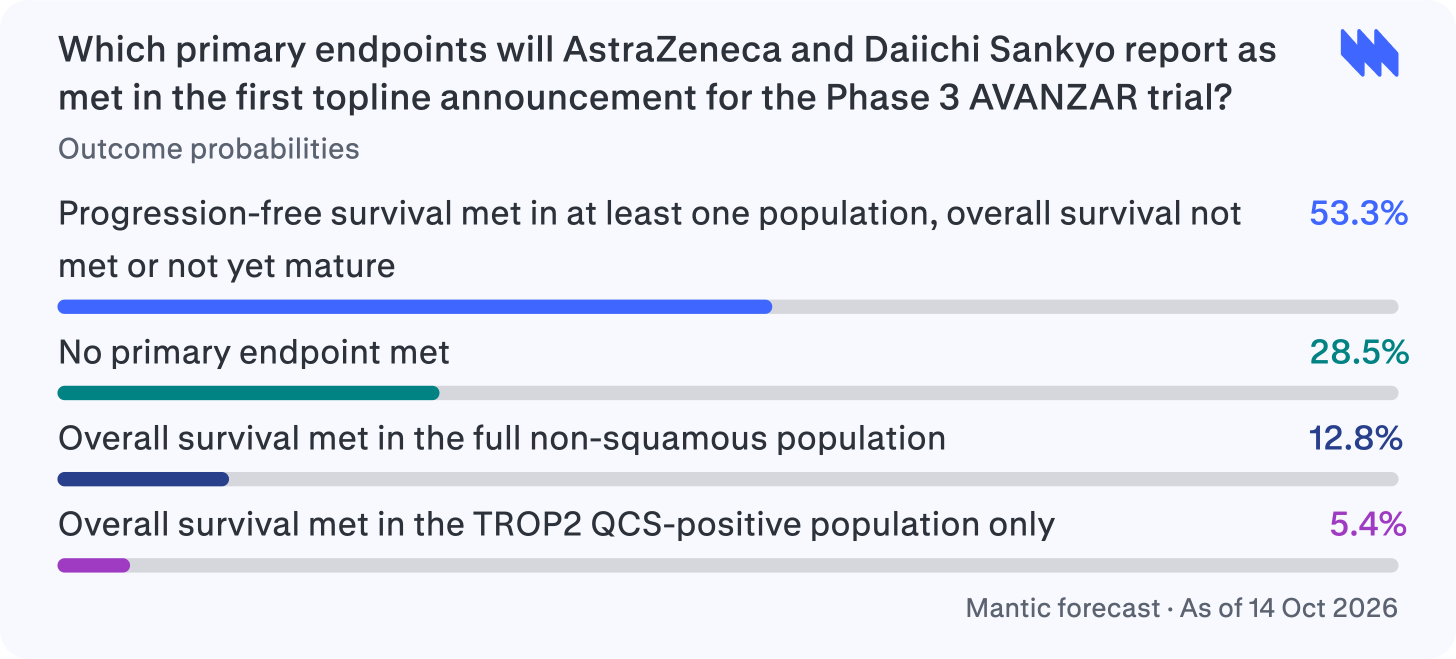
I give a 53% probability of progression-free survival success in at least one population without significant overall survival at the first announcement, 28% of no primary endpoint met, 13% of overall survival success in the full non-squamous population and 5% in TROP2 QCS-positive patients only.
Kelun-Biotech reported a progression-free survival win in the similar OptiTROP-Lung06 trial in July 2026. I favour progression-free survival success partly on this result and TROPION-Lung02’s retrospective biomarker activity.1
Daiichi Sankyo’s September 2024 TROPION-Lung01 results missed overall survival despite progression-free survival benefit. Combined with JPMorgan’s expectation of immature AVANZAR survival data, this lowers my expectation of first-announcement survival significance.2
EVOKE-03 missed progression-free survival in September 2026. I retain substantial failure risk because AVANZAR’s biomarker benefit also remains unproven prospectively.3
My estimates of progression-free survival success without significant overall survival range from 47% to 59%. They differ on how readily a survival benefit will pass the first analysis’s statistical requirements.
2. The FDA’s first decision on ivonescimab ↗
Ivonescimab’s trial missed its planned survival significance threshold. Later data look more favourable. Will they satisfy the FDA? Explore on Mantic ↗
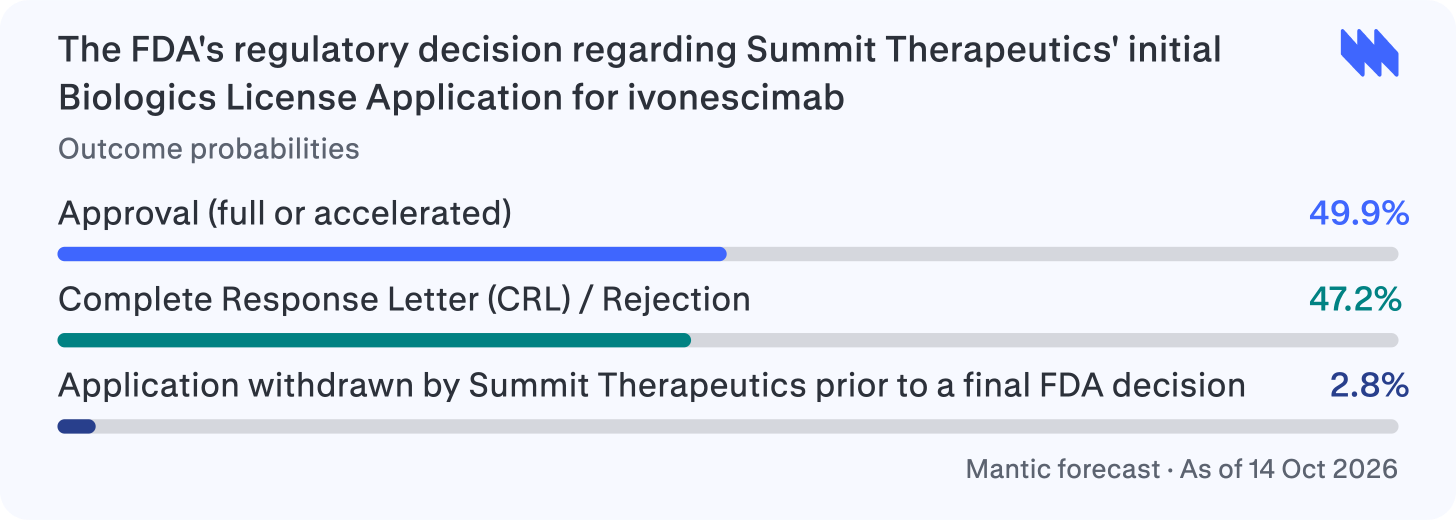
I give a 50% probability of FDA approval for ivonescimab’s initial application, 47% of a Complete Response Letter or rejection, and 3% of Summit withdrawing before a decision.
The FDA required a statistically significant overall-survival benefit. HARMONi’s prespecified test missed that threshold (p=0.057), making this my strongest reason for rejection.4
I credit Summit’s improved survival follow-up and median time without cancer progression of 6.8 versus 4.4 months towards approval. I do not equate the unplanned update with a successful prespecified test.
The FDA approved Rybrevant and Datroway in this setting without statistically significant survival benefits, and camizestrant despite a negative advisory vote. I treat those decisions as counterweights to the failed survival test.
AstraZeneca’s $2 billion equity investment supports Summit’s commitment. I keep withdrawal unlikely because Summit has substantial financial support and would have to withdraw before the FDA acts.5
3. When the FDA approves AMT-130, conditional on the deramiocel decision ↗
Deramiocel faces an FDA decision on 22 November after a 9–3 advisory vote against it. That may offer clues for AMT-130, uniQure’s Huntington’s gene therapy. Explore on Mantic ↗
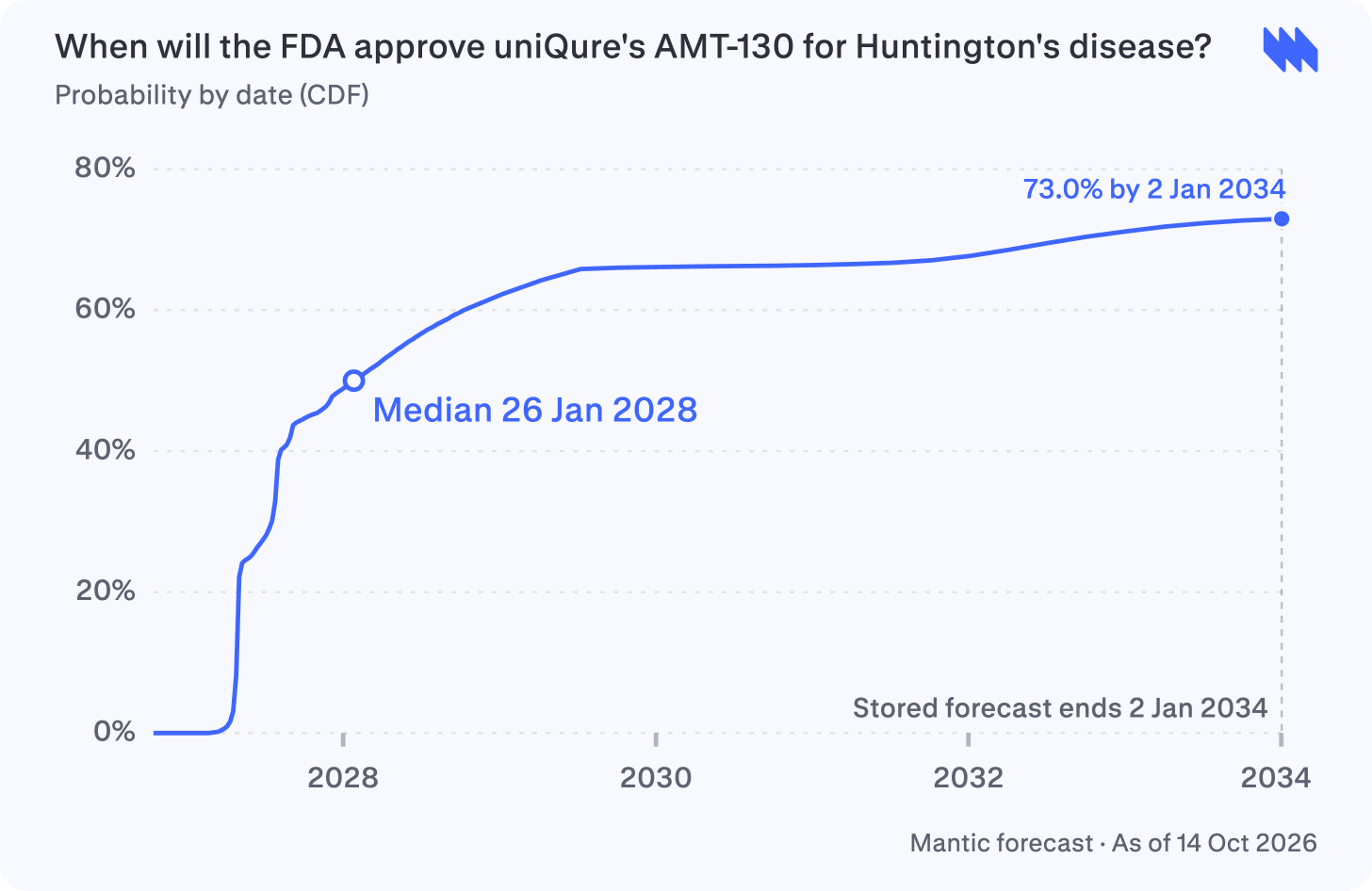
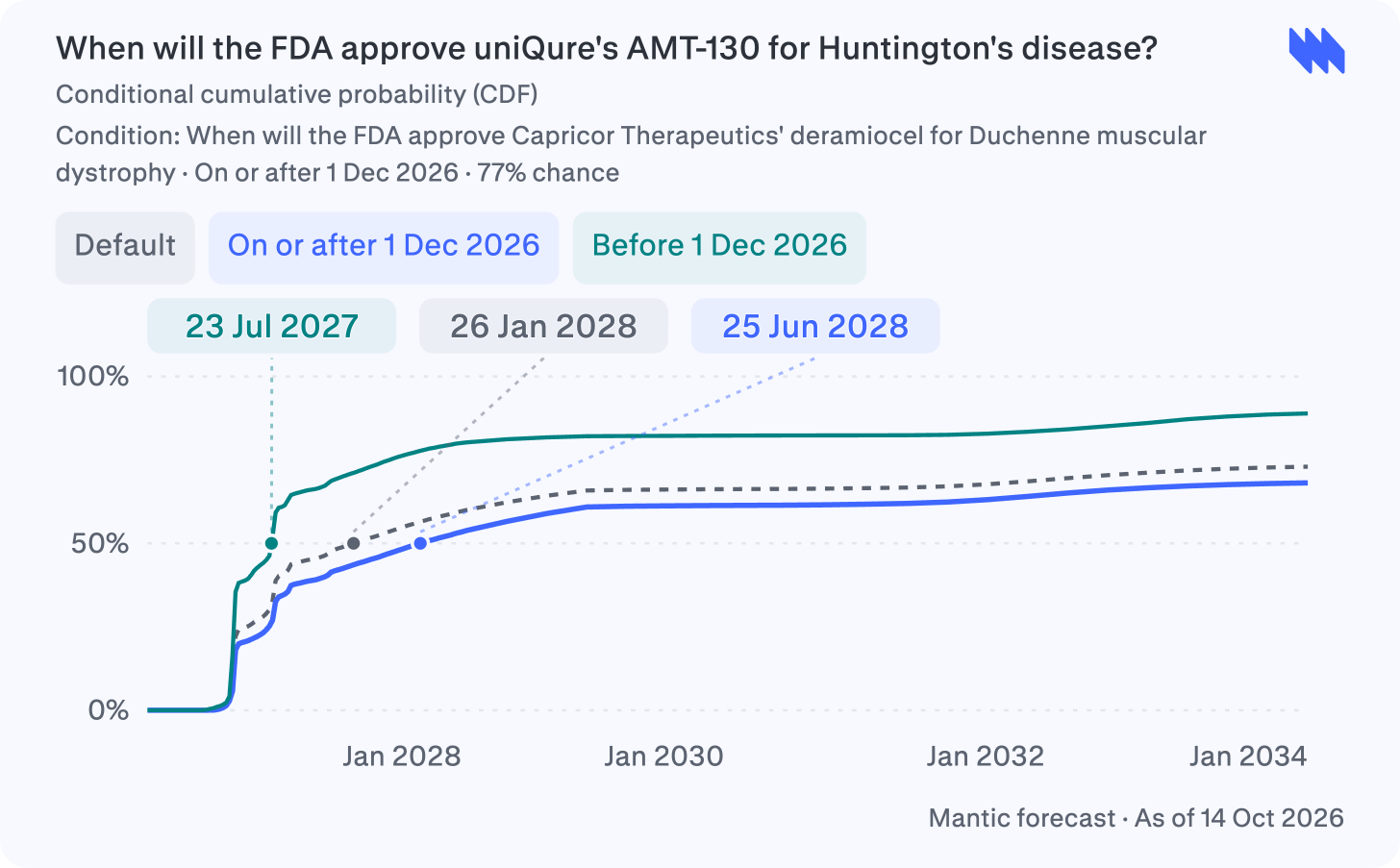
If the FDA has not approved Capricor Therapeutics’ deramiocel for Duchenne muscular dystrophy before 1 December 2026, I put the central approval date at 10 August 2027, 11 days later, with a range from 26 April 2027 to 24 March 2030 if approved by 2 January 2034. I put approval by that date at 68%, down 5 points from 73%.
Deramiocel faced a 9-3 negative advisory committee vote. A lack of approval by December implies a rejection or delay on contested evidence, weakening the case for broad regulatory flexibility across CBER and pointing to a stricter review standard.6
Under a stricter regulatory posture, uniQure’s mixed 48-month data carry more weight against immediate approval. In 12 high-dose patients, clinical slowing on the composite score fell to 44% and was not statistically significant.7
The September 2026 BLA filing and requested priority review still support an earliest approval window around May 2027. However, higher rejection risk and confirmatory trial readiness requirements shift more probability into extensions and later remediation.8
If the FDA approves Capricor Therapeutics’ deramiocel for Duchenne muscular dystrophy before 1 December 2026, I put the central approval date at 7 July 2027, 23 days earlier, with a range from 21 April 2027 to 24 September 2028 if approved by 2 January 2034. I put approval by that date at 89%, up 16 points from 73%.
An approval of deramiocel despite its 9-3 negative advisory committee vote would signal strong regulatory flexibility for rare-disease therapies backed by contested evidence. Without the assumption, I allowed for a more demanding posture, but this precedent substantially increases the likelihood of first-cycle approval.9
With regulatory hurdles lower, approval concentrates heavily around the six-month priority review action date in late April or early May 2027. That concentration pulls my central date earlier.10
Approval is not certain, because AMT-130 still has product-specific evidentiary weaknesses. At 48 months, clinical slowing on the composite score was not statistically significant, and confirmatory trial enrollment requirements can still cause procedural delays.11
4. Retatrutide’s weight-loss advantage over tirzepatide in TRIUMPH-5 ↗
Retatrutide has shown substantial weight loss in earlier trials. TRIUMPH-5 compares it directly with tirzepatide, testing how much advantage remains head-to-head. Explore on Mantic ↗
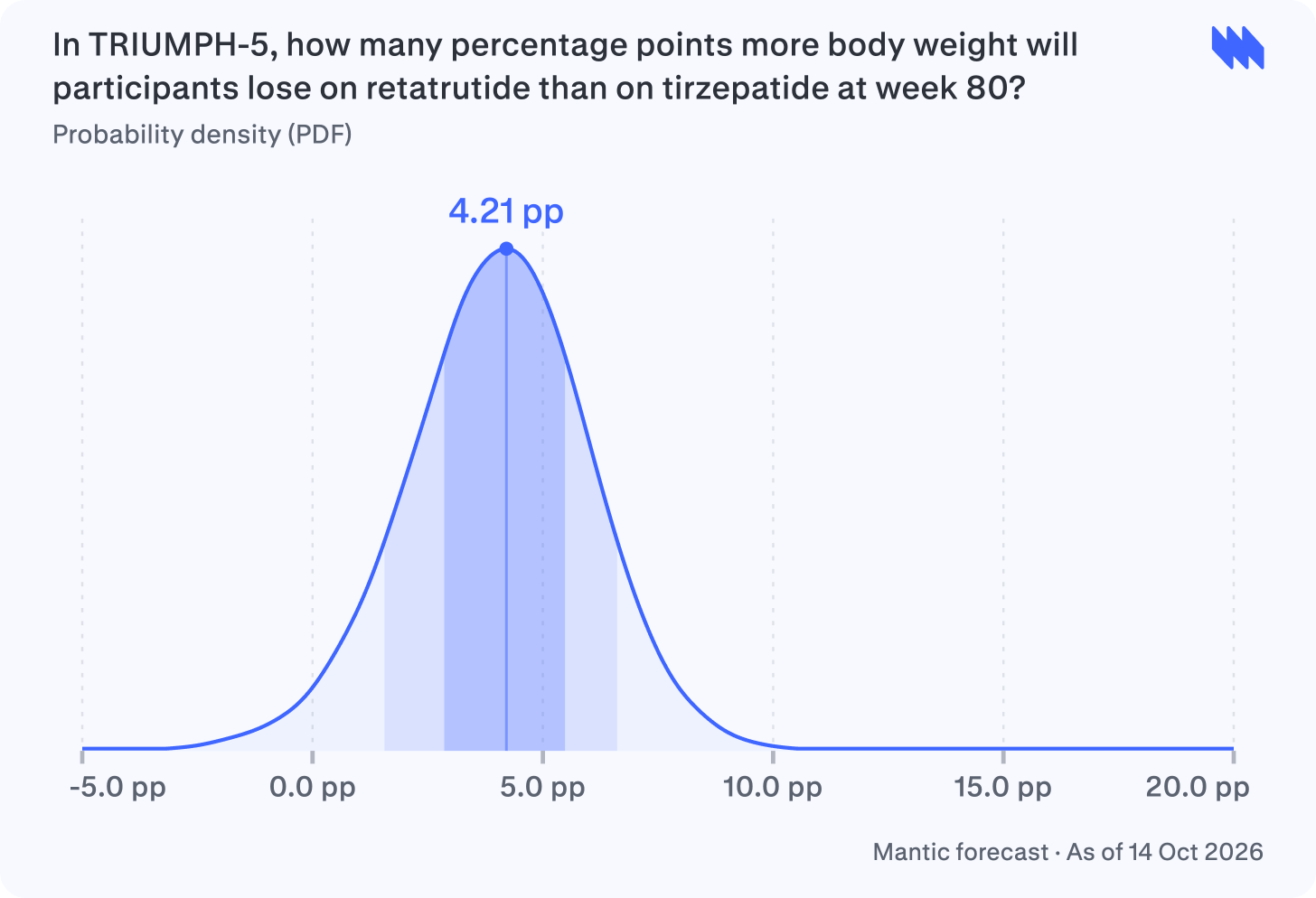
I give a 50% probability that retatrutide produces between 2.9 and 5.5 percentage points more weight loss than tirzepatide at week 80 in TRIUMPH-5, with 4.2 points the most likely difference.
Lilly’s TRIUMPH-1 reported 25.0% treatment-regimen loss at 80 weeks; SURMOUNT-1 reported 20.9% for tirzepatide at 72 weeks. I use this 4.1-point gap between separate trials as my anchor.
I reduce retatrutide’s advantage for its larger discontinuation penalty. Its efficacy result exceeded its treatment-regimen result by 3.3 points in TRIUMPH-1, versus 1.4 points for tirzepatide in SURMOUNT-5.
Lilly’s TRIUMPH-4 reported 18.2% discontinuation for adverse events on retatrutide 12 mg. I allow for poor tolerability to erase or reverse retatrutide’s advantage.12
I expect treatment-regimen results, but Lilly reported only efficacy results for TRIUMPH-2/3. Efficacy-only reporting would give a larger resolving advantage.13
5. Pelacarsen’s hazard ratio in Lp(a)HORIZON ↗
Lp(a)HORIZON missed its primary endpoint. The detailed result due on 7 November will show how close pelacarsen came, with implications for other Lp(a) drugs. Explore on Mantic ↗
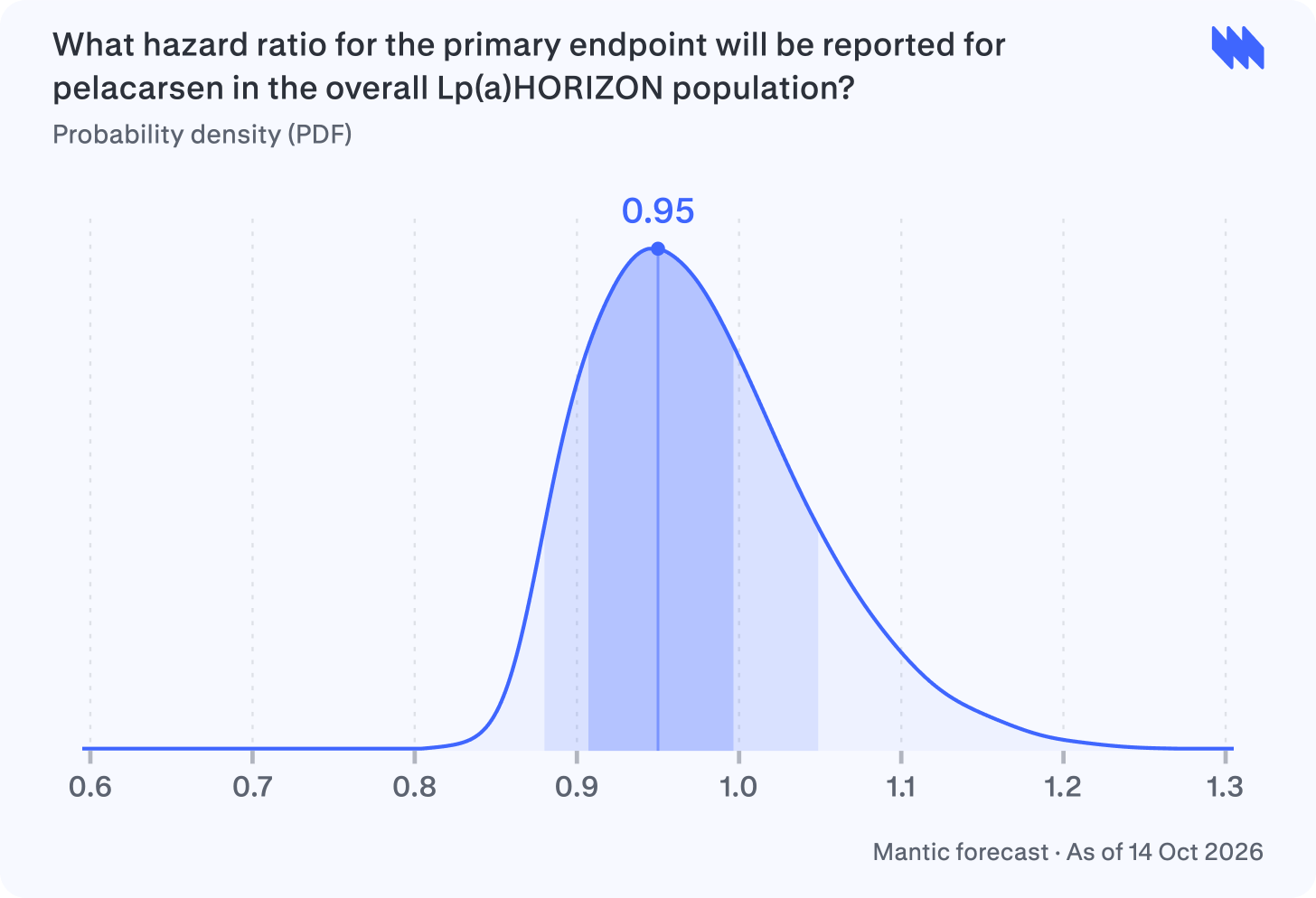
I give a 50% probability that the reported overall-population hazard ratio is between 0.91 and 1.00, with 0.95 the most likely value.
Novartis’s September 2026 announcement reported a missed primary endpoint. Given 993 planned events and the significance rules, I put little weight on reported hazard ratios below about 0.87.14
Novartis did not describe a favourable numerical trend or a narrow miss. I treat its wording as modest evidence against a near-significant benefit, shifting my forecast closer to no effect.
Before the results, Novartis management discussed a mid-teens cardiovascular risk reduction rather than the design’s 20%. I therefore gave smaller benefits more weight instead of centring my forecast on the design assumption.
I retain the possibility of a modest benefit, no effect or a ratio above 1. The missed endpoint cannot distinguish these, and variation in observed trial results widens my range.
