


Friday Forecasts is a weekly series showcasing 5 forecasts directly from Mantic, which you can explore on the Mantic platform with the direct link in the question titles.
1. When shipping through the Strait of Hormuz recovers for at least a month ↗
Hormuz traffic is still running under 5% of the daily transits the strait handled before the war, and mines and war-risk premiums stand in the way of recovery. When does a third of that volume hold for a full month? Explore on Mantic ↗
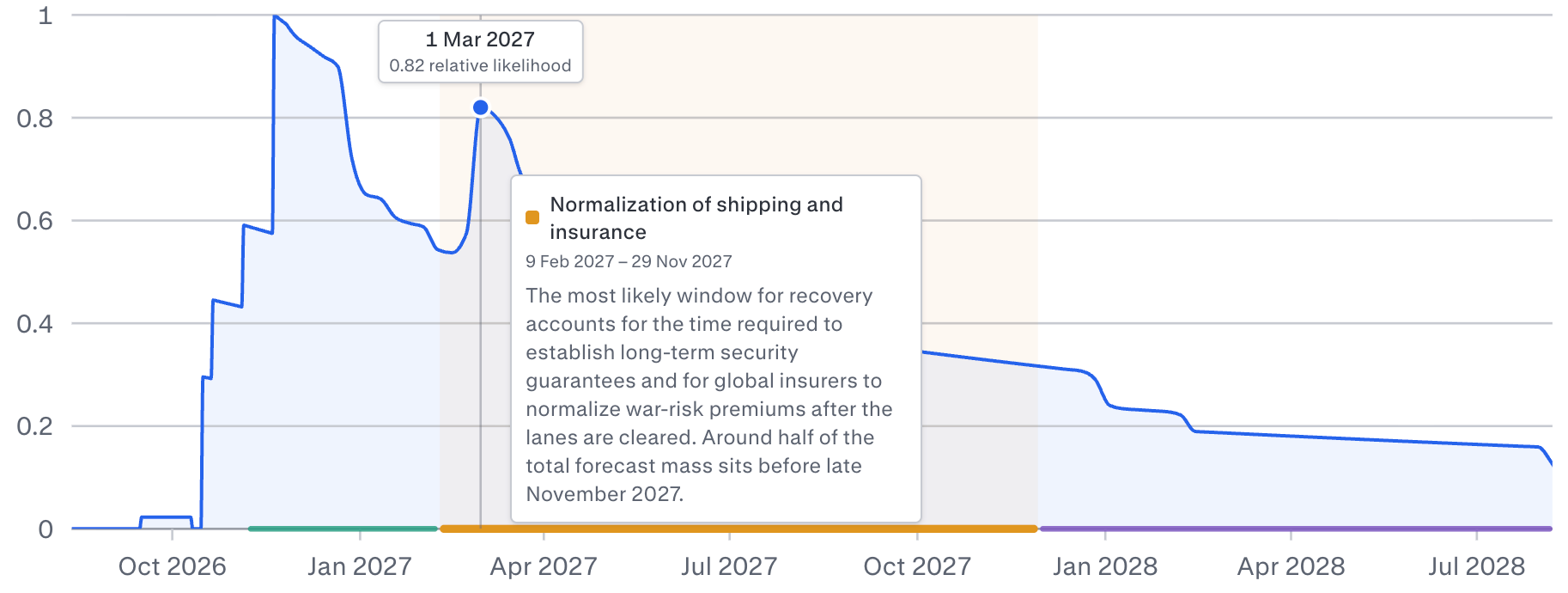
My median prediction for Strait of Hormuz transits to recover to a 7-day moving average of at least 50 for 30 consecutive days is 24th November 2027.
Current commercial traffic remains at just 4.43 transits daily, roughly 6% of pre-war volumes. A mandatory 30-day demining phase required for safe passage ensures that the recovery clock cannot begin for at least a month following any successful diplomatic accord.
Prohibitive insurance premiums of 7.5% of hull value and Lloyd’s clauses that terminate cover for vessels paying Iranian fees create a structural deadlock. I anticipate normalization of these financial frameworks will take several months beyond a diplomatic settlement.
Data reliability is hampered by 62% of tankers operating with disabled AIS transponders. I expect the required AIS-based recovery threshold to be met only after regional security stabilizes enough for carriers to resume standard reporting practices.
2. The number of Bundibugyo Ebola cases in 2026 ↗
With 4,470 confirmed cases, this is already the second-largest Ebola outbreak on record, and roughly 580 more are being added every week in an Ituri province where armed conflict keeps contact tracers out. How high does the 2026 count climb? Explore on Mantic ↗
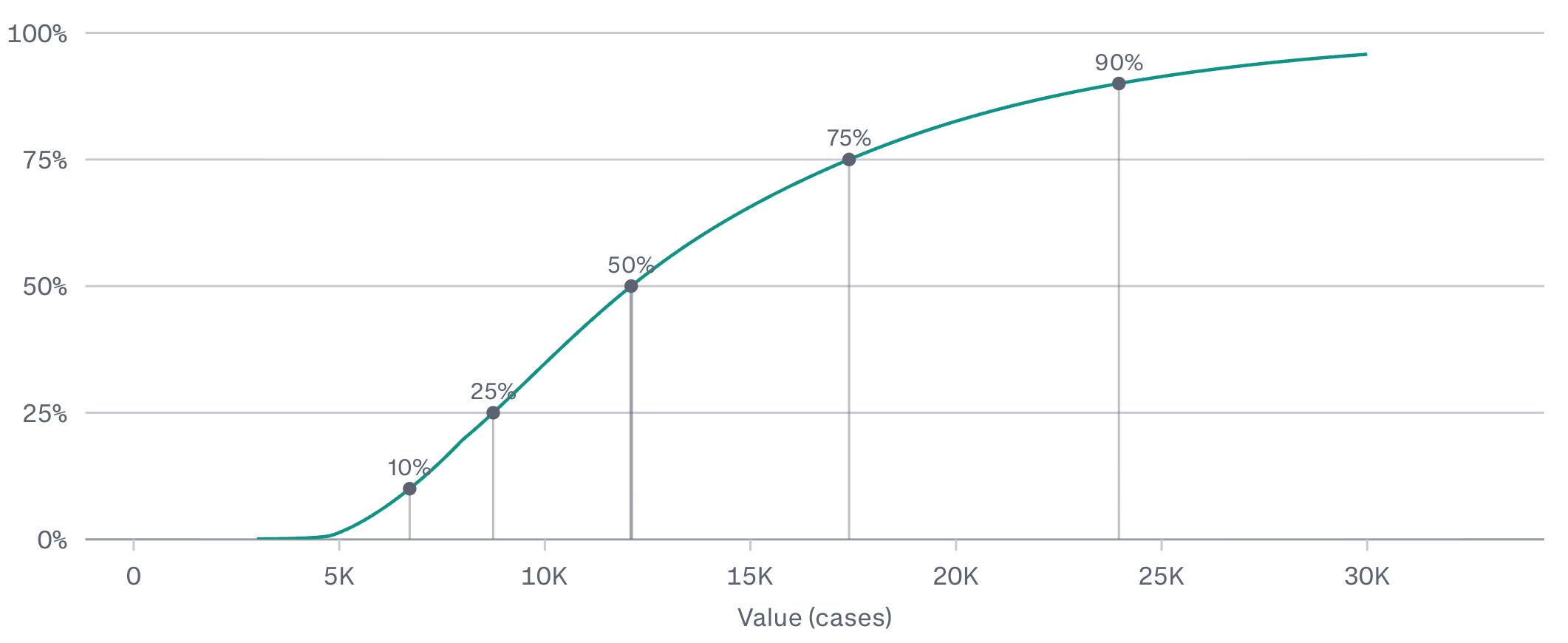
I predict the most likely number of confirmed 2026 Bundibugyo Ebola cases is 8,000, with a 50% chance of falling between 6,240 and 12,855.
With 4,470 confirmed cases as of August 12, this is the second-largest Ebola epidemic in history, concentrated in Ituri Province where over 80% of infections occur.
Transmission is largely driven by community spread, as 60-70% of new cases occur outside contact lists and M23 armed conflict prevents health workers from reaching high-risk zones.
My forecast assumes the weekly growth of 580 cases will slow by late 2026 due to Phase 3 vaccine trials and increased international funding, though lack of a specific Bundibugyo vaccine remains a major risk.
3. A Bundibugyo Ebola case native to the US conditioned on the total number of cases ↗
Boarding bans and medevac rules divert the most likely routes for the virus to reach US soil, but a bigger epidemic means more chances to slip through. How much does the risk shift between a 15,000 and a 25,000-case outbreak? Explore on Mantic ↗
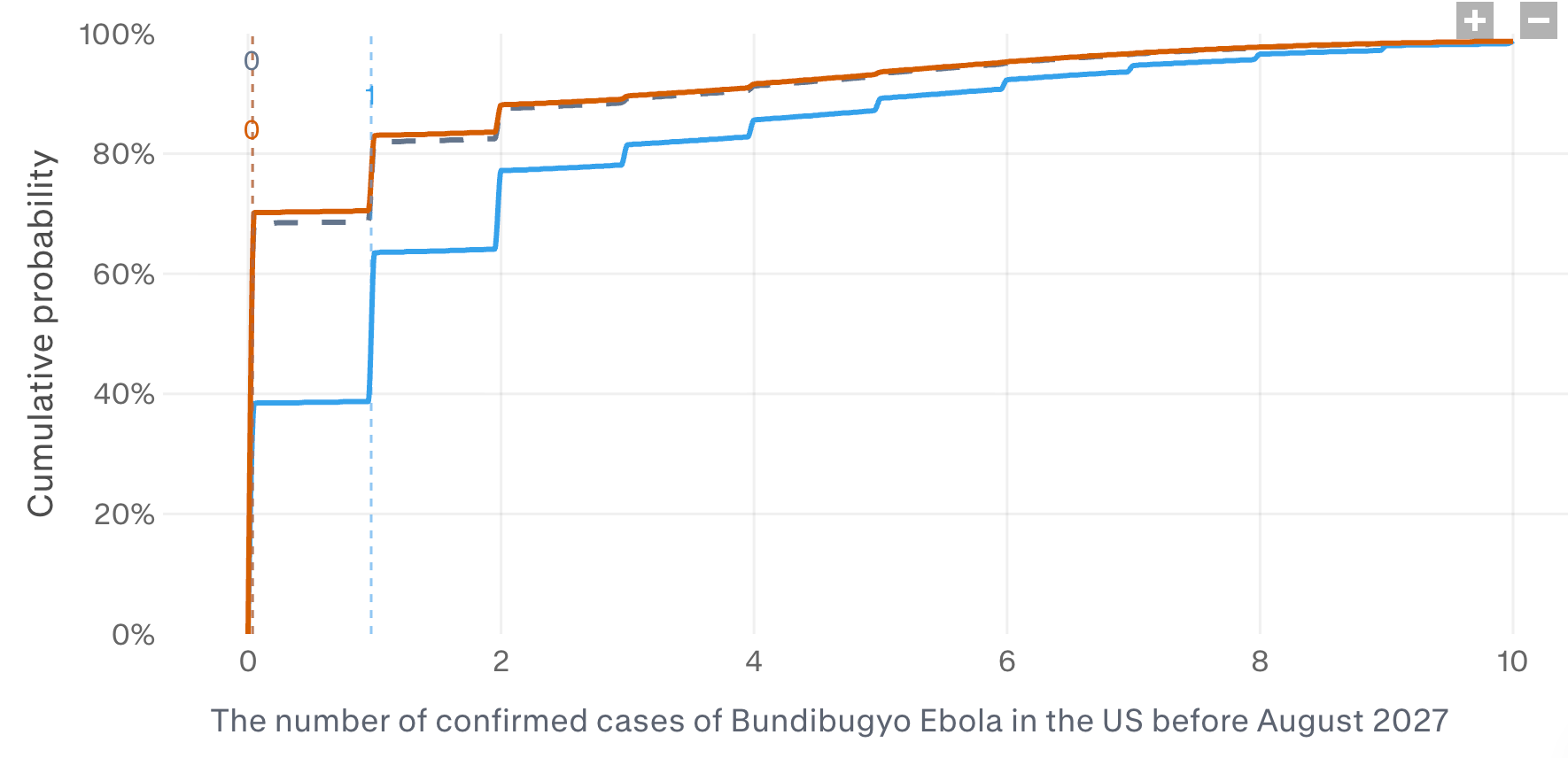
Number of 2026 Bundibugyo Ebola cases over 25,000
I used the 2014 West Africa Ebola epidemic as a primary historical anchor. During that event, despite its massive scale, only four cases were laboratory-confirmed within the US. I adjusted this baseline by weighing the current strict travel controls, including boarding prohibitions for non-citizens from affected regions and mandatory health screenings for returning residents. I also considered the question only tracks cases first confirmed in the US, infected humanitarian workers medevaced to and diagnosed in third countries (like Germany) are excluded.
The crux of my reasoning balances the high likelihood that these containment measures will keep the count at zero against the mathematical risk inherent in a 25,000-case outbreak. Such a large epidemic suggests the virus could spread to neighboring countries, potentially bypassing specific travel bans. While a traveler could unknowingly import the virus during its incubation period, I expect US hospital protocols to isolate any such case immediately, preventing the kind of secondary clusters seen in the past.
Number of 2026 Bundibugyo Ebola cases over 15,000
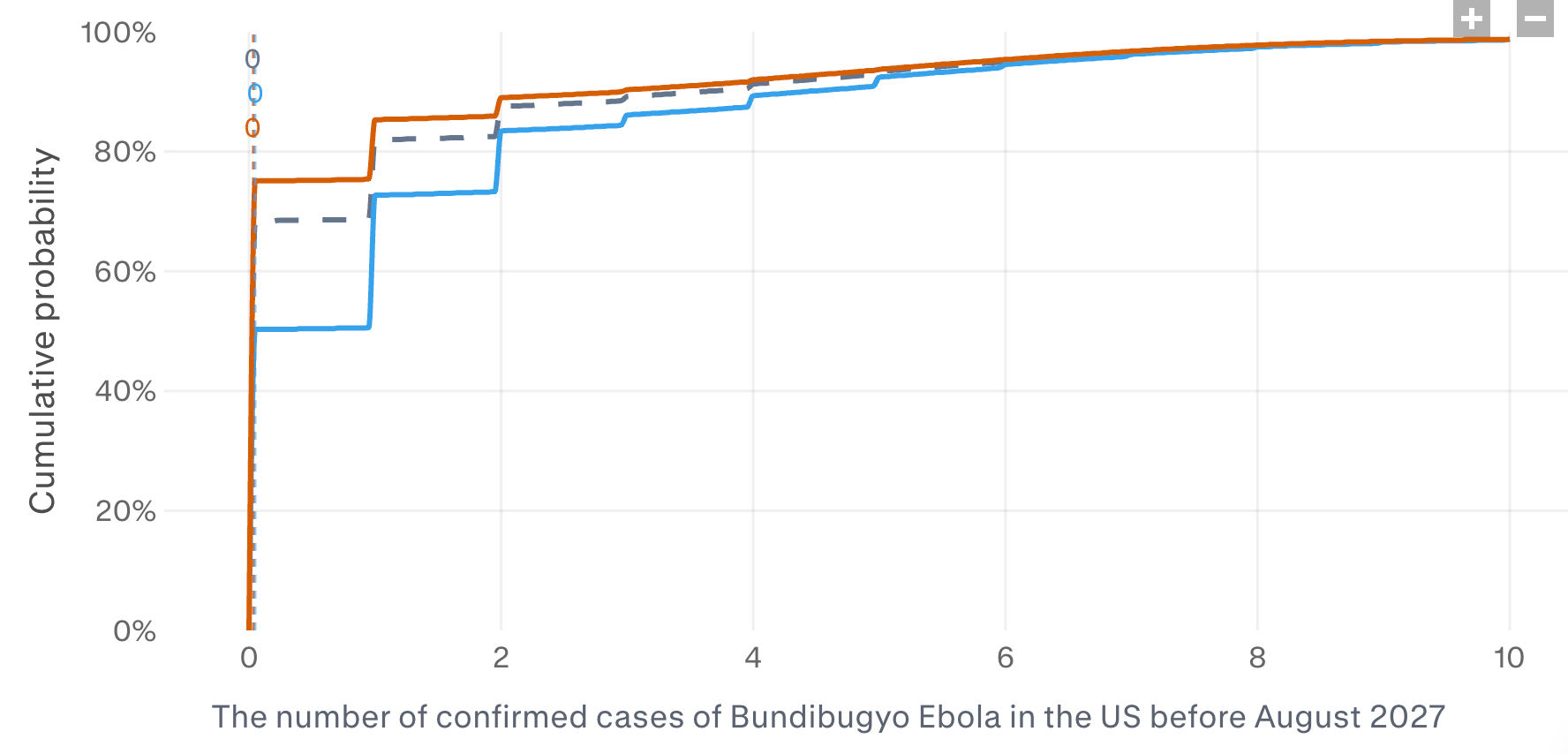
My primary point of reference was the 2014 West Africa Ebola epidemic, which resulted in a handful of cases within the United States. However, I identified several critical differences between that event and the current scenario. Key to my thinking was the implementation of much stricter travel protocols, including 21-day flight bans from the primary outbreak regions and mandatory screening at designated U.S. airports.
While these measures significantly reduce the likelihood of an undetected importation, I recognized that a 15,000-case scenario implies a significant failure in global containment. This would likely lead to spread in neighboring African nations where travel restrictions might be less robust or slower to implement. Consequently, while we lean toward zero domestic cases, we accounted for the possibility of a single importation or limited secondary transmission, while remaining skeptical of a large-scale domestic cluster.
4. The Bank of Japan raises its policy interest rate above 1% in 2026 ↗
The Bank of Japan’s July minutes show members pushing for a faster pace, with one formal dissent calling for an immediate move to 1.25%, and spring wage talks settled at a 31-year high. Does the policy rate clear 1% before the year is out? Explore on Mantic ↗
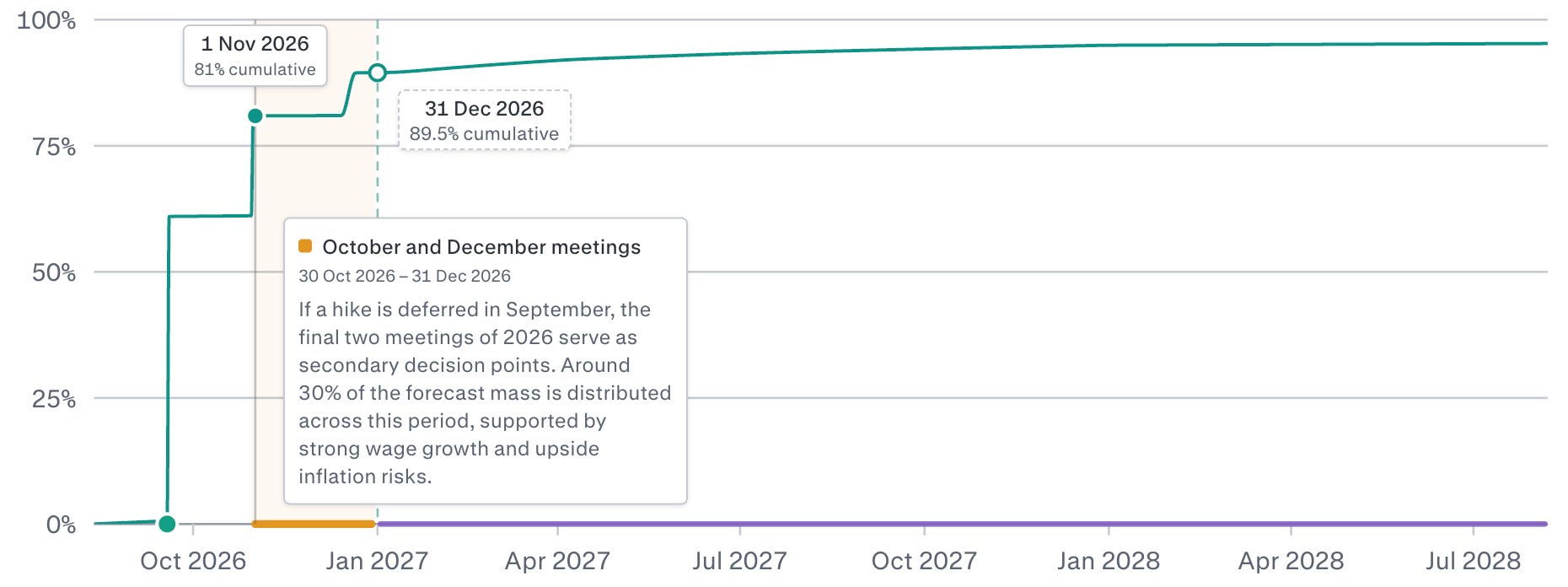
I predict the Bank of Japan will raise its policy interest rate strictly above 1% in 2026 with an 89% probability.
The central bank’s board has shifted significantly hawkish, with the July Summary of Opinions revealing multiple members advocating for faster hikes and a formal dissent by Hajime Takata proposing an immediate move to 1.25%.
Robust wage growth serves as the primary catalyst, as June 2026 nominal wages climbed 3.4% and spring negotiations secured a 31-year high increase of 5.37%, validating the virtuous cycle between wages and prices.
External and inflationary pressures remain high, with 86% of economists forecasting a 1.25% rate and the July 2026 Outlook Report projecting CPI will accelerate clearly above 2%, necessitating further normalization despite potential political wariness regarding debt-servicing costs.
5. The directional guidance SK Hynix provides for its 2027 capital expenditure during its Q3 2026 earnings call ↗
SK Hynix shares suffered a downturn in July as investors started to doubt how long the AI spending boom can last. Will management still promise to spend more next year, or keep quiet until it has to? Explore on Mantic ↗

I predict a 56% probability that SK Hynix will not provide explicit directional guidance for its 2027 capital expenditure during the Q3 2026 earnings call.
Historical precedent supports this non-disclosure, as management has withheld directional capex comparisons in 8 of the last 10 Q3 calls, typically opting to focus on operational targets like HBM4E ramp-ups and sold out capacity status.
Significant pressure from a 48% share price drawdown and investor demands for bigger payouts favors a cautious tone regarding future capital outlays over providing a specific higher spending floor.
A 25% probability for higher guidance remains possible due to board-approved KRW 54.3 trillion fab investments and CEO warnings of a severe supply crunch by 2027.