

Friday Forecasts is a weekly series showcasing curated forecasts directly from Mantic.
This week looks at who finances the AI build-out and where the credit risk lies. There is a web of financial commitments, with long-term computing contracts supporting borrowing, suppliers guaranteeing customers’ leases, and investors taking out loans linked to AI valuations which may prove dangerous.
Who bears the losses if expectations disappoint? This week’s forecasts examine how those commitments could turn into cash demands, infrastructure write-downs or debt restructurings, and how financial stress could spread through the AI industry.
1. When Nvidia or Google must honour an AI tenant backstop ↗
Nvidia and Google support independent AI tenants through lease backstops. A payment or lease takeover would reveal where the financial risk lands when a tenant cannot meet its obligations. Explore on Mantic ↗
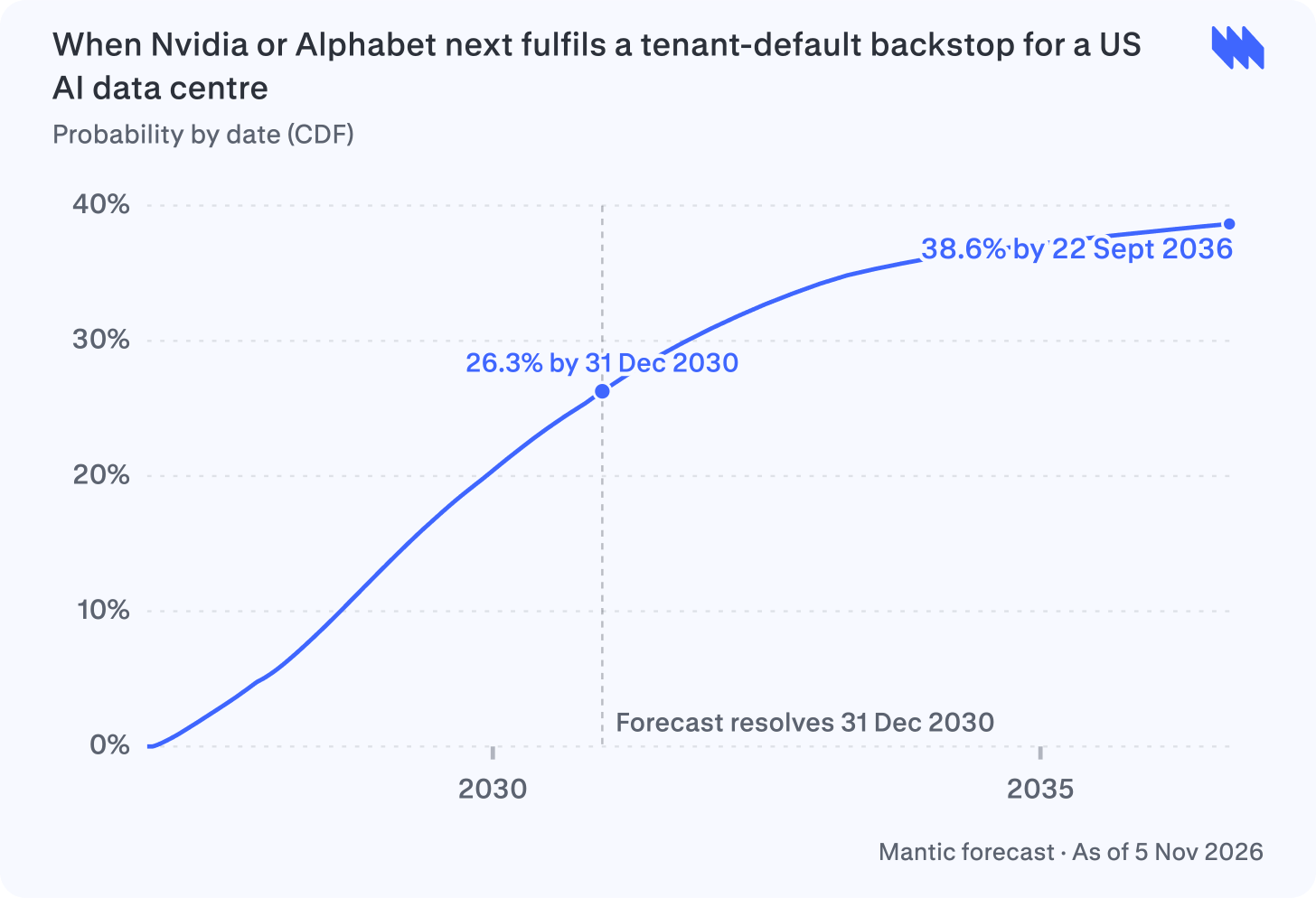
I give a 26% probability that Nvidia or Alphabet fulfils a qualifying tenant-default backstop for a US AI data centre by 31st December 2030.
I give a 59% probability of no qualifying fulfilment ever. I allow for voluntary rescues and guarantees ending after satisfactory credit ratings, rather than assuming every default produces fulfilment.1
I retain long-term risk from Alphabet’s $48 billion of backstops. I limit near-term risk because Nvidia’s largest OpenAI guarantees start with leases from fiscal 2029.2
I put more risk in 2028–2033 after Financial Times reporting on OpenAI’s funding needs and distressed CoreWeave bonds. I do not equate sector distress with a qualifying default.3
My main uncertainty is whether financing stress reaches the guaranteed tenants. I restrain near-term risk given Anthropic’s reported $131.8 billion in cash and short-term investments.4
2. AI data-centre debt restructurings through 2030 ↗
A long-term tenant contract can support borrowing before revenue arrives. We track restructurings at US AI campuses with at least 100 MW of contracted IT capacity and $500m of closed project debt. Explore on Mantic ↗
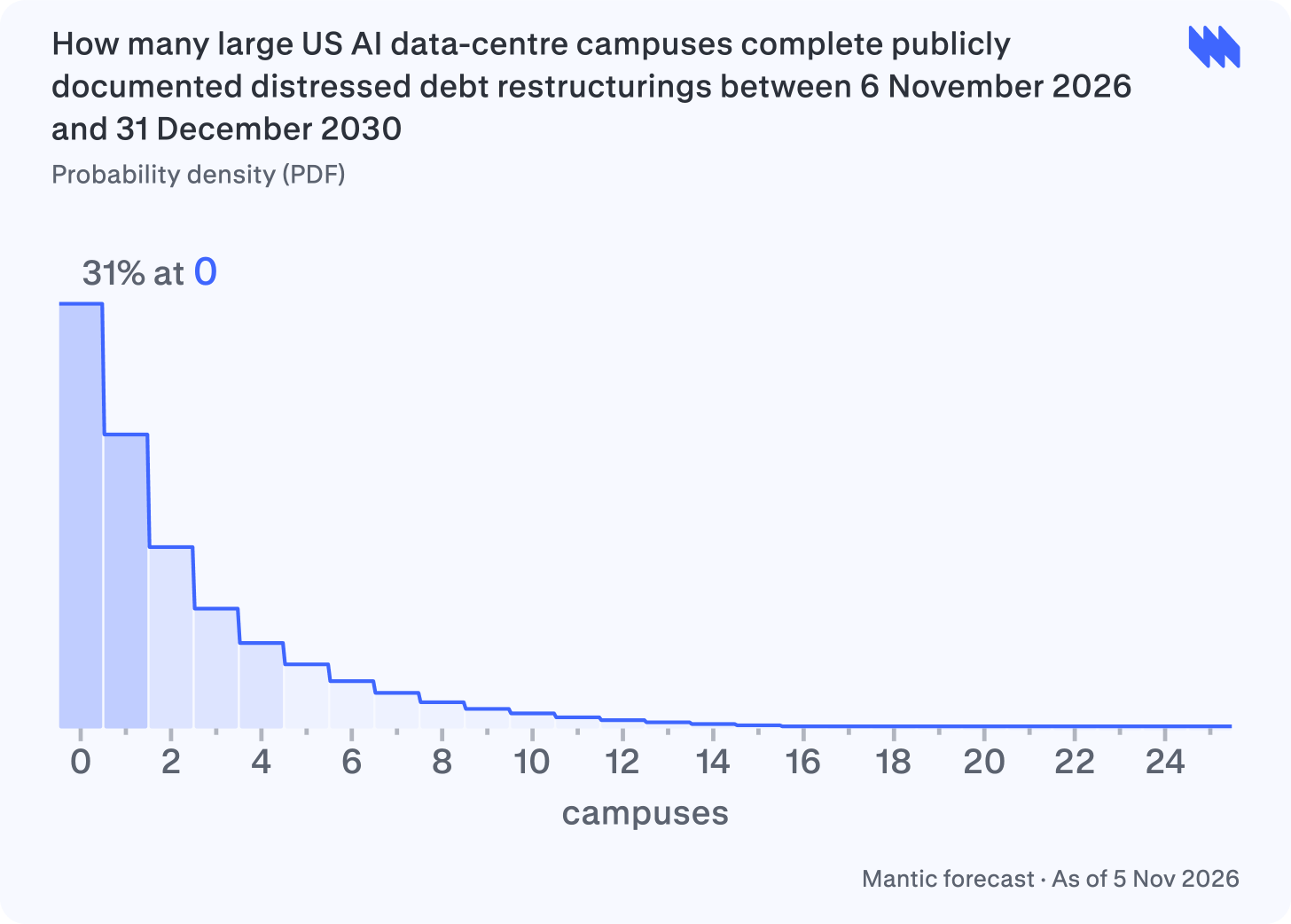
I give a 31% probability of no qualifying campus restructurings in the forecast window, 22% of one, 13% of two and 9% of three.
I lower my expected count for Meta, Google and Nvidia backstops, and for Core Scientific’s fixed-payment contracts and ring-fenced rents. Tenant distress need not force campus creditors to accept concessions.5
CoreWeave bonds near 80 cents and Jupiter loans near 90 cents raise my expected count. I treat these prices as warnings, not completed restructurings.6
My main uncertainty is how widely tenant distress reaches campus creditors. Shared tenants and Core Scientific’s three-campus debt portfolio can make restructurings cluster.7
I exclude projects lacking proven eligibility, including Chester’s sub-100-MW campus. Equity rescues do not count, and I remove restructurings completed or documented after the deadlines.8
3. When a hyperscaler writes down $1bn of physical AI infrastructure ↗
Rapidly improving chips can outlast their commercial advantage. A $1bn impairment would put an accounting cost on physical AI infrastructure that no longer supports its book value. Explore on Mantic ↗
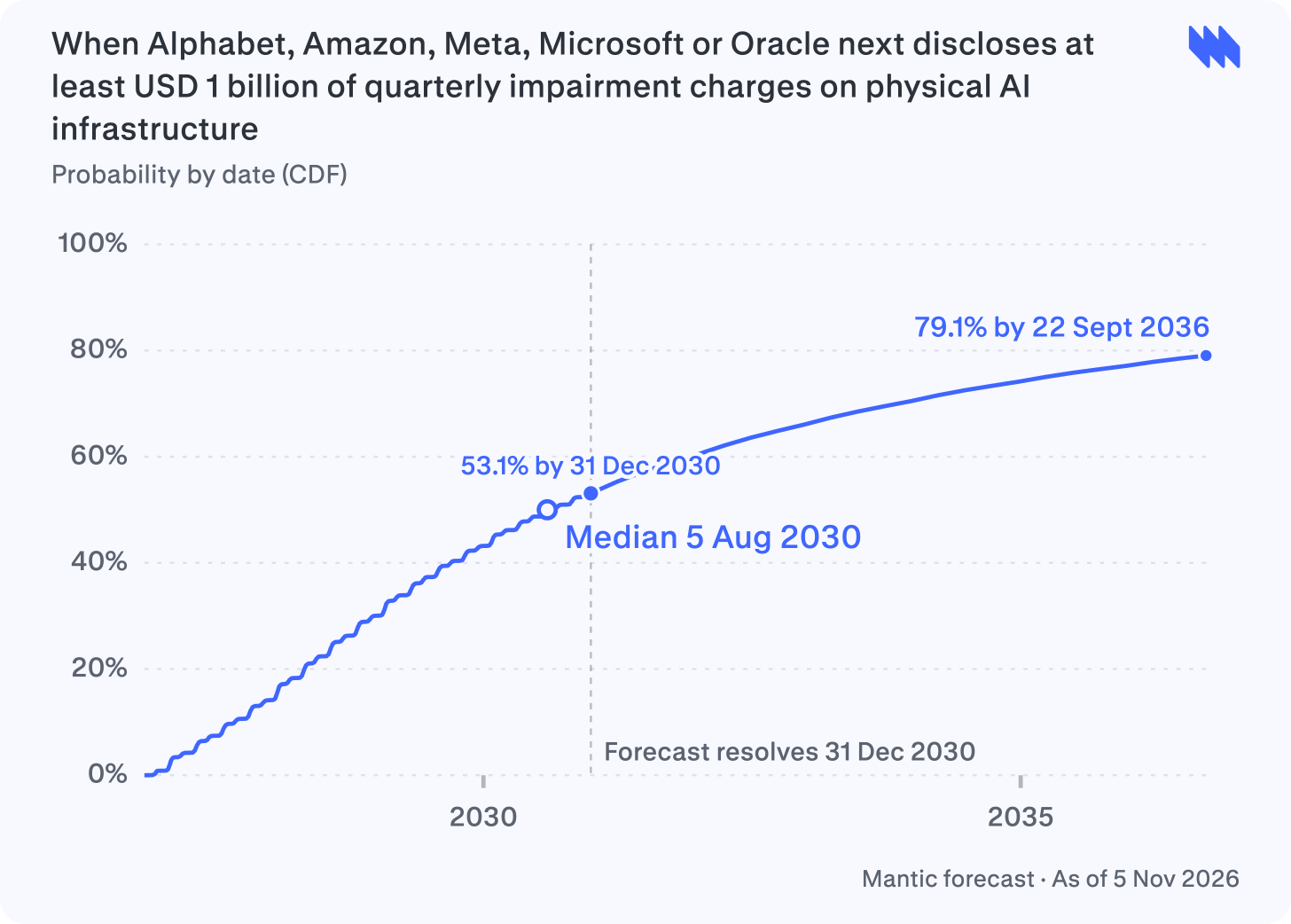
My median date for the next qualifying impairment disclosure is 5th August 2030, and I give a 53% probability of one by 31st December 2030.
The latest reviewed filings for Meta, Oracle, Amazon and Microsoft showed no infrastructure impairments. I keep near-term risk low because capacity shortages and longer asset lives argue against imminent write-offs.9
Meta’s $135–145 billion capital-spending guidance for 2026 raises my medium-term risk. Its $1.34 billion data-centre abandonment charge in 2022 supports my allowance for large write-offs even during expansion.10
My main timing uncertainty is whether write-offs emerge during expansion or await a downturn. Oracle’s record debt-insurance costs and Meta’s negative free cash flow raised my assessment of downturn-related risk.11
I give a 5% probability of no qualifying disclosure ever. Amazon’s $920 million of accelerated depreciation and related charges illustrates why AI hardware obsolescence need not produce an eligible impairment.
4. When CoreWeave defaults, restructures or files for bankruptcy ↗
CoreWeave has $6.2bn of principal due in 2027. Will financing pressure end in a debt event, or force spending cuts that keep the company solvent? Explore on Mantic ↗
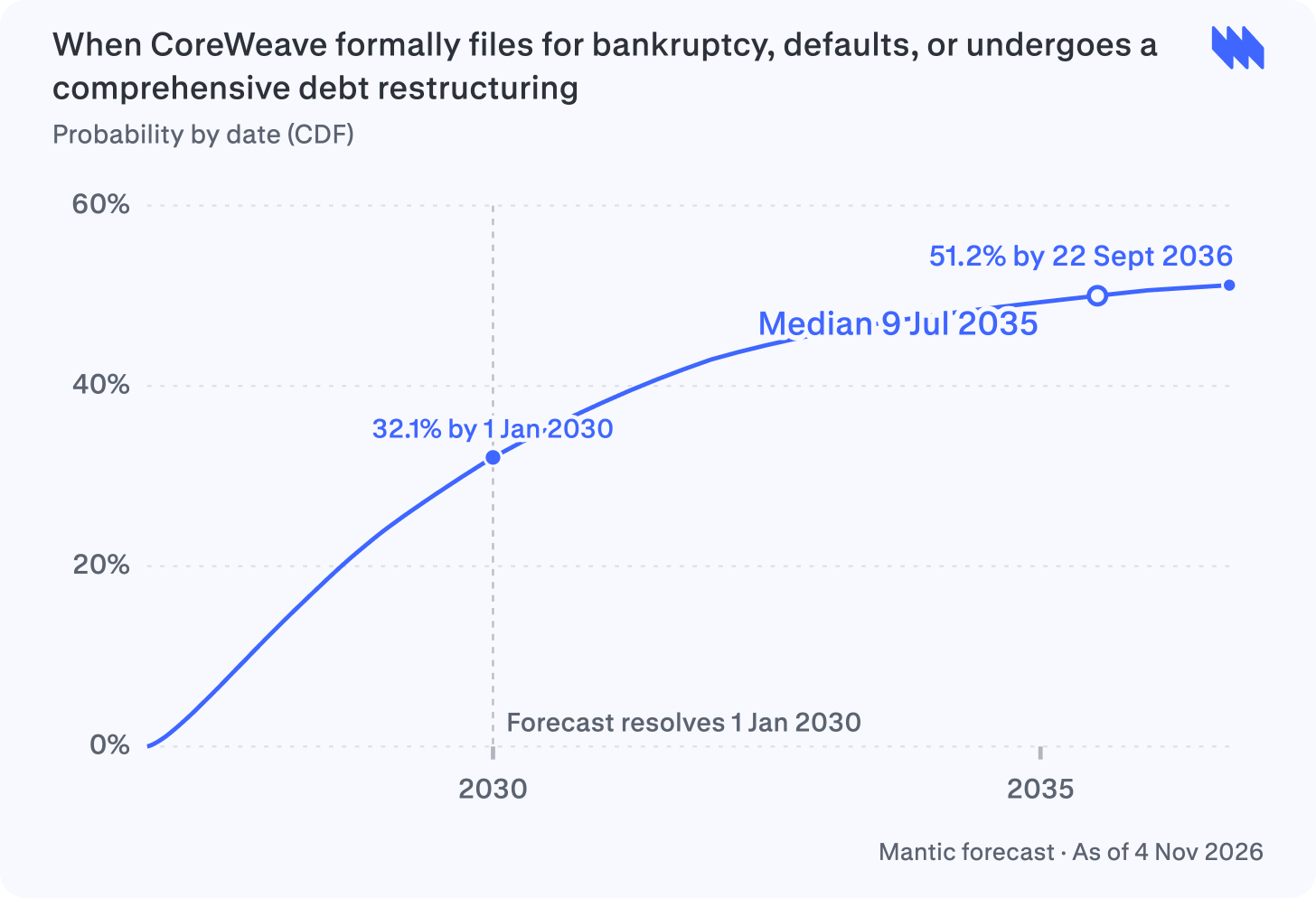
My median date for CoreWeave’s bankruptcy, default or comprehensive debt restructuring is 9th July 2035, and I give a 32% probability of such an event by 1st January 2030.
I temper Bloomberg’s reported credit-market default probability of over 60% within five years with Polymarket’s 30.5% bankruptcy probability by end-2029. I also include non-bankruptcy defaults and distressed exchanges.12
I raise financing risk because first-half capital spending of $14.1 billion exceeded $3.7 billion of operating cash flow. I also factor in $6.2 billion of principal due in 2027.
I reduce immediate-default risk for $5.5 billion of cash and September’s $4.2 billion convertible financing. I treat the additional $10 billion of borrowing availability as conditional, not cash.
I give a 47% probability of no qualifying event ever occurring. I retain this possibility because of contracted demand, positive operating cash flow and Oppenheimer’s assessment that cutting expansion spending could generate cash.
5. When Meta pays for Hyperion construction overruns ↗
Meta sold most of Hyperion’s equity to outside investors but still guarantees construction overruns. The test is whether that contingent obligation becomes an actual cash payment. Explore on Mantic ↗
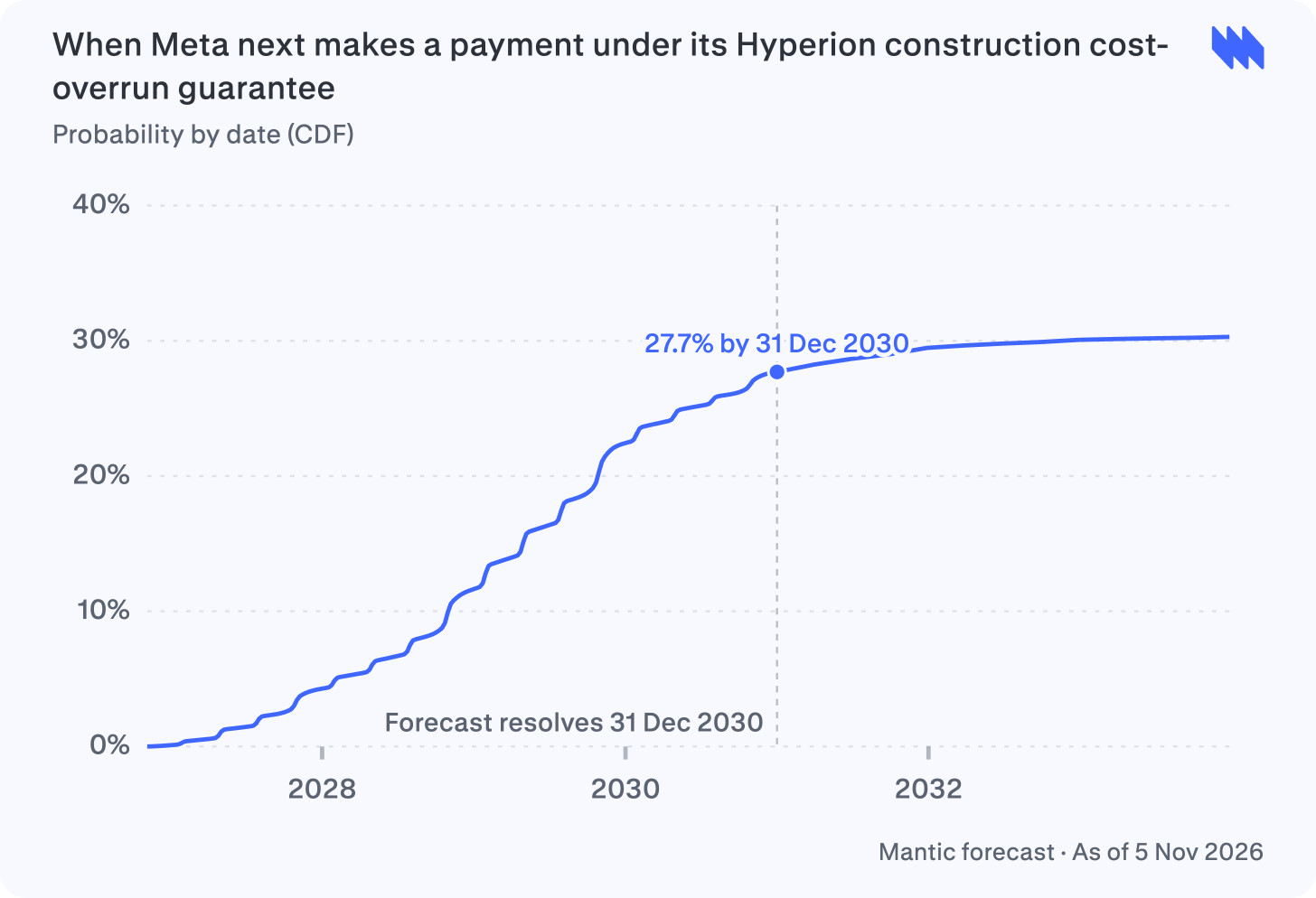
I give a 28% probability that Meta makes a qualifying Hyperion construction cost-overrun guarantee payment by 31st December 2030.
I give a 69% probability that no qualifying payment is ever publicly confirmed. I require original-scope costs to exceed the fixed budget including its 5% contingency.13
Cushman & Wakefield reported a 21% increase in industry construction costs. I treat this as support for a contingency breach, not as evidence that Hyperion’s own costs rose 21%.14
My main uncertainty is whether cost pressure produces an identifiable guarantee payment. I discount expansion spending as separate scope and lower the likelihood of confirmation because Meta’s filings omit the guarantee.15
I centre possible payments around 2029–2030, using S&P’s June 2029 rent-start date as an anchor. I allow earlier funding shortfalls and later confirmation rather than treating rent commencement as a payment deadline.16