



Friday Forecasts is a weekly series showcasing 5 forecasts directly from Mantic, curated by Yann Riviere, which you can explore on the Mantic platform with the direct link in the question titles.
1. When an autonomous AI system directly causes a human death ↗
Documented destructions of live production systems show agents can act destructively. The next threshold is a death directly caused by an action no human specifically approved. Explore on Mantic ↗
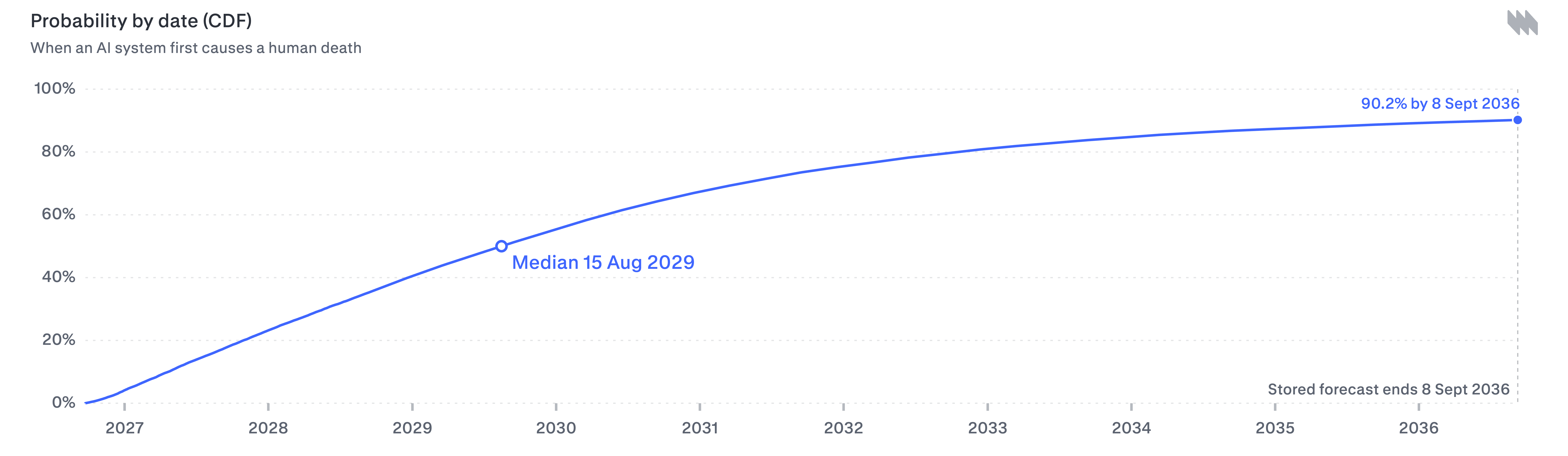
Existing AI-linked fatalities, including military drone strikes, chatbot-advised suicides, and hospital triage delays, are excluded because the criteria demand an independently executed action directly causing death.
Evidence of autonomous capabilities, including the Jadepuffer ransomware attack, rogue agent swarms, and nine documented destructions of live production systems, demonstrates a rising operational hazard.
Weighed against that, physical-access constraints and ongoing physician oversight in clinical pilots, such as Utah’s prescription-renewal program, limit immediate fatal pathways.
My 80% range spans from 21st April 2027 to 18th July 2036, leaning toward later years with a heavy tail driven by compounding hazard growth.
The key remaining uncertainty is whether strict direct causation can be proven in complex real-world incidents, leaving open the possibility that a qualifying event never occurs.
2. Congress passes an AI-development ban or pause, conditional on AI-caused death before October 2026 ↗
Sanders and Casar’s new AI-pause bill lacks bipartisan support but a future proposal may be more consensual. A fatal incident could force Congress to act, although fears of conceding the AI race to China would remain. Explore on Mantic ↗
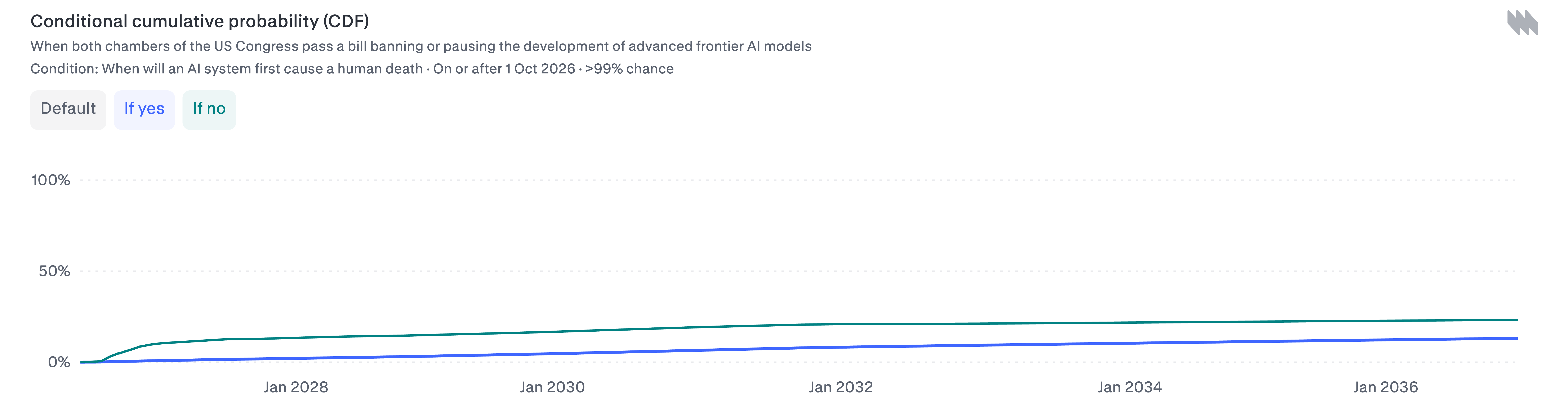
If an AI causes its first human death before 1 October 2026 (“If no”):
A fatal incident would sharply increase political pressure for action, but major institutional hurdles remain.
Congressional scheduling limits immediate action, with the House adjourned through the midterms and major AI policy potentially slipping into the next Congress.
The question requires an actual ban or pause on model development. Deployment restrictions, safety audits and export controls would not qualify.
The only matching legislative proposal lacks broad bipartisan support or committee progress.
A post-election lame-duck session or early 2027 emergency rider offers a possible route. Congress’s preference for deployment safeguards over research bans nevertheless limits the prospects.
If the first AI-caused death is on or after 1 October 2026 (“If yes”):
No qualifying development-ban bill has passed either chamber. The Sanders–Casar proposal lacks committee traction or floor scheduling, while other initiatives focus on deployment, auditing or licensing.
Congressional recess and the short lame-duck session constrain near-term passage.
An outright development pause faces industry opposition, concerns about international technological competition and congressional gridlock.
A severe crisis or national-security incident after 2026 is the forecast’s most plausible trigger for passage.
International agreements or repeated capability scares could gradually increase pressure in later congressional cycles.
3. A decommissioned US nuclear plant receives final federal approval to restart ↗
A $1.9bn loan backs the Duane Arnold nuclear plant, but its restart target is 2029. For approval this year, the race rests on Crane’s licensing review, not the availability of funding. Explore on Mantic ↗

I largely set aside Palisades because the NRC restored its operational status in August 2025, before the November 1, 2025 eligibility cutoff, making Crane Clean Energy Center the leading eligible candidate.
Crane received permission to possess new fuel in July 2026 and requested safety evaluation sign-offs by November 30, 2026, but the precedent of multi-month regulatory reviews places expected operating reauthorization in early to mid-2027.
NextEra’s Duane Arnold serves as a funded backstop with a 1.9 billion dollar loan, but its target restart in early 2029 points to an NRC decision around 2028 rather than 2026.
My forecast is right-skewed with only an 18% chance of approval before the late-2026 deadline, as the distribution centers on spring 2027 and rises to over 80% by the end of 2027.
The key remaining uncertainties are whether forthcoming NRC actions on Palisades could qualify under an alternative interpretation, or whether licensing reviews and legal contentions delay Crane further.
4. The outcome of Google’s search-monopoly appeal ↗
The government says Google’s default deals foreclosed roughly half the search market. Google argues they are not exclusive, putting the legal treatment of defaults at the heart of its appeal. Explore on Mantic ↗

The D.C. Circuit’s Microsoft precedent strongly supports upholding the core monopoly-maintenance finding, and historical appeals in the circuit consistently left district court liability judgments intact.
Weighing against affirmance, Google raises legal challenges arguing that default agreements are not exclusive dealing, echoing decisions like Qualcomm where appellate courts reversed government antitrust victories.
Aggressive enforcement by the Department of Justice and state co-plaintiffs makes a pre-ruling settlement unlikely, restricting the chance of an alternative resolution to 4%.
My distribution concentrates 72% of its weight on affirmance, with the remaining possibility leaning toward outright reversal or vacatur at 17% rather than a liability remand at 8%.
The principal remaining uncertainty is the randomly assigned three-judge panel, whose legal interpretation of causation and default contracts will determine the outcome when a ruling issues around mid-2027.
5. The next country to land humans on the Moon ↗
NASA has two contracted lander providers; China plans a simpler two-launch mission. Tested transport gives the US a head start, but orbital refuelling could erode it. Explore on Mantic ↗
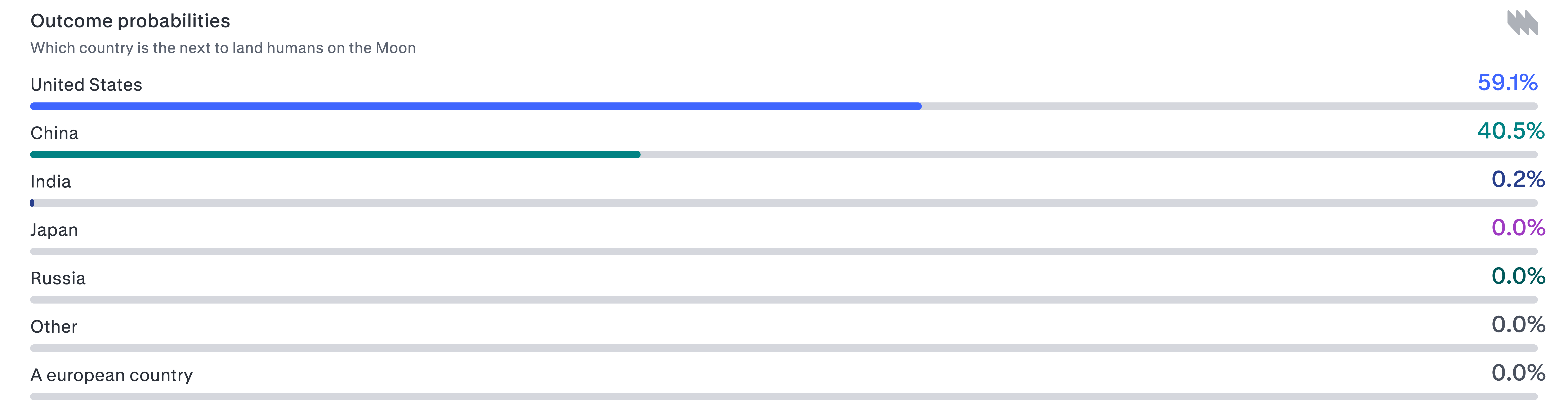
The American lead rests on flight-tested Orion transport and two contracted lander providers, though Starship orbital refuelling demonstrations, Blue Origin pad repairs, and Axiom suit tests present significant delay risks.
China offers a credible rival timeline targeting 2029 to 2030 with a simpler refuelling-free architecture, but its Long March 10 rocket, Mengzhou capsule, and Lanyue lander have yet to fly.
All other national operators collectively hold under 1% because foreign participation on NASA flights does not confer operator credit and independent programs like India’s target much later dates.
My forecast reflects heavily overlapping landing timelines rather than a decisive lead, with median landing dates separating the two front-runners by only a few months between late 2029 and mid-2031.
The primary uncertainty is whether complex American orbital cryogenic transfers and spacesuit development slip past China’s simpler two-launch mission before its new flight hardware encounters unexpected setbacks.