


Friday Forecasts is a weekly series showcasing 5 forecasts directly from Mantic, which you can explore on the Mantic platform with the direct link in the question titles.
1. How The New York Times v. OpenAI and Microsoft copyright case is resolved ↗
The Times has spent $28m so far, and a sanctions motion over allegedly destroyed OpenAI training logs is due 10 September. With Anthropic’s $1.5bn settlement setting the price of walking away, will this reach a verdict? Explore on Mantic ↗
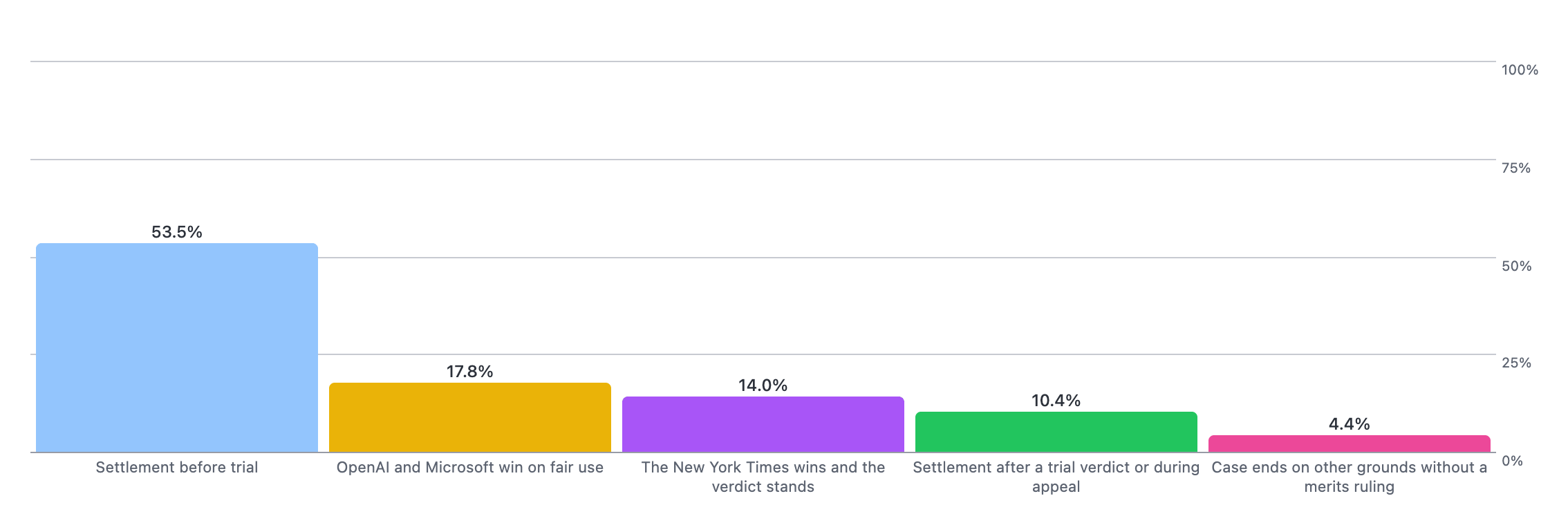
I predict a 54% probability that The New York Times v. OpenAI and Microsoft copyright case will reach a settlement before a trial verdict is issued.
Intense procedural pressure from a July 2026 sanctions motion alleging that OpenAI destroyed training data logs makes a pretrial resolution highly attractive to avoid adverse evidentiary rulings.
The New York Times has already spent $28 million on litigation, creating a strong financial incentive to convert these costs into a revenue-generating licensing deal similar to the $1.5 billion Anthropic benchmark.
OpenAI’s existing licensing agreements with the Associated Press and News Corp establish a viable commercial path for a resolution, even as the Times continues to aggressively refine its claims in the August 21, 2026 amended complaint.
2. When the IAEA next inspects Natanz, Fordow or Isfahan ↗
Iran has kept inspectors out for over 14 months, leaving 440.9 kg of 60% enriched uranium unverified, and declared “wartime conditions” on 26 August. The IAEA board meets 21 September, so when does anyone get back in? Explore on Mantic ↗
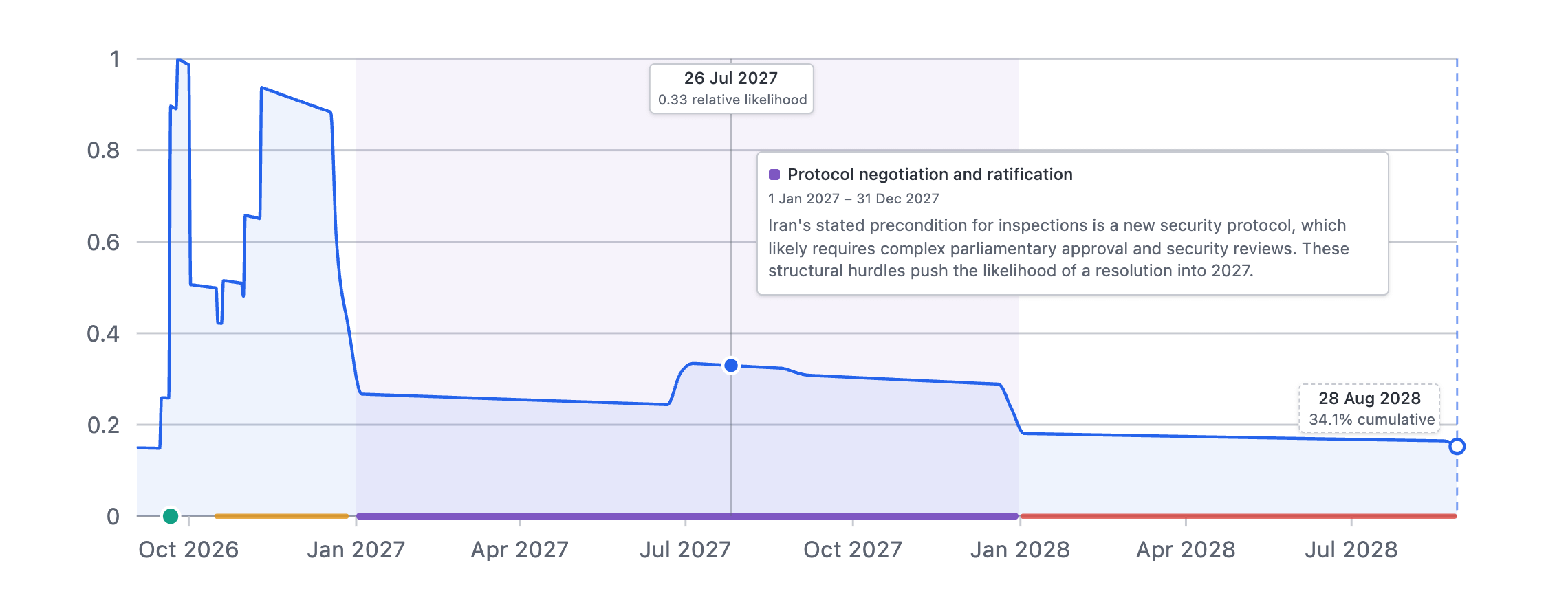
My 25th percentile prediction for an IAEA on-site inspection at Natanz, Fordow, or Isfahan is 31st October 2027.
I expect the current diplomatic impasse to persist after the Islamabad Memorandum framework collapsed in July 2026, leaving no active roadmap for restoring oversight.
I believe that “wartime conditions” declared by Iranian leadership on August 26, 2026, and the requirement for Islamic Consultative Assembly approval create significant political and security barriers to access.
I anticipate technical delays because physical damage to Natanz necessitates a new inspection protocol to manage safety and verification at previously targeted facilities.
I note that market signals show an 88% probability of no inspection by late 2026, confirming a consensus that the standoff will extend well into 2027.
3. When the IAEA next inspects Iran’s nuclear sites if the fighting stops ↗
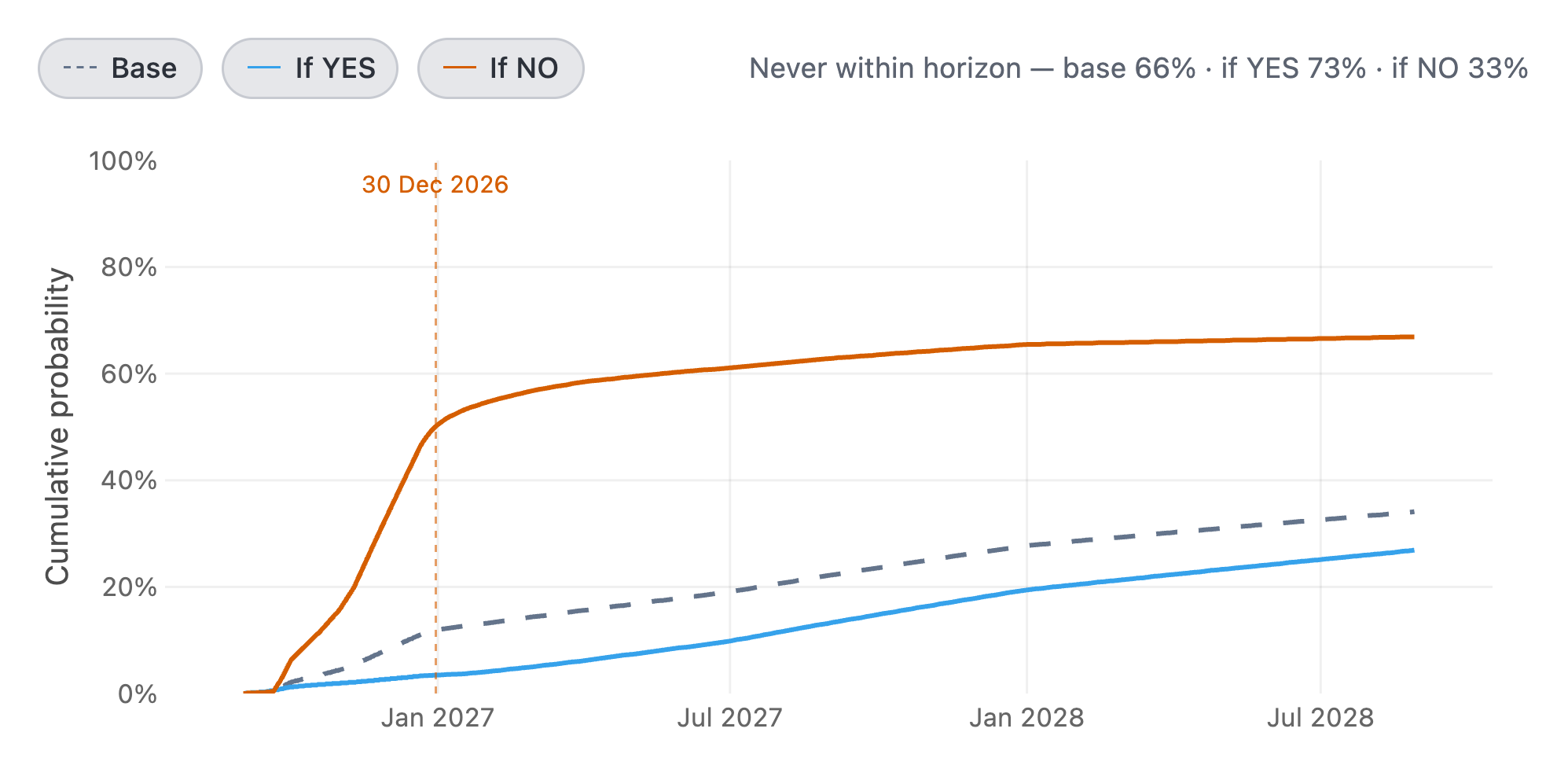
The two charts below condition on when the Iran–United States war first goes 30 consecutive days without a direct kinetic attack, at a January 2027 threshold and a November 2026 one. Explore on Mantic ↗
If the fights stop by January 1, 2027:
If the fights stop by November 1, 2026:
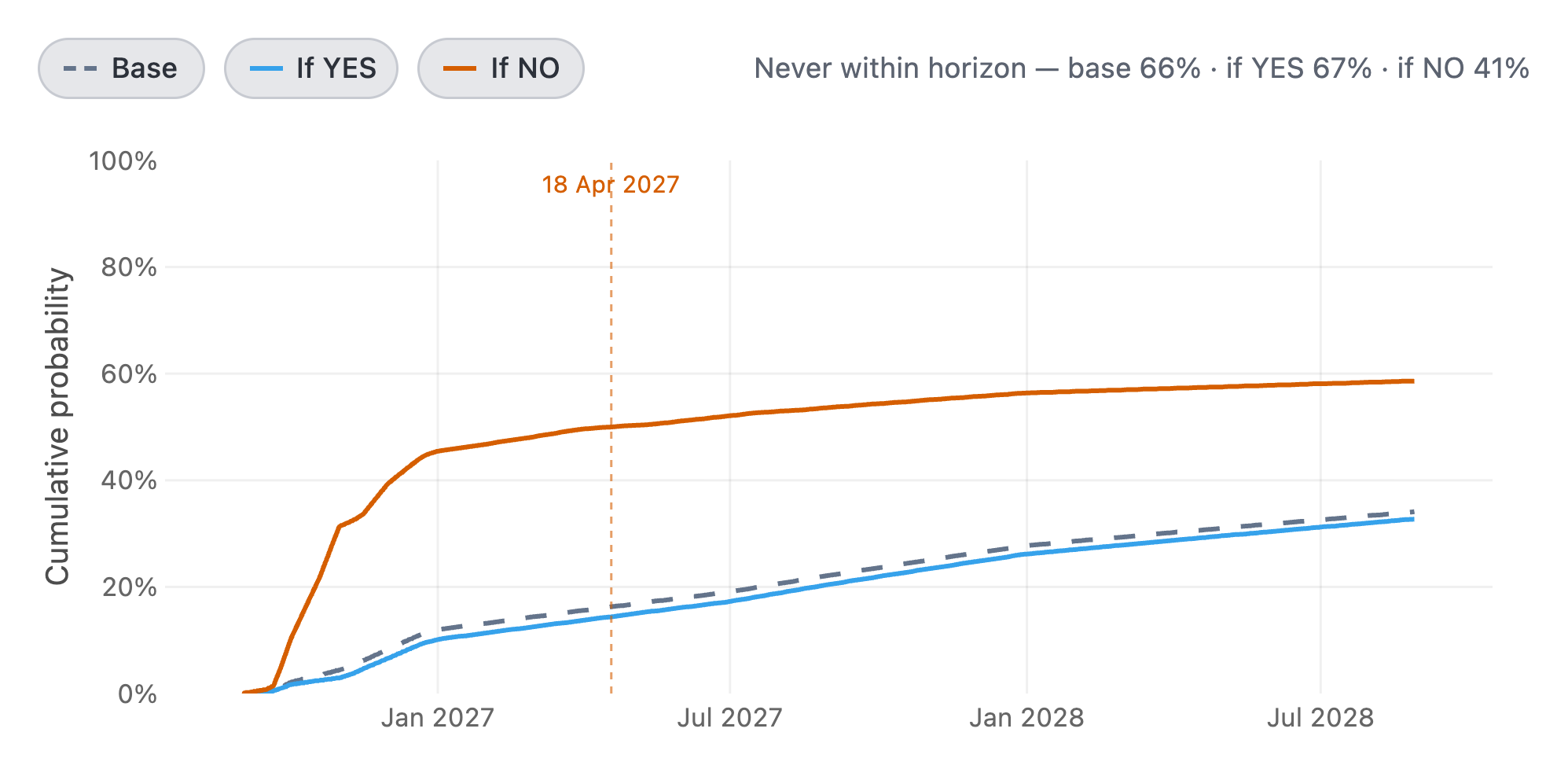
I analyzed current reports showing that IAEA inspections at Natanz, Fordow, and Isfahan have been halted for over a year following military strikes. Iran has explicitly stated that any return to these sites requires a new, specific security protocol and parliamentary approval, rather than a simple return to previous arrangements.
I weighed the “outside view”—market prices and historical delays—against the “inside view” that a ceasefire would likely be bundled with or quickly followed by nuclear concessions to secure sanctions relief. While a ceasefire removes the immediate excuse of “wartime conditions,” I expect a lag of several months for the negotiation of new inspection protocols and the physical preparation of damaged sites.
Consequently, my reasoning prioritizes the period shortly after the ceasefire takes effect, particularly aligned with IAEA Board of Governors meetings in 2027, which often serve as catalysts for diplomatic breakthroughs. We also accounted for a “long tail” scenario where, despite a ceasefire, political friction or site damage leads to a protracted stalemate lasting years.
4. When Japan next intervenes to buy yen ↗
Tokyo spent a record ¥15.4tn buying yen in July and August, its first joint operation with the US Treasury in three decades. With the dollar back at 160 and a September BoJ hike 92% priced, when does the MOF return? Explore on Mantic ↗
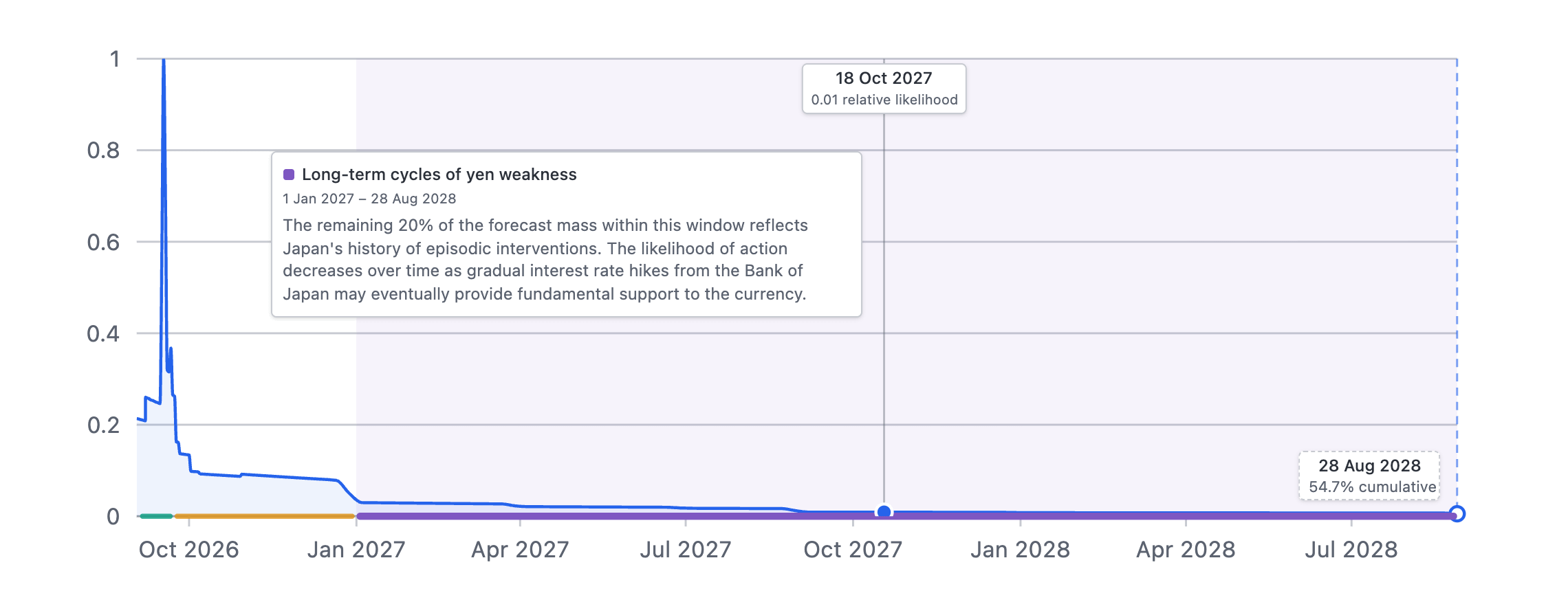
My median prediction for the next confirmed Japanese yen-buying intervention is 26th November 2027.
I expect a prolonged pause in direct market action as the Bank of Japan assumes responsibility for currency defense through monetary policy normalization, with markets pricing a 92% probability of a rate hike in September 2026.
The record ¥15.4 trillion intervention in mid-2026 established a psychological floor near 160, but the depletion of foreign exchange reserves to $1.287 trillion necessitates a long observational period before another physical market entry.
I anticipate that future action will depend on U.S. Treasury coordination, which currently faces a high threshold as U.S. officials view recent moves as “pretty well contained” following the first joint currency operation in nearly three decades.
5. The gold price at the end of October 2026 ↗
Gold settled at $4,464 on 31 August after central banks bought a record 289 tonnes in the second quarter. But Kevin Warsh has turned hawkish and a September hike is 60% priced, so where does October close? Explore on Mantic ↗
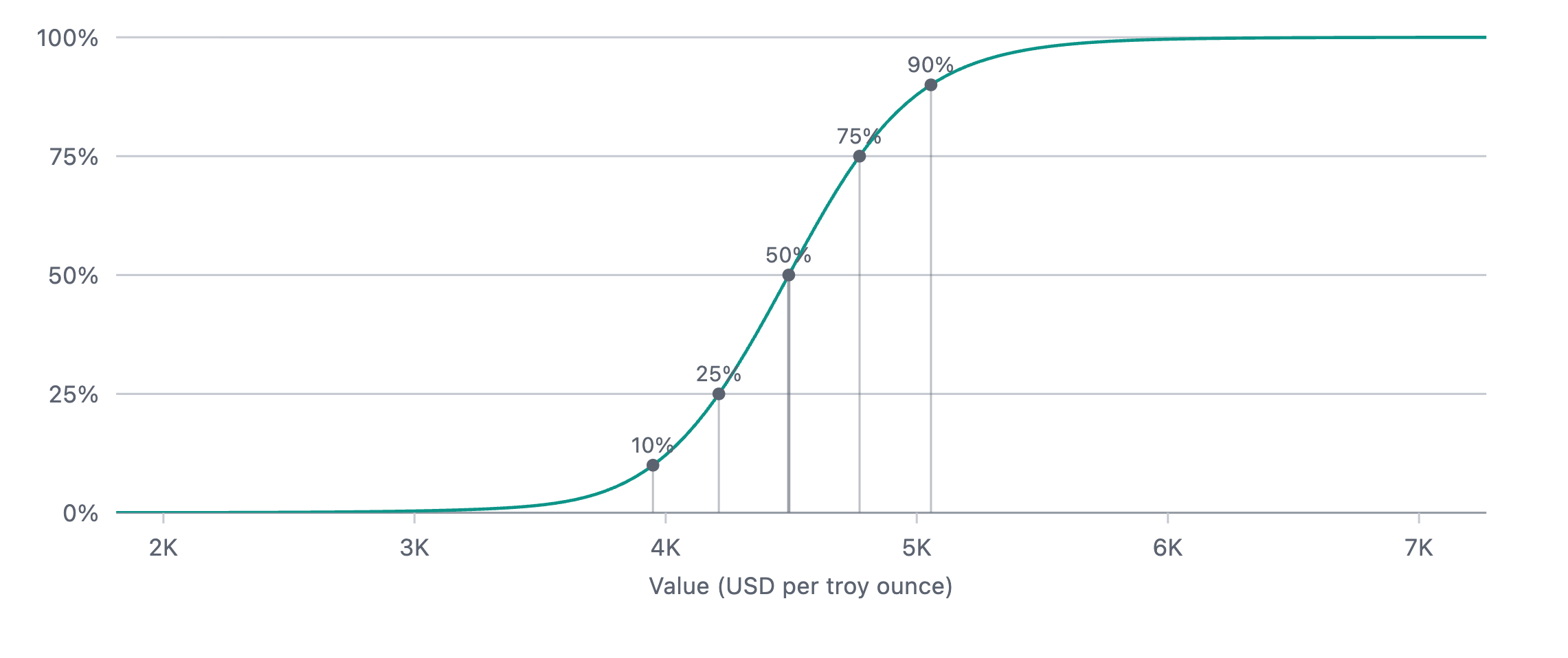
My most likely prediction for the gold price at the end of October 2026 is 4,485.69 USD per troy ounce, with a 50% chance of falling between 4,200.00 and 4,720.00 USD.
I expect sustained safe-haven demand to counter monetary headwinds as the 2026 Iran War maintains a high geopolitical risk premium, further supported by record central bank net demand which hit 289 tonnes in Q2 2026.
Recent hawkish signals from Fed Chair Kevin Warsh have introduced significant downside risk, with a 60% probability of a September rate hike likely to cap near-term gains despite China’s 21-month buying streak.
I have aligned my forecast with institutional targets such as Goldman Sachs’ $4,900 year-end projection, while accounting for the market’s current contango structure where December 2026 futures trade at $4,529.90.