

Friday Forecasts is a weekly series showcasing 5 forecasts directly from Mantic, which you can explore on the Mantic platform with the direct link in the question titles.
1. The combined capital expenditures of Alphabet, Amazon, Meta and Microsoft in calendar Q4 2027 ↗
Combined quarterly spending already hit $165bn in Q2 2026, and consensus for 2027 cloud capex has reached $1.2 trillion, most of it locked into long-term commitments. Power bottlenecks could still push the cash into 2028, so how big does a single quarter get? Explore on Mantic ↗
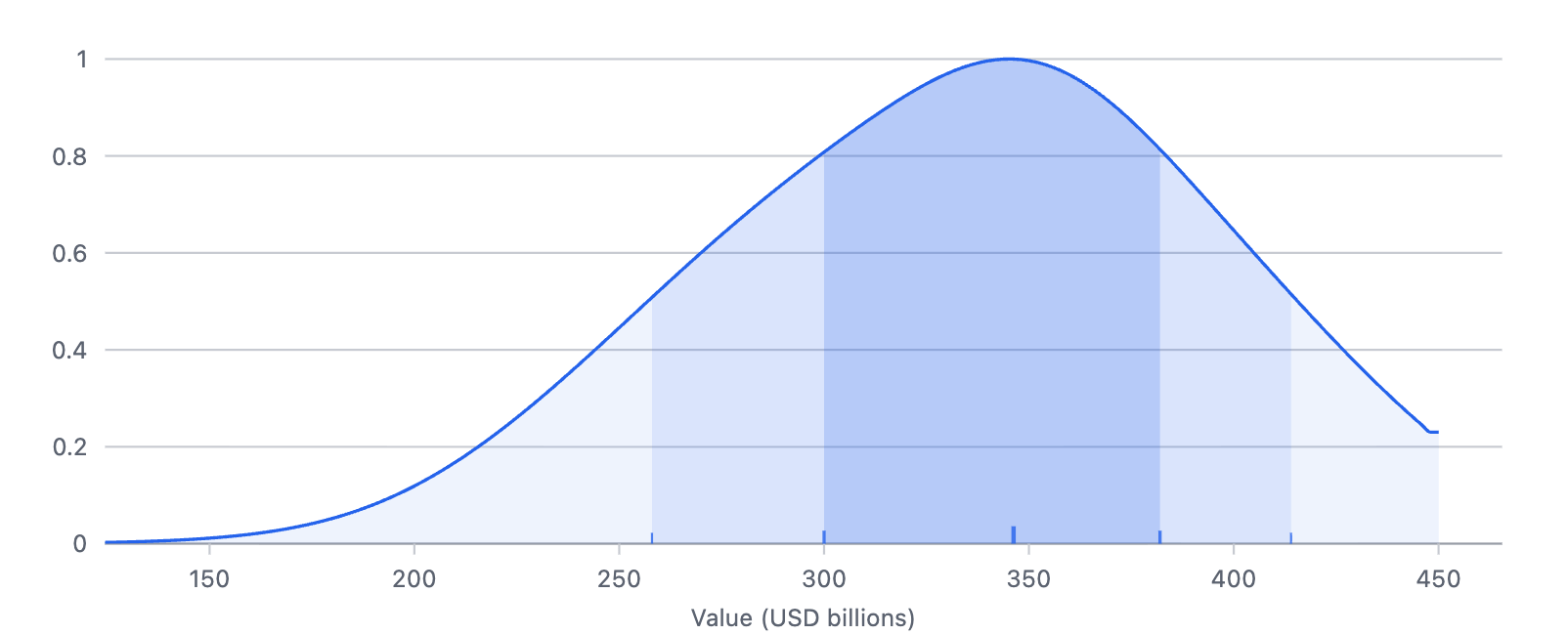
My most likely prediction for the combined capital expenditures of Alphabet, Amazon, Meta, and Microsoft in Q4 2027 is 346.25 billion USD, with a 50% chance of falling between 300.00 and 382.00 billion USD.
This forecast reflects an AI infrastructure supercycle where market consensus for 2027 cloud spending has reached $1.2 trillion. Combined quarterly spending already hit $165 billion as of Q2 2026, as demand for AI workloads consistently outstrips available compute capacity.
The scale of these outlays is anchored by nearly $2.4 trillion in combined long-term purchase commitments and data center lease obligations, suggesting spending is increasingly locked into contractually-mandated execution phases.
I accounted for accounting shifts like Microsoft reclassifying $15 billion to operating leases. While corporate profitability is robust, physical bottlenecks like power shortages could shift the timing of these cash outflows into 2028.
2. US real GDP growth over the 4 quarters to Q4 2027 if the AI data center capex is lower than anticipated ↗
If AI infrastructure spending is what is holding growth up, a capex slowdown should be visible in GDP. This is where that link gets priced instead of argued about. Explore on Mantic ↗
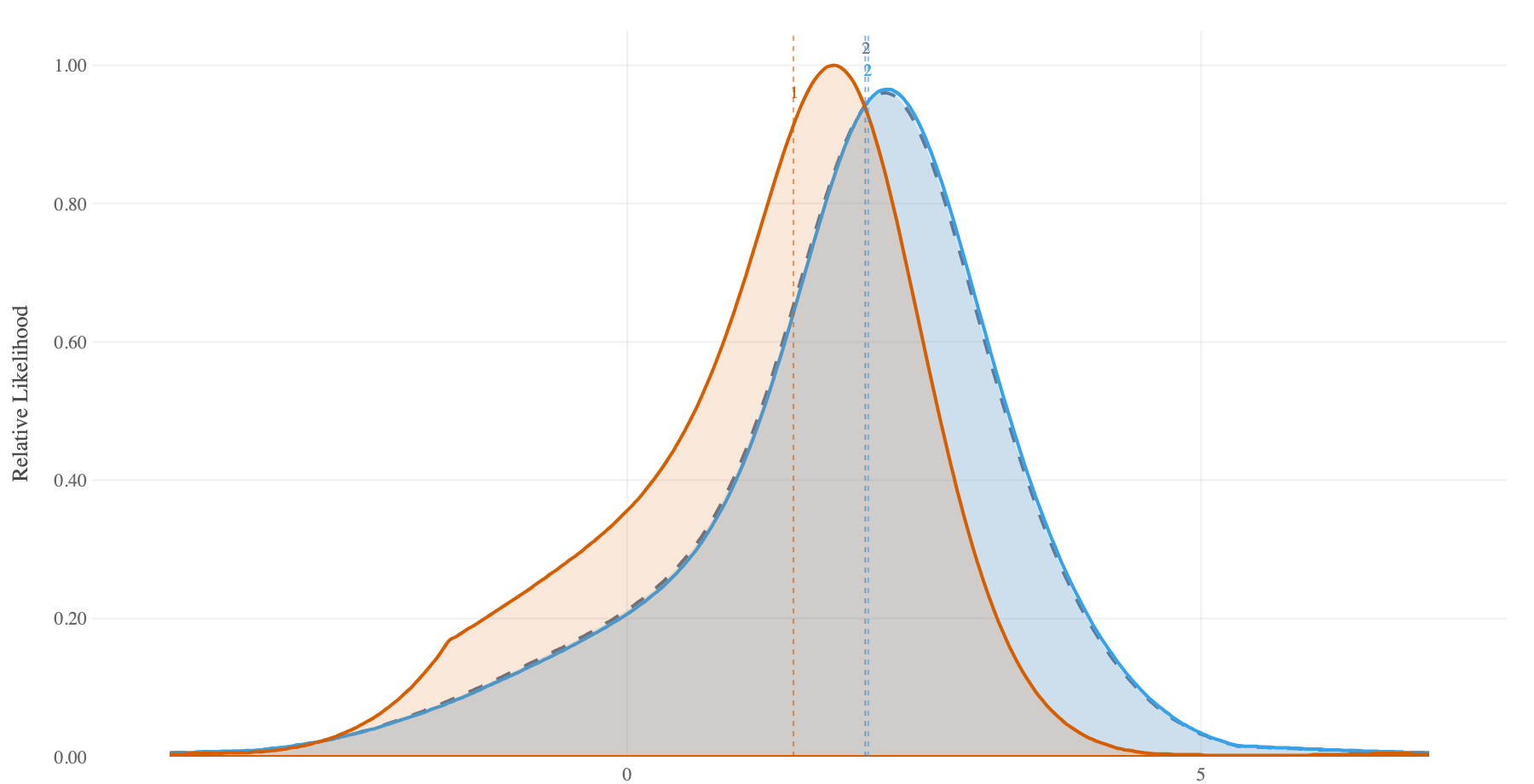
My most likely prediction for US real GDP growth over the four quarters ending Q4 2027 is 2.24%, with a 50% chance of falling between 1.45% and 2.99%.
I view massive capital expenditure on artificial intelligence infrastructure as a critical tailwind, with AI-related spending reaching nearly 2% of total U.S. GDP and fueling up to $5.5 trillion in total investment through 2030.
I expect growth to be tempered by a significant fiscal cliff in 2027, as scheduled cuts to Medicaid estimated at $900 billion over the next decade begin to dampen consumer spending power and labor demand.
I anticipate the Federal Reserve will pivot to a more accommodative stance, likely delivering 50 basis points in rate cuts as inflation normalizes, though I remain cautious of energy market volatility following the spike in oil prices caused by regional conflict.
3. When China and the Philippines get into a military clash ↗
Second Thomas Shoal is the likeliest place a US treaty obligation gets tested this decade. The timing matters more than the odds, because it sets how long anyone has to prepare. Explore on Mantic ↗
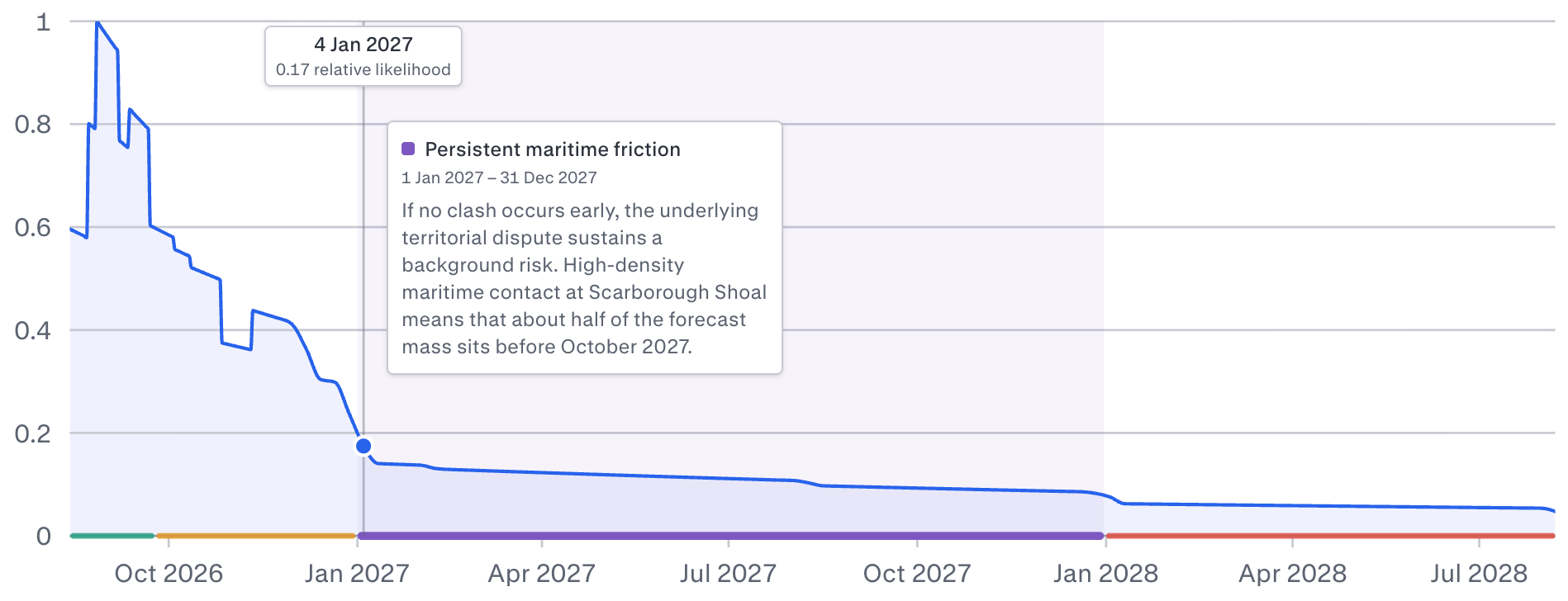
My median prediction for a military clash between China and the Philippines is 21st September 2027.
The structural decay of the BRP Sierra Madre at Second Thomas Shoal is the primary trigger, as its impending collapse forces the Philippines into reinforcement missions that Beijing has pledged to block.
Operational density reached record levels in 2026, with Chinese Coast Guard ship-days at Scarborough Shoal nearly doubling to 156 per month, significantly raising the likelihood of a violent collision.
I believe the recognition of Chinese martyrs and the deployment of the Typhon missile system have shortened the escalation timeline by increasing domestic political pressure and strategic friction.
Recent transitions to hand-to-hand combat and boarding actions show that both sides have abandoned non-violent standoffs for a high-risk gray zone of physical conflict.
4. Starship Flight 14 achieves orbit ↗
Every Starship flight so far has deliberately stopped short of orbit. Clearing that line is what turns a test programme into a working launch business, and Starlink V3 depends on it. Explore on Mantic ↗

I predict Starship Flight 14 will achieve orbital insertion, defined as an osculating perigee of at least 80 km, with a 68% probability.
This mission marks a critical shift from suborbital testing to operational deployment, as Flight 14 is intended to place Starlink V3 satellites into a stable orbit rather than the transatmospheric paths used in previous flights like Flight 13.
Transitioning to the Block 3 architecture with Raptor 3 engines provides improved thrust-to-weight ratios and reduced weight, granting the performance margins necessary for the first successful circularization burn in the program’s history.
While technical reliability is high, the final FAA launch license for the new orbital reentry path is still pending, and any engine relight failure during the upper-stage burn remains a primary risk factor for mission success.
5. When a major U.S. city first has 10% of its taxis be autonomous vehicles ↗
Robotaxi progress gets reported in ride counts and funding rounds. Share of a city’s actual taxi fleet is the number that would show drivers being displaced at scale. Explore on Mantic ↗
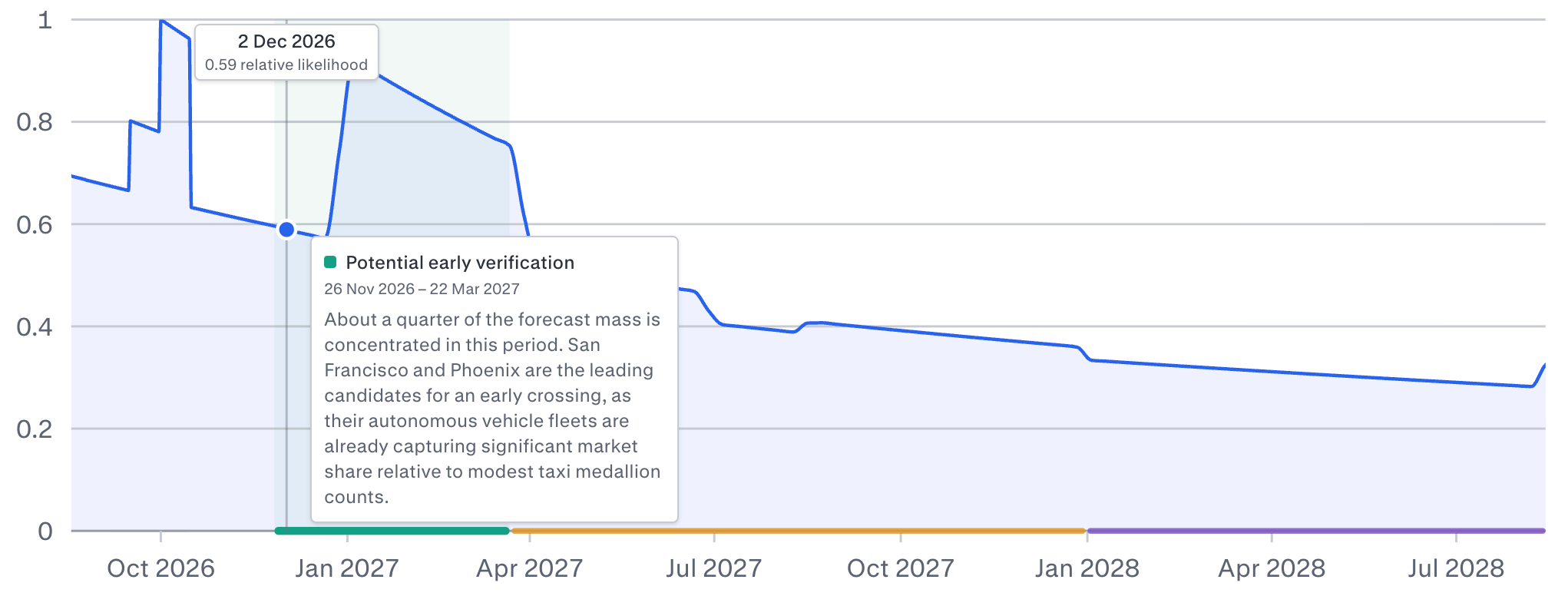
My 25th percentile prediction for when a major U.S. city will first have 10% of its taxis be autonomous vehicles is 26th November 2027.
I anticipate this milestone will be reached as Waymo aggressively scales its fleet following a significant $16.0 billion investment from Alphabet and the recent import of over 3,200 new vehicles to support densification in mature markets like San Francisco and Phoenix.
While Waymo already captures 15% to 19% of rider spending in its primary hubs, I expect the transition to a 10% active vehicle share will be slower than revenue growth because robotaxis must directly substitute for a large pool of 5,000 to 10,000 human-driven TNC vehicles per city.
I expect rapid deployment in Texas cities like Austin and Dallas due to House Bill 100, which limits local municipal restrictions, alongside the market entry of the Tesla Cybercab and Zoox’s expansion under federal exemptions.