

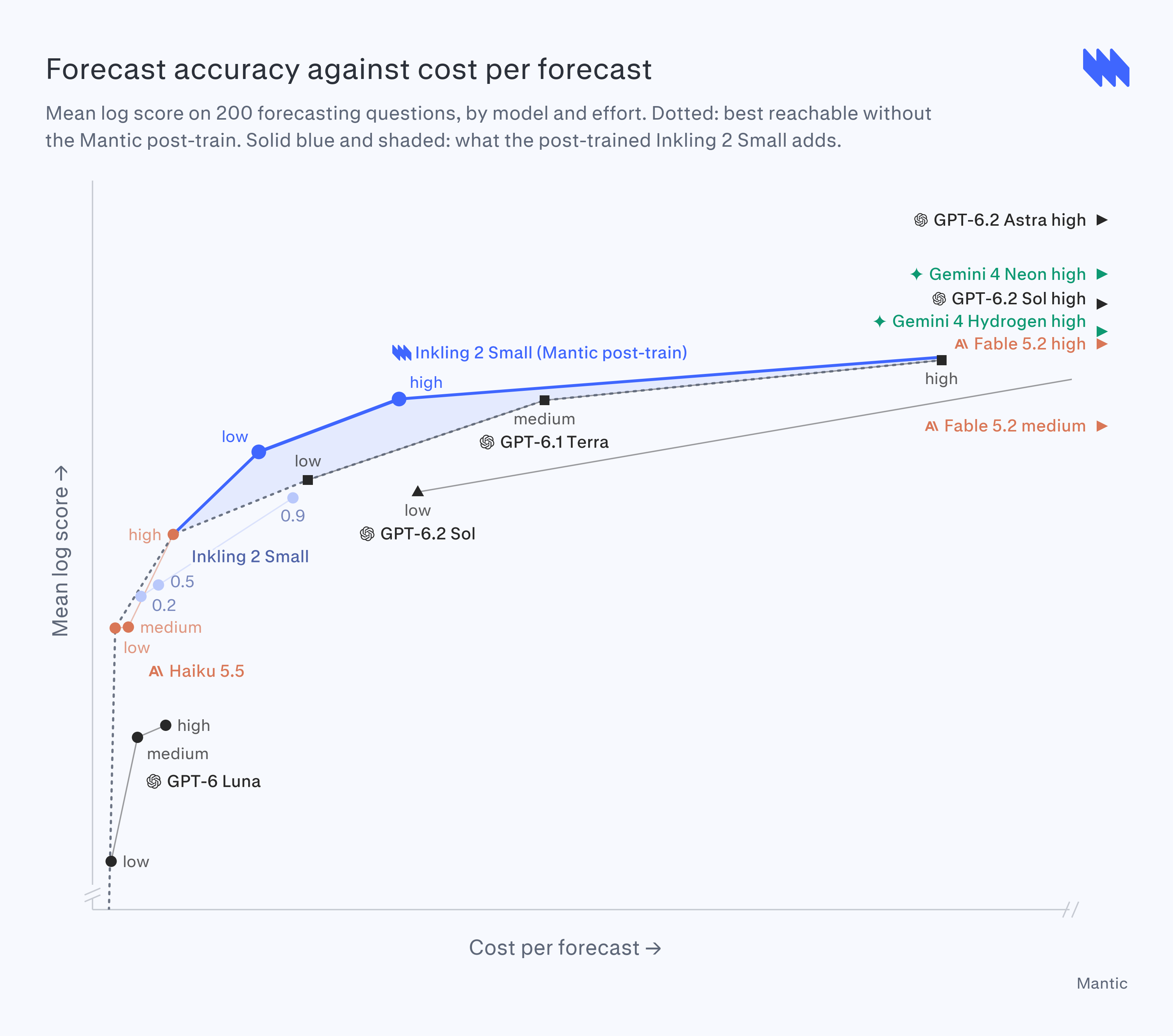
This week, we published a post with Thinking Machines on how we post-trained Inkling 2 Small to match Fable 5.2 medium at 1/15th the cost. Read the full post here.
Using our agent, we produced 100,000 forecasts for S&P 500 companies’ 2027 revenue and earnings per share across 50 geopolitical and economic scenarios. Explore the demo here.

We’re really grateful to everyone who has taken the time to read and comment on our work. We’re sharing responses to some of our favourite points below.
Can decision models forecast?
Michelle Chen at CloudFlare posted some initial results using Clairic, the CloudFlare decision model.


We ran a full suite of decision models and found that some of them do land on the frontier between the zero-cost, uniform forecast and GPT-6 Luna (low), the next cheapest solution.
Some decision models are worse than guessing, achieving negative scores, and most benefit from being provided with the research that Fable 5.2 (high) produced. The Fable research costs $0.88 on average, a 1000 fold increase in the base cost that erases any benefits of the decision models themselves being cheap to run.
CloudFlare’s Clairic does not generally perform well but Clef is among the best, though at 3x the cost of Baseten’s Mammoth, the single best performer.
Does the agent take its own modelling seriously?
Daniel Lenton asked whether the trained model ever threw out its forecasting model in response to the results of its own backtests.

The answer is yes, it does. Here’s an example of this behaviour compared to the base Inkling 2 Small model.
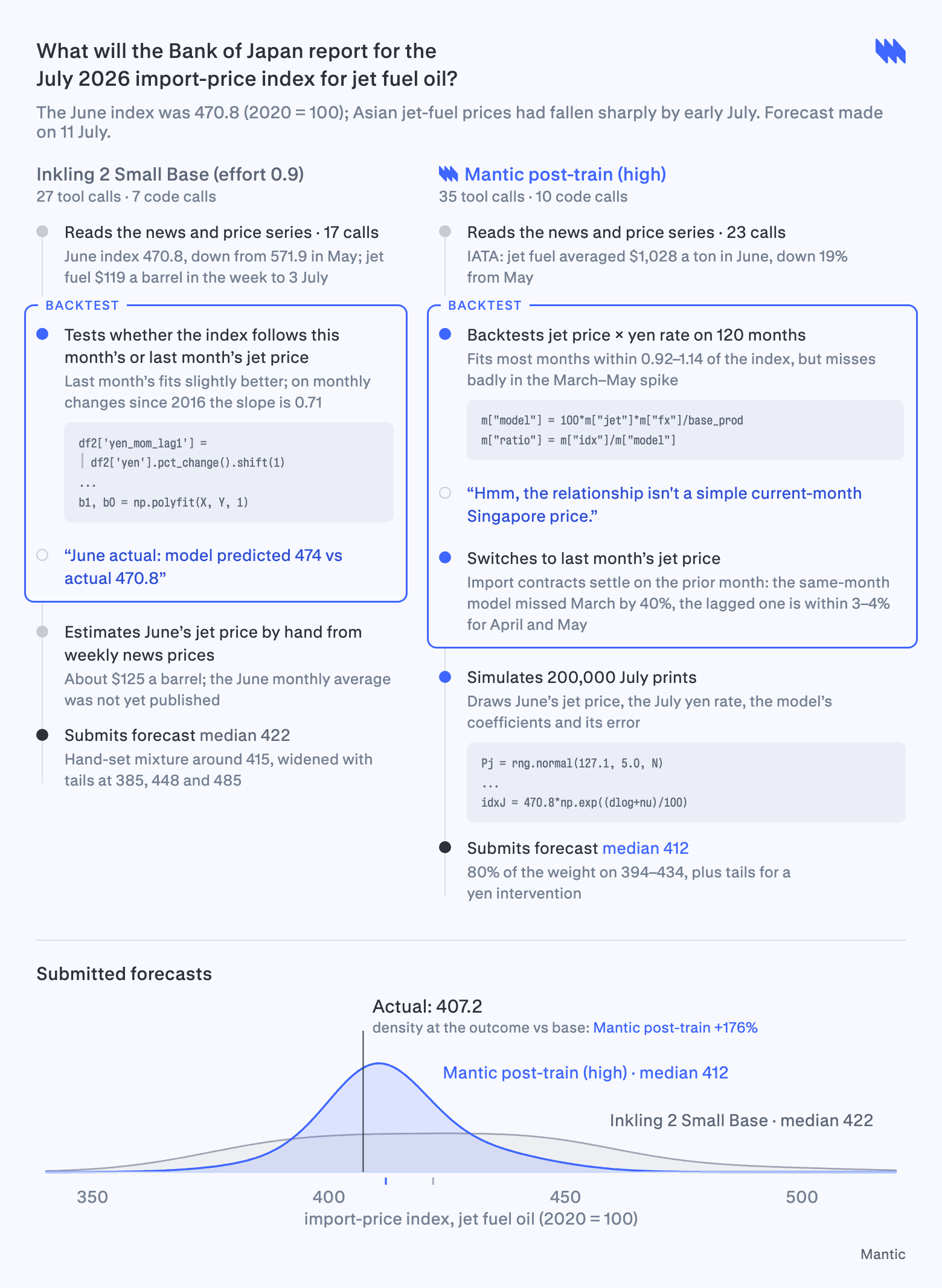
In this case, the post-trained agent initially tests a pure pass-through, same-month level model: take the current month’s Singapore jet price (USD) and multiply it by the USD/JPY exchange rate to get a Yen denominated jet price. If this accurately described the situation then we’d expect a fit of 1.0. The agent observes months falling in the 0.92-1.14 range but sees bad misses around the March-May spike and realises that the import contracts settle on the prior month, and switches to a t-1 model. The March miss comes down from 40% to 3-4%, and the final forecast is greatly improved.
Is our model well-calibrated?
We’ve been asked whether our trained model is well-calibrated. Within the Mantic harness, over 1,024 forecasts we found the 50%, 80%, and 90% forecast intervals contained the actual outcome 51%, 79%, and 90% of the time, respectively — so we’re very well calibrated, and you can also see this in the calibration curve.
How does our forecasting environment compare to newly released ‘time machines’?
Epochal and Perplexity launched web time machines this week, joining Exa and General Reasoning. A backtest asks the agent to make a forecast using only information available at the time. These tools differ in how far back they go and which versions of web pages they can retrieve.
Epochal (launch) spans more than 30 years. About 1% of indexed pages have five or more versions. Archive breakdown
Perplexity (launch) goes back up to 365 days. Time Machine docs
Exa offers five months on its developer plan and uses current search signals to find historical pages. Snapshot docs
General Reasoning takes monthly Wikipedia snapshots, so a page can be weeks out of date at the forecast cutoff. BackSearch docs
This tools complement other parts of our backtesting setup. Our forecasters can read the Wikipedia revision in effect at the cutoff and, where historical vintages are available, retrieve the economic figures as they were reported at the time. We track millions of time series and billions of observations, including revisions. Our news archive includes print coverage and articles from paywalled publications. We use the same historical research tools for training and evaluation. In one 12-hour run, 41,000 rollouts made 728,000 calls to our news, Wikipedia, and time-series tools.