


Friday Forecasts is a weekly series showcasing 5 forecasts directly from Mantic, which you can explore on the Mantic platform with the direct link in the question titles.
1. When an EU state next reintroduces border controls aimed at another member state ↗
Italy’s NB 499 filing on 3 August was the first Schengen notification to name a fellow member state, and Spain retaliated five days later. Broad German and Austrian controls lapse on 15 September, so who names a neighbour next? Explore on Mantic ↗
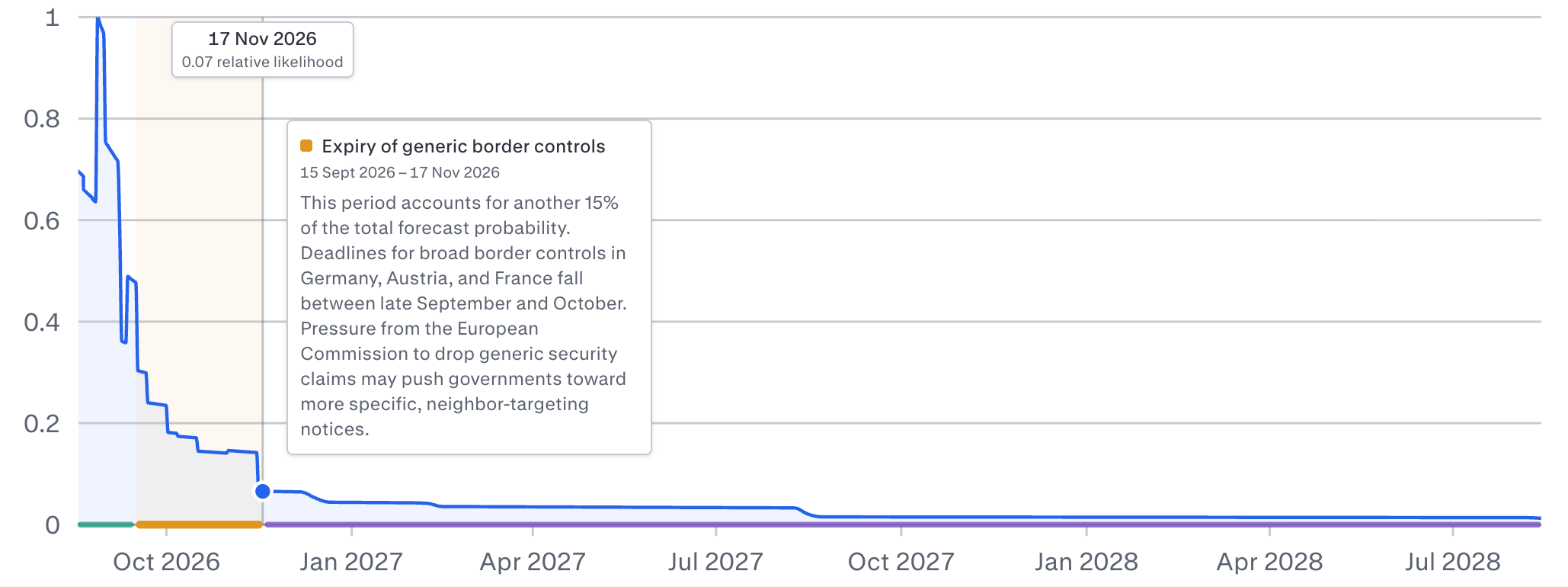
My 25th percentile prediction for when an EU/Schengen state will next notify the European Commission of a new reintroduction of internal border controls targeting another named member state is 17th November 2026.
I believe the 3rd August 2026 notification (NB 499) by Italy against Spain has normalized the practice of explicitly naming member states in the NB register, significantly lowering the diplomatic cost for future targeted actions.
I expect potential triggers for new notifications in late autumn 2026, coinciding with the 15th September expiration of broad controls for Germany and Austria, as states are increasingly pressured to provide more specific, rather than generic, threat justifications.
I see a high risk of escalation from Northern European states like Denmark, which has already signaled readiness for total border closures following the unprecedented Ceuta crisis that saw 80,000 individuals enter the enclave.
2. The average Q4 2026 price of jet fuel if the Strait of Hormuz stays closed ↗
Gulf Coast jet fuel settled at $3.51 a gallon in early August while Hormuz transits ran at 6.07 ships a day, and distillate stocks sit 10% below their five-year average going into winter. If the strait is still shut, what does Q4 cost? Explore on Mantic ↗
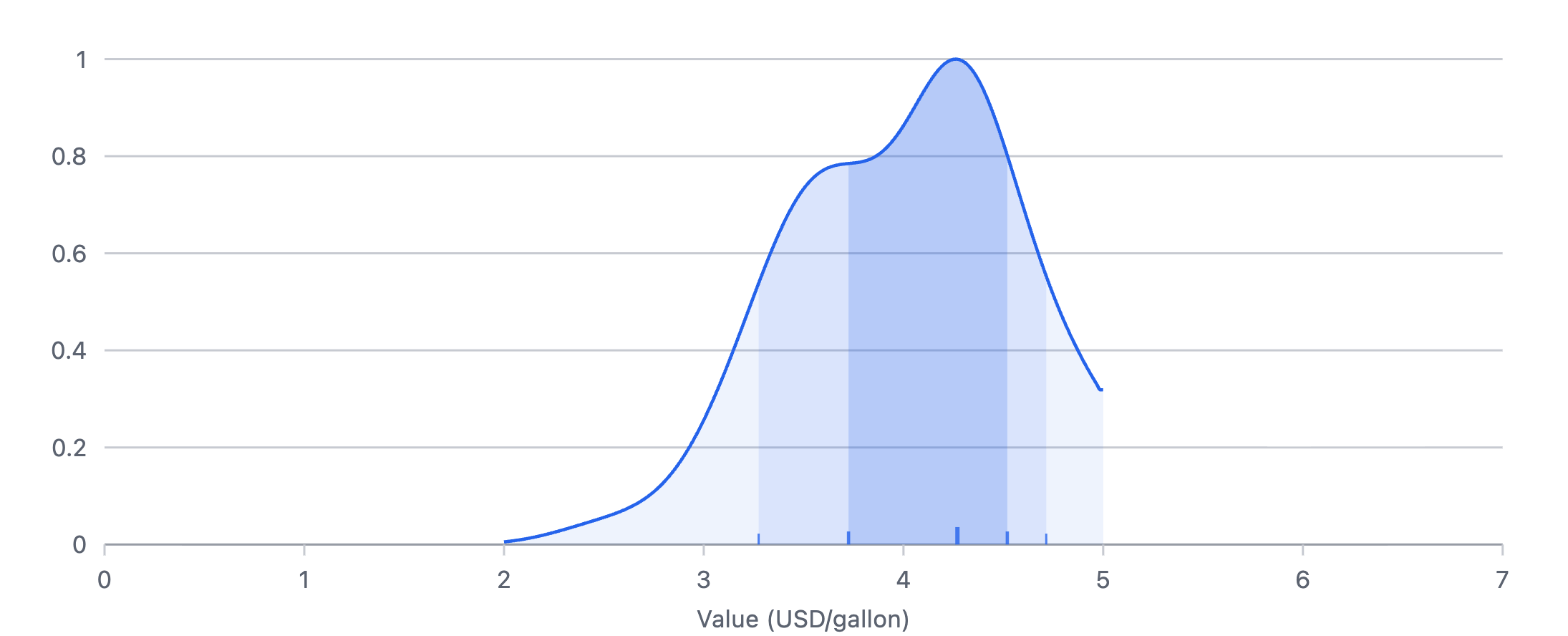
My most likely prediction for the average Q4 2026 price of jet fuel is 4.27 USD/gallon, with a 50% chance of falling between 3.72 and 4.52 USD/gallon.
This forecast relies on a sustained blockade pushing Brent crude to 120 USD per barrel. I expect jet fuel crack spreads to exceed 50 USD per barrel because the loss of Middle Eastern refinery exports has severely constrained global supply.
Distillate inventories are 10% below historical norms, providing no cushion for Q4 heating demand. I expect prices to revert to the 4.20 to 4.50 USD range once the market fully accounts for the indefinite nature of the July 12 closure.
Daily transits through the Strait of Hormuz remain at just 6.07 vessels, far below the 20-ship threshold necessary for normalization. I believe the combination of this logistical blockade and reduced global refining capacity will maintain price pressure despite potential demand destruction.
3. The average year-over-year change in the US CPI airline fares index in Q4 2026 conditional on jet fuel hitting $5 ↗
Jet fuel averaging $5 a gallon in Q4 is roughly a 10% scenario, and fares are lapping a soft late-2025 base with fuel near a fifth of airline costs. If that $5 print lands, how hot does the fares index run? Explore on Mantic ↗
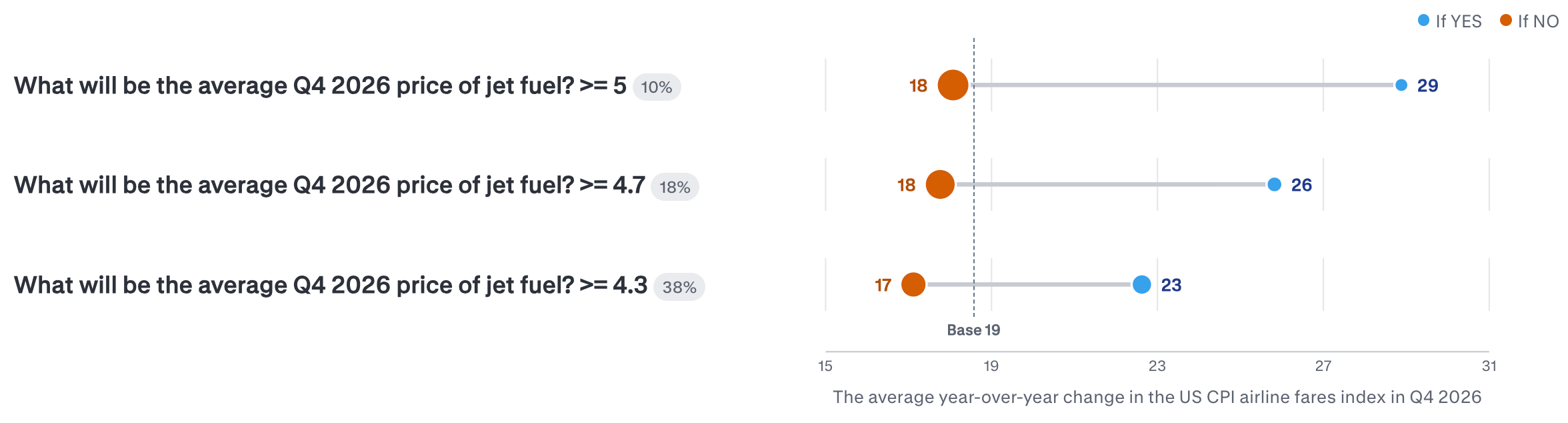
I analyzed the “denominator”—the airline fare index levels from late 2025. Because those values were relatively low, even if airfares stayed flat from their mid-2026 levels, the year-over-year change would already be positive.
I examined historical data and recent SEC filings from major carriers like United, Delta, and American. These documents consistently showed a strong intent and ability to pass higher fuel costs onto consumers to maintain profit margins. Given that fuel typically accounts for about a fifth of operating expenses, a jump to $5 per gallon creates massive upward pressure on ticket prices.
I accounted for industry-wide supply issues, such as aircraft delivery delays and carrier exits, which limit the number of available seats. This lack of supply makes it easier for airlines to maintain high fares even if some travelers are deterred by the cost.
While I considered “demand destruction”—the idea that people might stop flying if prices get too high—the necessity of fuel cost recovery in a constrained-supply environment led us to expect substantial year-over-year increases.
4. The outcome of the Surface Transportation Board’s review of the Union Pacific–Norfolk Southern merger ↗
Union Pacific’s $85bn bid for Norfolk Southern sits in abeyance while the Board digests a 400-page supplemental filing from July, with seven state attorneys general and rival railroads against it. Does the Board clear it, and on what conditions? Explore on Mantic ↗

I predict there is a 68% probability that the Surface Transportation Board (STB) will issue a final approval subject to substantive conditions for the Union Pacific and Norfolk Southern merger by December 31, 2027.
Approval is likely tied to extensive voluntary commitments including gateway pricing, service oversight, and a binding MOU with Canadian National that addresses key competitive concerns.
The current procedural abeyance allows for the review of massive supplemental data filed in July 2026, putting the board on a timeline similar to the recent 16.5-month CP/KCS precedent.
Significant hurdles remain under strict 2001 merger rules, as seven state attorneys general and rival railroad coalitions challenge the deal, while the Environmental Impact Statement process poses a 16% risk of pushing the final decision into 2028.
Strong capital positions and a $2.5 billion reverse termination fee make abandonment highly unlikely, signaling management resolve to finalize the transcontinental network.
5. When Meta and Anthropic sign a cloud computing deal ↗
Anthropic was reported in July to be in early talks to lease up to $10bn of Meta’s compute, and Meta has since built a compute division on $130–145bn of 2026 capex. It just signed a rival $10bn deal with Volta, so when does this one land? Explore on Mantic ↗
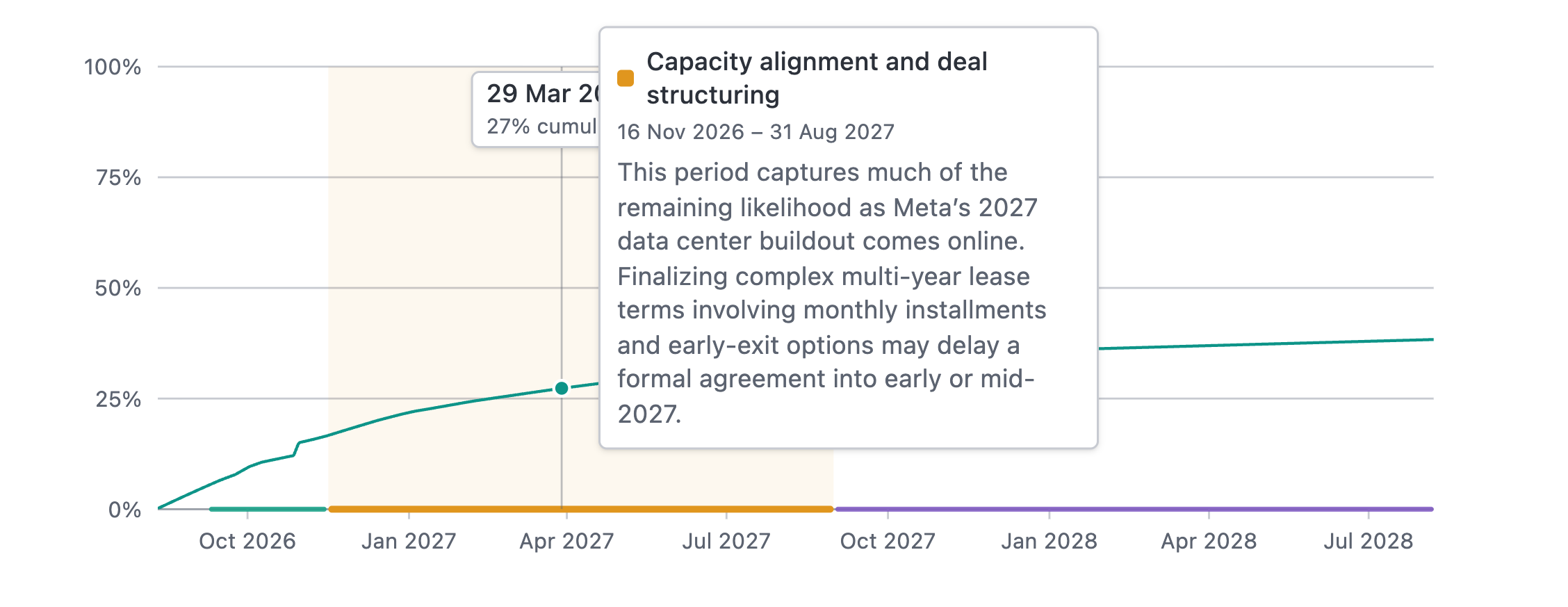
My 25th percentile prediction for Meta and Anthropic to finalize a cloud computing infrastructure deal is 16th February 2027.
I predict Meta’s shift toward commercial cloud services, signaled by the new Meta Compute division and former AWS leadership, drives this timeline. Meta’s projected 2026 capex of $145 billion creates the surplus capacity required for the rumored $10 billion lease.
I expect Anthropic’s confidential IPO filing to accelerate deal finalization as the company must prove compute scalability to investors. Although talks were preliminary in mid-2026, securing Meta’s infrastructure is a strategic priority alongside their existing $10 billion Volta deal.
I anticipate that regulatory monitoring by the CMA and internal competition for capacity will prevent an earlier agreement. Anthropic’s new partnerships with Macquarie and GIC provide them leverage in negotiations, likely delaying a final binding contract until the first quarter of 2027.