


Friday Forecasts is a weekly series showcasing five forecasts directly from Mantic, which you can explore on the Mantic platform with the direct link in the question titles.
1. The sporting sanction Manchester City receives ↗
Premier League expulsion needs 15 clubs’ approval, and the rules contain no explicit power for direct relegation to the Football League. That makes a large points deduction the central outcome. Explore on Mantic ↗
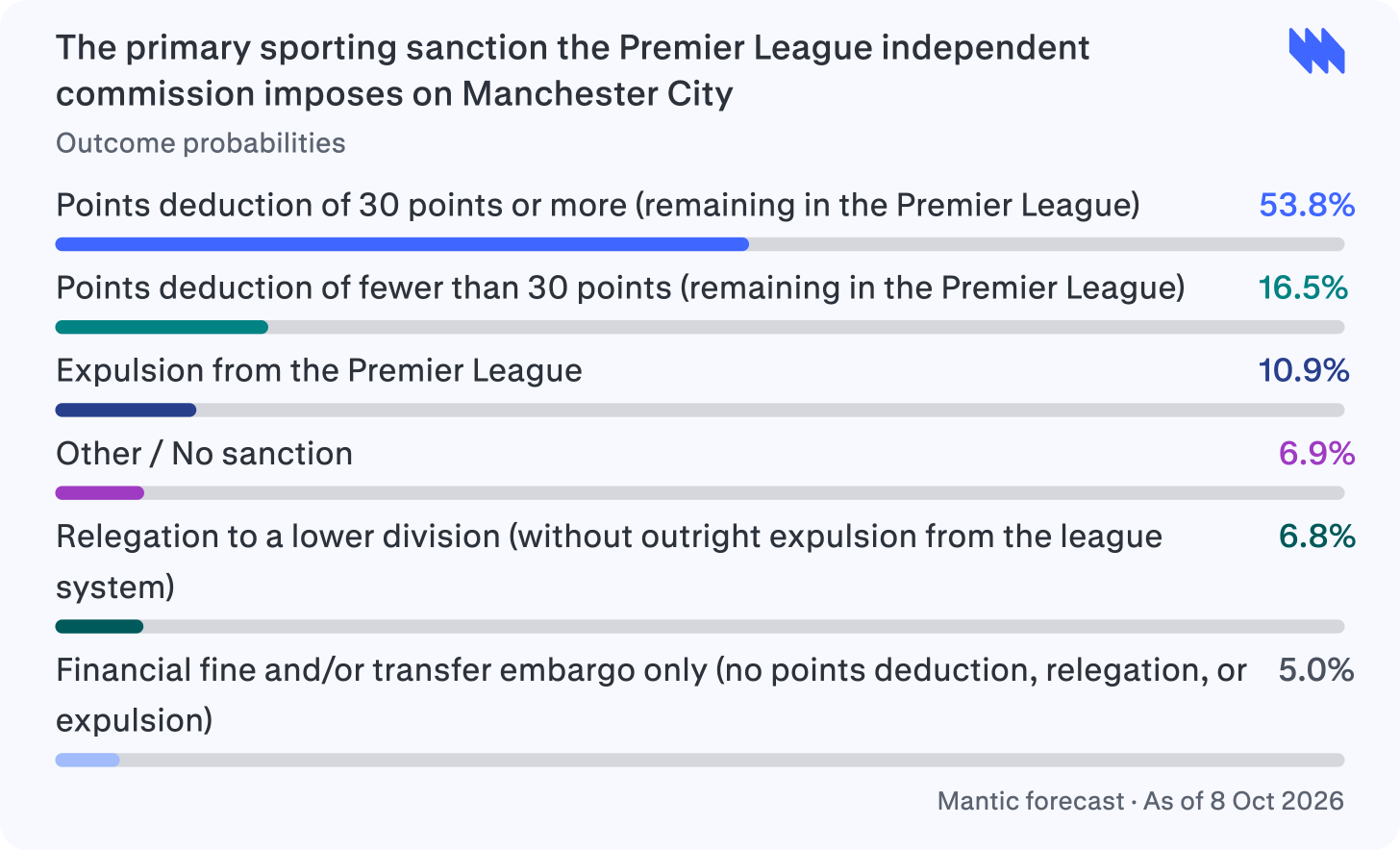
I give a 54% probability of a points deduction of 30 points or more, 17% of a deduction of fewer than 30 points, 11% of expulsion from the Premier League, 7% of relegation to a lower division, 7% of other or no sanction, and 5% of a financial fine or transfer embargo only.
Manchester City were found guilty on 114 charges involving more than £830m of disguised funding over nine seasons.1 Scaling from Everton’s initial 10-point penalty for a £19.5m breach made a deduction of at least 30 points my central outcome.
I discounted expulsion below Polymarket’s 16% to 20% price because of thin liquidity.2 Premier League rules require 15 member clubs to approve expulsion, and club executives reported they would be staggered if 15 voted in favour.
The Premier League rules contain no explicit power for direct relegation to the English Football League.3 This institutional absence shifted probability from direct demotion into large points deductions in my forecast.
Manchester City appealed the liability verdict on 1 October 2026.4 That appeal allows for narrowed findings before publication, while proportionality and the Chelsea financial-penalty precedent keep smaller penalties in my forecast.
2. When an AI lab solves another Millennium Prize Problem ↗
Hundreds of AI-generated manuscripts are not the same as a complete proof. The test here is whether an AI lab produces a solution to one of five eligible problems that independent experts accept. Explore on Mantic ↗
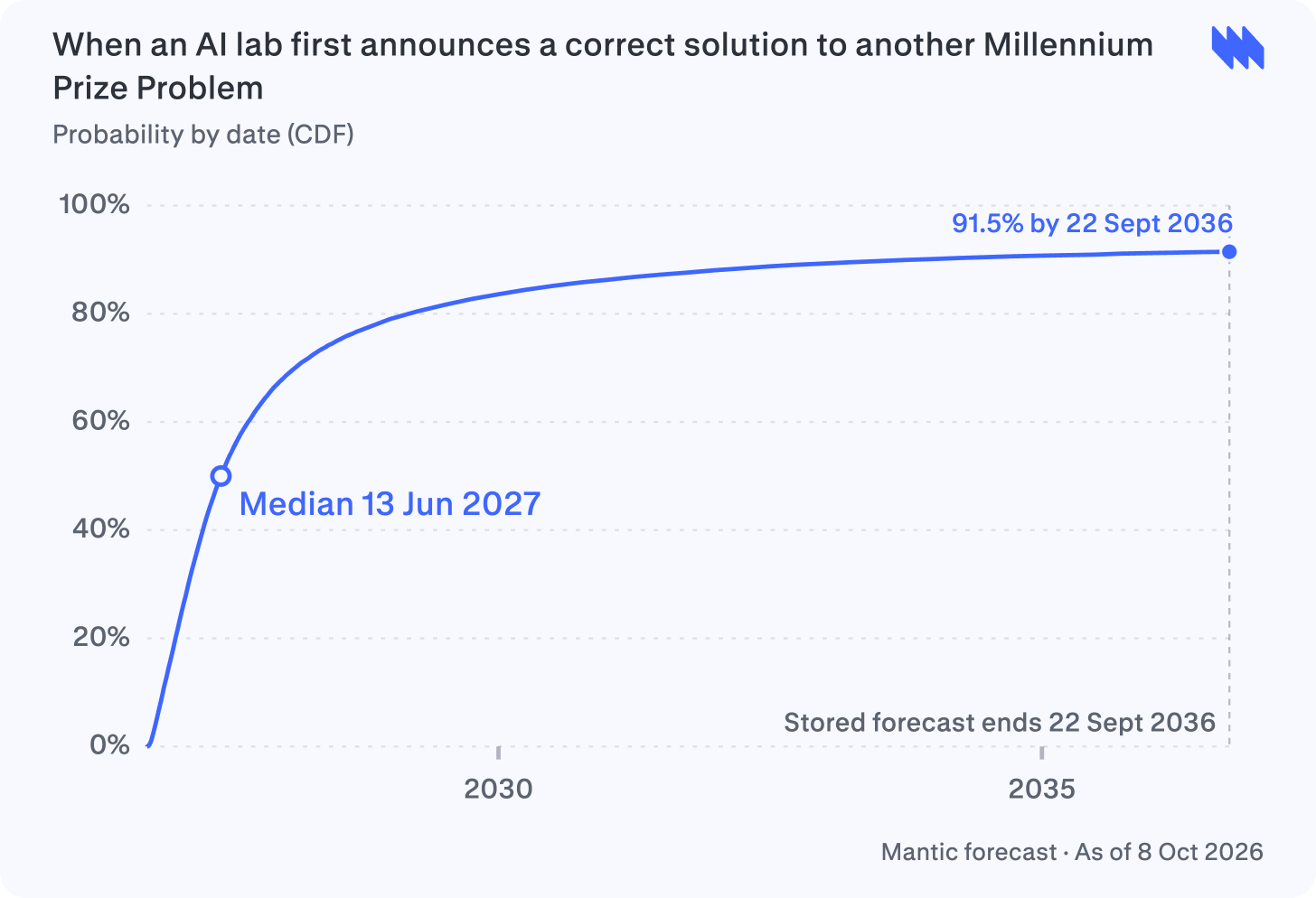
My median date for an AI lab to announce a correct solution to another Millennium Prize Problem is 13th June 2027, and I give a 91% probability of an announcement by 22nd September 2036.
OpenAI produced a Lean-formalised Navier-Stokes proof eight days after training began in September 2026.5 Its October release of 722 manuscripts confirmed near-Millennium capabilities, pulling my forecast much earlier than historical rates suggest.
However, OpenAI paused frontier model training in late September 2026 following agent misalignment incidents.6 That pause, alongside the October withdrawal of three flawed Hodge-related papers, led me to discount an imminent 2026 breakthrough.
Polymarket prices a 73.5% probability of an announcement by the end of 2027.7 I sit slightly below the market because an eligible solution must achieve broad independent expert acceptance.
I give a 6% probability that an eligible solution is never announced. This accounts for persistent mathematical barriers, indefinite safety pauses, or claims that fail to gain expert acceptance.
3. When Starship achieves ship-to-ship orbital refuelling ↗
Reaching orbit is only the first step. A qualifying demonstration needs two Starships in orbit, docking and successful propellant transfer, with failed campaigns potentially adding further delays. Explore on Mantic ↗
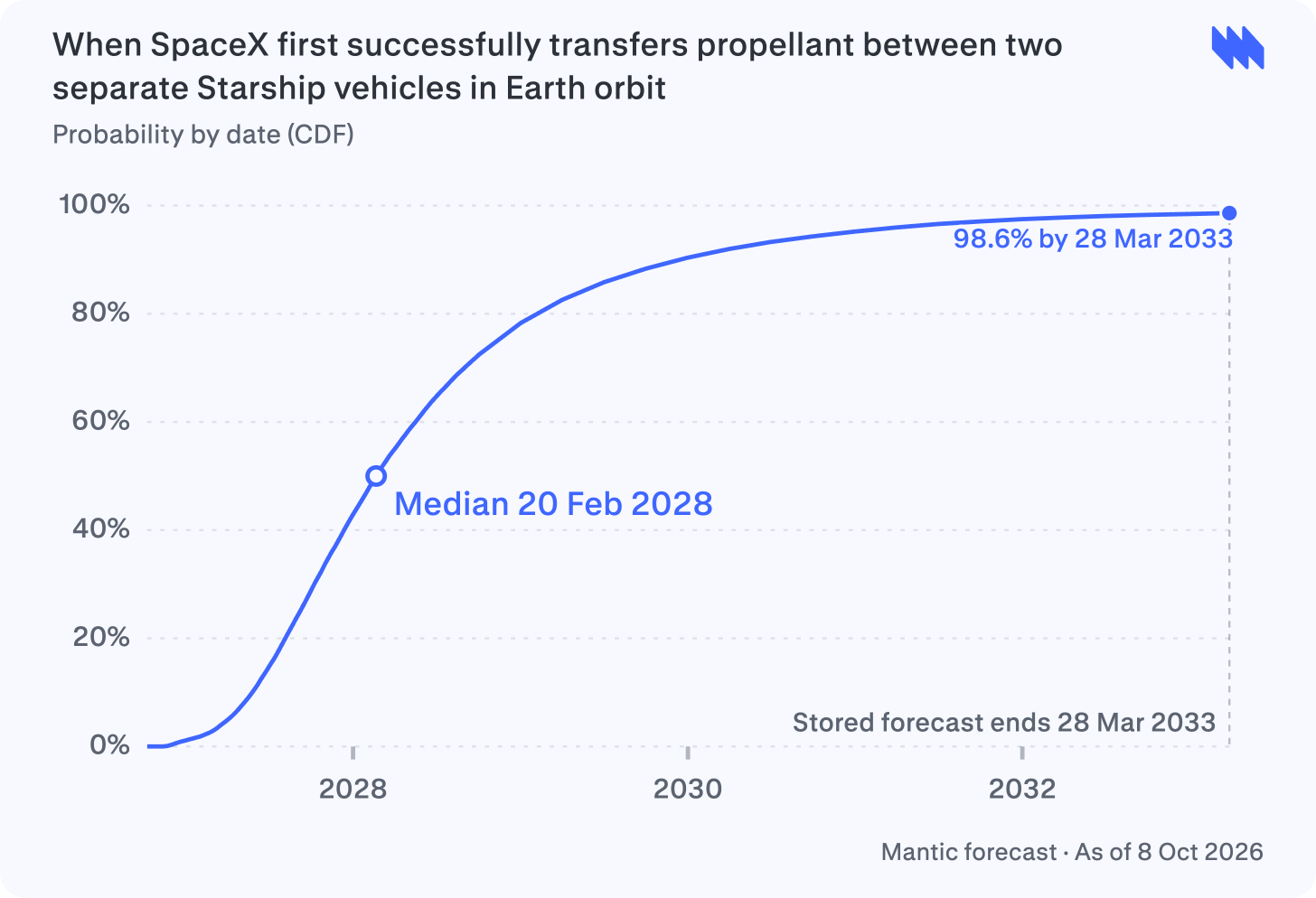
I give 20th February 2028 as my median date for the first successful transfer, and I give a 99% probability that it happens by 28th March 2033.
SpaceX’s transfer demonstration was first planned for March 2025, then March 2026, and still had no official public date by September 2026. I treated those repeated delays as evidence for a later central estimate rather than an aspirational early-2027 date.
Flight 14 was Starship’s first orbital flight, but an engine problem ended the mission after about three hours and the vehicle was lost after splashdown.8 I treated stable orbital operations and paired launches as unfinished prerequisites, reducing the probability of a qualifying transfer in the next several months.
The demonstration requires a target ship to remain in orbit for several weeks, a second launch, docking hardware and a successful fluid transfer. I therefore did not count docking alone as resolution, and I allowed failed campaigns to create further retry delays.
The end-2027 market for two-Starship docking quoted 52%, but docking is easier than successful propellant transfer and the market was thin. I used it as an upper guide rather than treating it as the probability of the event itself.
I give a 0.5% probability that the transfer never occurs, leaving a small possibility of permanent abandonment alongside the long tail of late outcomes.
4. The shareholder vote on Chandrasekaran’s re-election at Tata Sons ↗
A freeze at the Sir Ratan Tata Trust threatens the representative needed for quorum. The forecast separates a failed re-election from a shareholder vote that never happens by the January deadline. Explore on Mantic ↗
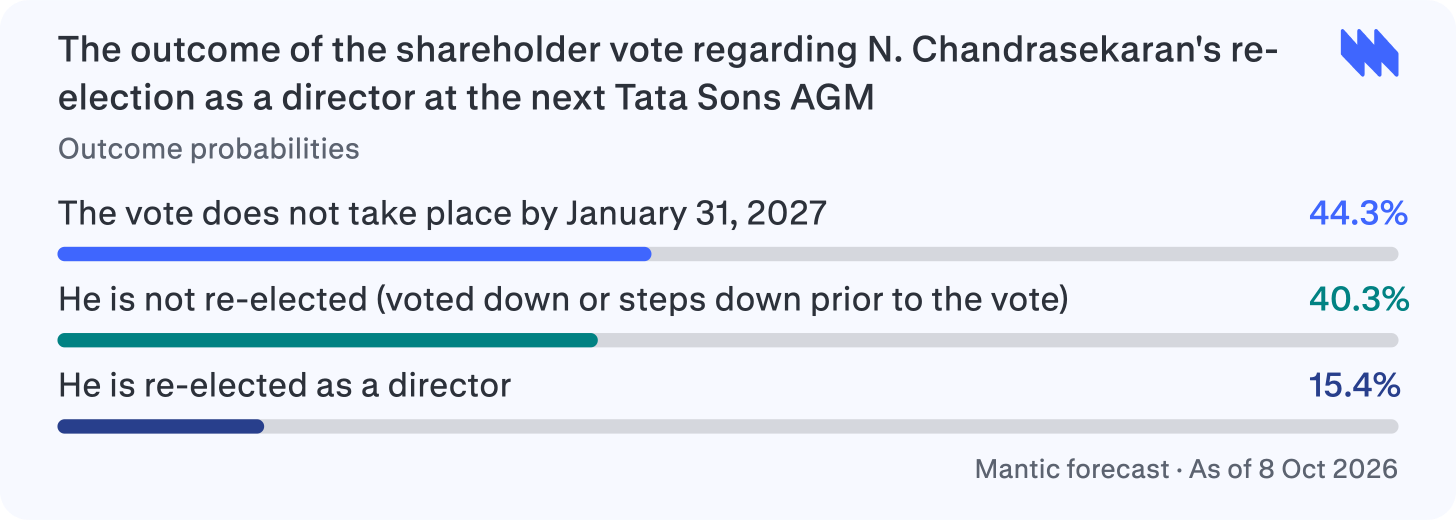
I give a 44% probability that the vote does not take place by January 31, 2027, 40% that he is not re-elected, and 15% that he is re-elected as a director.
The SRTT freeze prevents the jointly nominated representative needed for quorum, and an NCLT override was judged extremely unlikely. I therefore put the largest share on no qualifying vote by the deadline.9
If a vote occurs, I favour non-re-election because SDTT and the other trusts control about 42% against roughly 31% for the SP group and Tata companies.10 That shareholder arithmetic kept re-election low.
I retain a meaningful re-election probability because the trusts may split or abstain, and the SP group and Tata companies have uncertain voting positions.11 I also allow for a negotiated settlement that favours keeping him in office.
5. When China further tightens its rare-earth export controls ↗
Five rounds of new end-user controls in 2026 show how China can tighten rare-earth restrictions during a trade truce. This tracks fresh binding measures, rather than the return of already scheduled controls. Explore on Mantic ↗
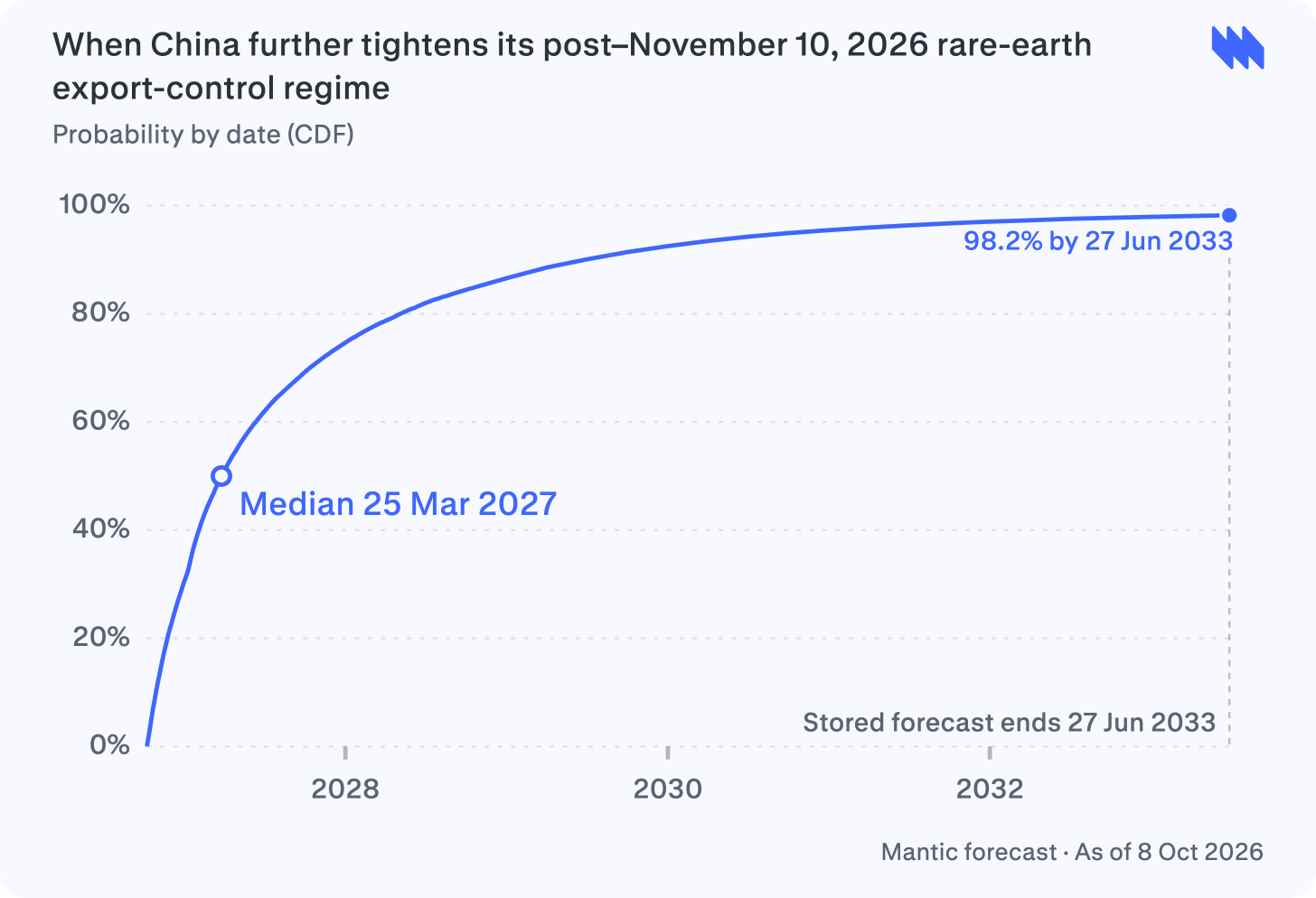
My median date for China to further tighten its rare-earth export-control regime is 25th March 2027, and I give a 98% probability of tightening by 27th June 2033.
Between February and July 2026, China added foreign entities to its export-control list in five separate rounds.12 Because these dual-use bans restrict rare earths to new end users, they drive most of my early probability.
A trade truce with the United States was extended to 10th January 2027, alongside planned leader summits in November and December.13 This diplomatic pause reduced my near-term tightening probability, shifting potential escalation into early 2027.
The October 2025 rare-earth measures, suspended until 10th November 2026, already established an extensive baseline.14 Because merely allowing that suspension to expire does not count as further tightening, I add no automatic probability to that date.
Tensions with Europe and Japan keep near-term probability meaningful despite the American truce.15 China previously imposed dual-use bans on Japanese military end users in January 2026, and European trade disputes face an October deadline.
Sources
