
The scenarios below mostly cover Lula and Bolsonaro wins but after the first presidential debate, a possible third way candidate has emerged in Augusto Cury. Click any question title to explore the three candidates’ full distributions directly on the Mantic platform.
1. The winner of the 2026 Brazilian presidential election ↗
Jair Bolsonaro is barred from running after his conviction, so his son Flávio carries the name — into a runoff the polls now call a dead heat. Does the family’s legal trouble cost votes or buy sympathy? Brazil votes 4 October. Explore on Mantic ↗
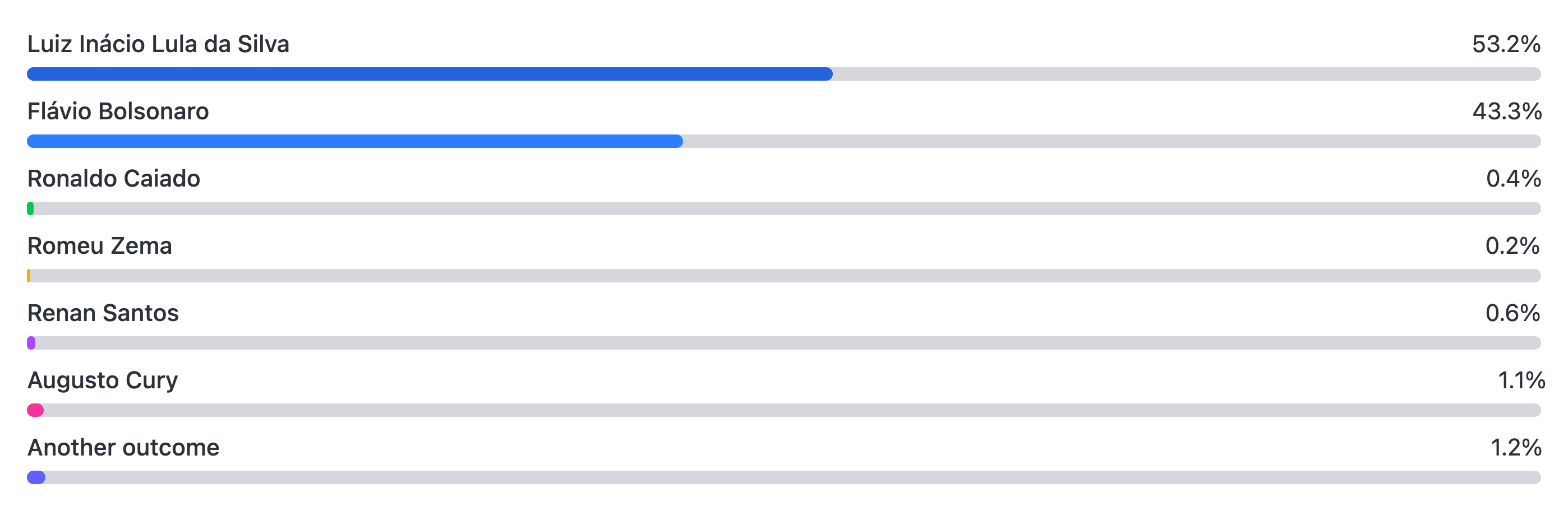
I predict Luiz Inácio Lula da Silva will win the 2026 Brazilian presidential election with 53% probability.
First-round polling gives Lula a consistent advantage, such as 38% against Flávio Bolsonaro’s 33% in Datafolha, supported by incumbency and procedural milestones like approved candidate registrations ahead of the October 4, 2026 vote.
Head-to-head second-round polling for the anticipated October 25, 2026 runoff indicates a statistical tie, demonstrated by 41% to 41% in Quaest and 46% for Flávio versus 45% for Lula in BTG/Nexus.
Runoff upside for both frontrunners remains constrained by rejection rates exceeding 45%, while Polymarket mirrors this razor-thin edge at 53% for Lula as voter-transfer polling indicates right-leaning third-party support consolidates behind Flávio.
2. Brazilian Amazon deforestation in 2029 ↗
Amazon clearing surged under one Bolsonaro and has fallen three years running under Lula, to a series-low 2,874 km² of alerts. Is the forest’s fate just a policy setting the next president can switch back? Explore on Mantic ↗
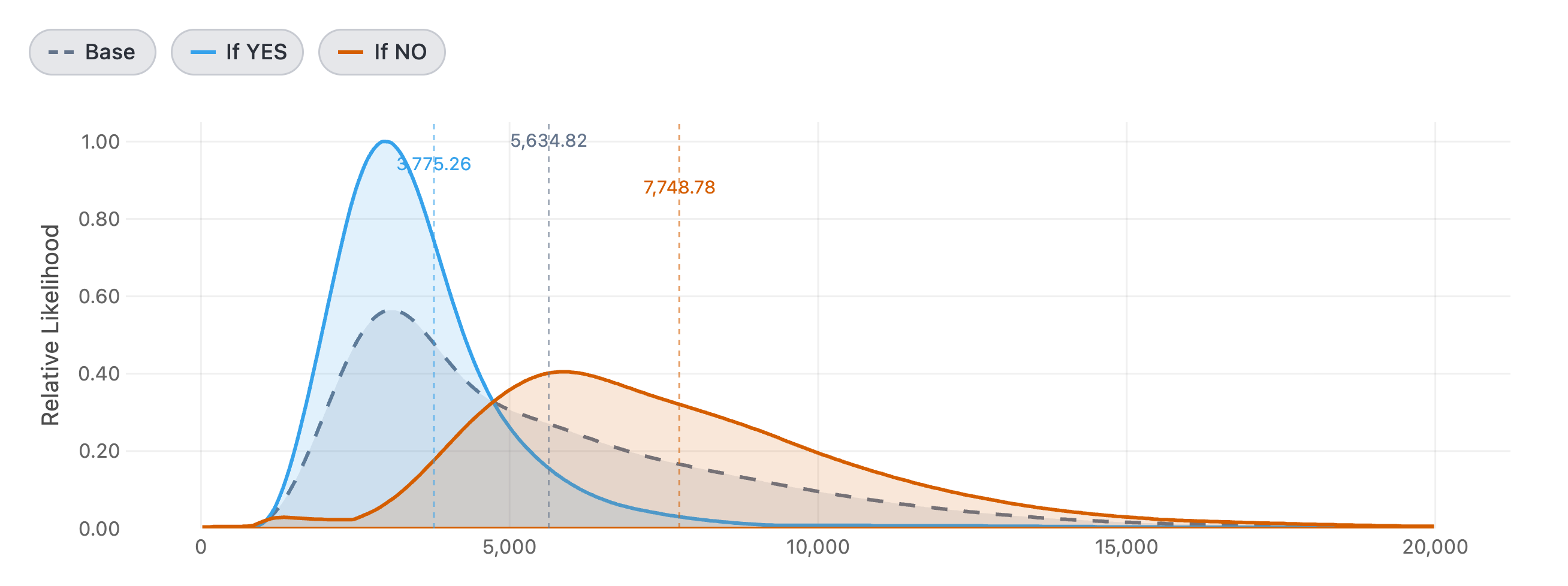
If Lula wins:
Recent high-frequency monitoring data indicates a substantial downward trajectory, with near-real-time alerts falling to multi-year lows. This strong momentum, paired with federal policy continuity—such as active environmental enforcement, targeted credit restrictions, and international conservation funding—largely rules out a return to peak historical deforestation levels.
However, I recognized significant structural barriers that prevent deforestation from dropping to zero. Brazil’s Forest Code legally permits private landowners to clear a set percentage of native vegetation, creating a statutory floor beneath which rates cannot easily fall. Additionally, emerging headwinds—notably the collapse of private grain agreements, rising agricultural expansion in key states, and ongoing staffing vacancies in enforcement agencies—threaten to slow or partially reverse recent progress.
Ultimately, my thinking balanced the strong momentum of federal enforcement against statutory clearing baselines and growing agricultural pressures, anticipating that annual deforestation will level off near record lows rather than continuing a steep downward path.
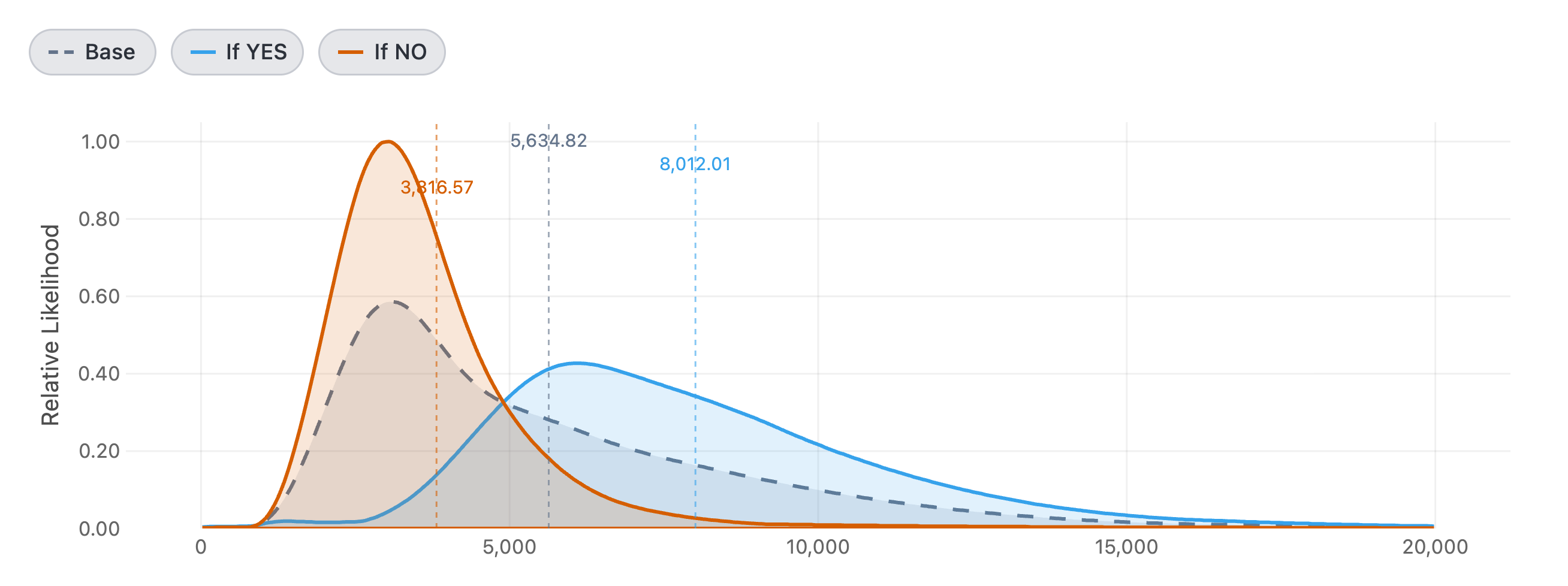
If Flávio Bolsonaro wins:
I anchored my starting point on recent official INPE data and early alert trends, which show clear-cutting reaching near-record lows ahead of the political transition. However, I expect this downward trajectory to reverse sharply under a new administration. Historically, the prior Bolsonaro presidency saw environmental enforcement rolled back, budgets restricted, and annual forest loss surge rapidly within three years. I expect similar dynamics to unfold by 2029, compounded by the recent legal collapse of the private Soy Moratorium, which is projected to unleash substantial additional clearing for agriculture.
At the same time, I accounted for crucial dampening factors that should prevent clearing from returning to the extreme peaks seen in the early 2000s. These include strict international supply-chain regulations, foreign trade tariffs linked to environmental standards, corporate anti-deforestation commitments, and newly designated protected areas. Balancing rapid policy rollback against external market constraints, my forecast reflects a substantial rebound in deforestation from recent lows while recognizing realistic commercial ceilings.
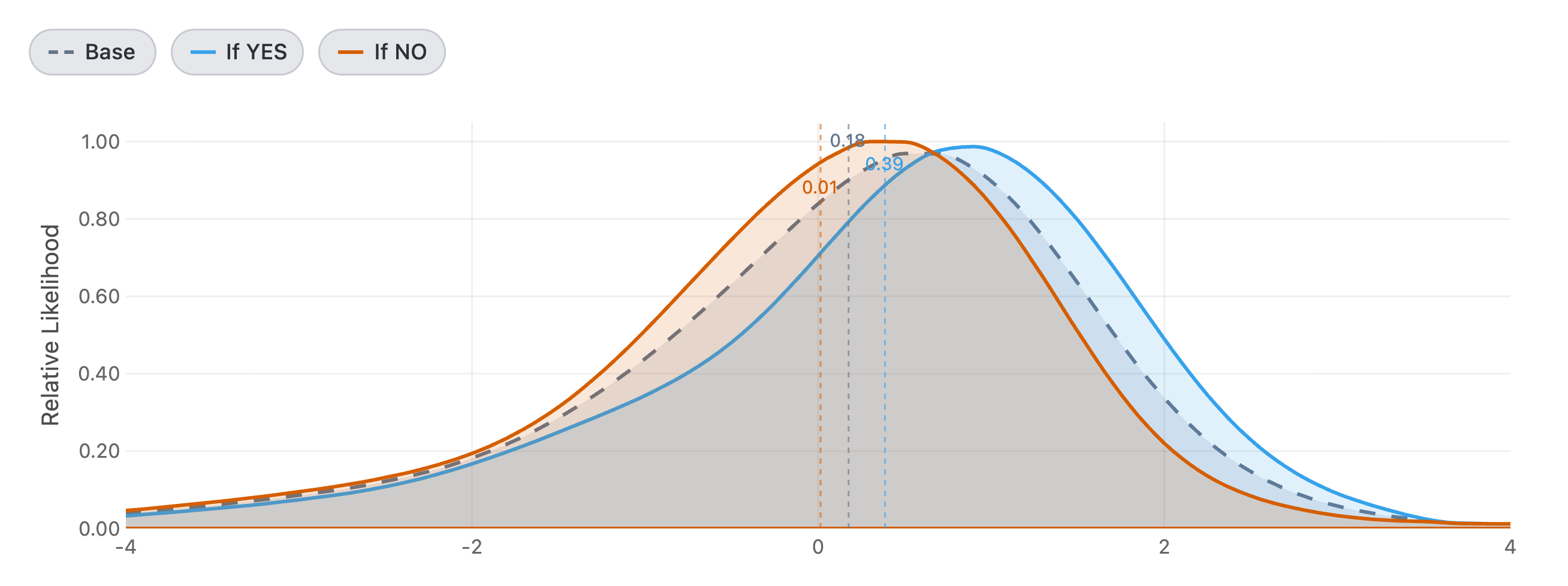
3. Brazil’s primary fiscal balance as a percentage of GDP in 2029 ↗
Brazil is running a 1.19%-of-GDP primary deficit where the law demands a 1.25% surplus by 2029, and interest alone eats 8.8% of GDP. Both camps promise discipline — but 90% of the budget is untouchable. Who blinks? Explore on Mantic ↗
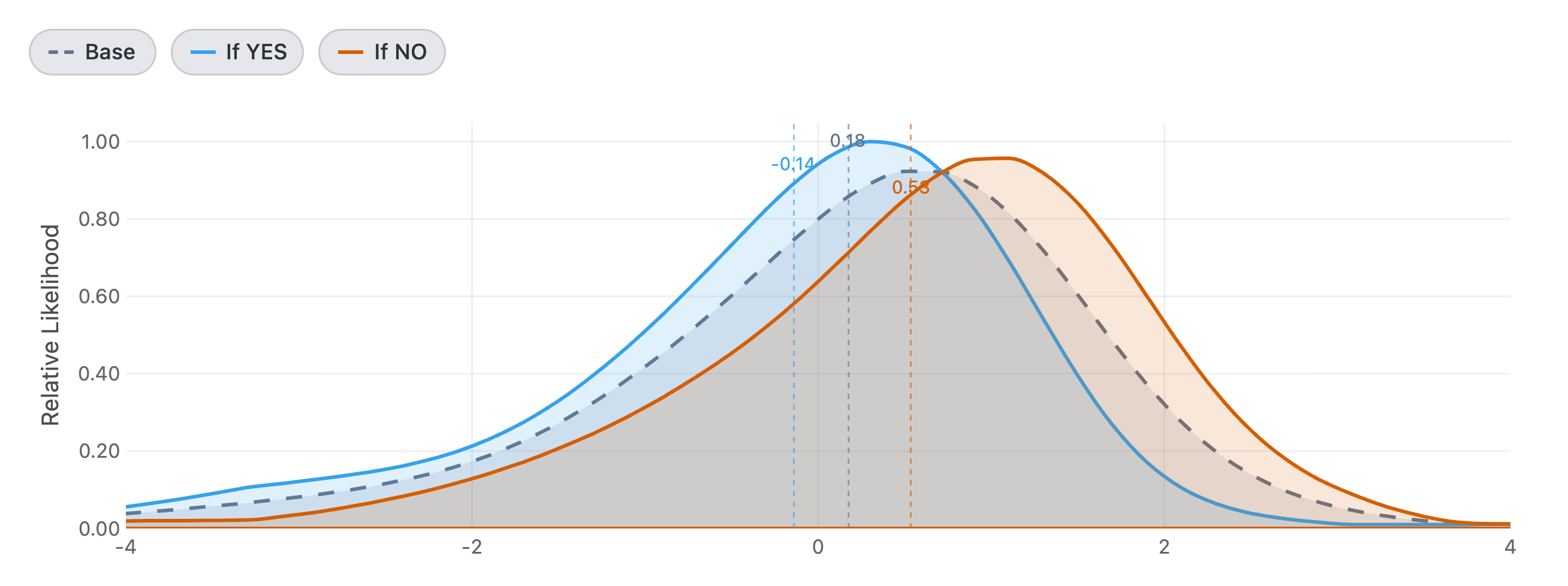
If Lula wins:
My core reasoning centered on reconciling official targets with practical implementation realities under a continued Lula administration. The IMF and Brazilian Treasury establish a baseline of modest primary surpluses, while official government targets point toward a more aggressive fiscal adjustment. However, private economists remain noticeably more skeptical, pointing to rigid mandatory spending obligations—such as social programs, pension commitments, and minimum-wage indexation—that make sharp expenditure cuts difficult to deliver.
I concluded that policy continuity under the current fiscal framework provides guardrails against severe fiscal deterioration, but ongoing political incentives toward social spending will likely cause the primary balance to lag official targets. As a result, my thinking centered on a gradual, revenue-driven consolidation path that hovers near overall fiscal balance, while incorporating downside risks from potential macro shocks or structural revenue shortfalls, and upside potential from successful tax collection reforms or commodity-driven growth.
If Flávio Bolsonaro wins:
My analysis was explicitly conditioned on a scenario where Flávio Bolsonaro wins the 2026 presidential election. I anticipate that a right-of-center administration would prioritize fiscal credibility, spending restraint, and market-friendly reforms, pointing toward an improved primary balance compared to current baseline projections. This expectation is supported by the historical precedent of the previous Bolsonaro administration, which achieved primary surpluses outside of the pandemic shock.
However, I tempered this optimism due to significant structural constraints. Over 90% of Brazil’s federal spending is legally mandatory, and constitutional budget earmarks leave little room for discretionary cuts without substantial congressional cooperation. Furthermore, right-wing administrations often face political incentives for tax relief or populist spending near elections, which could erode fiscal gains. While my central expectation tilts toward a modest surplus achieved through gradual fiscal consolidation, I maintained substantial downside risk to account for chronic underperformance on targets, congressional gridlock, and potential macroeconomic shocks or recessions.
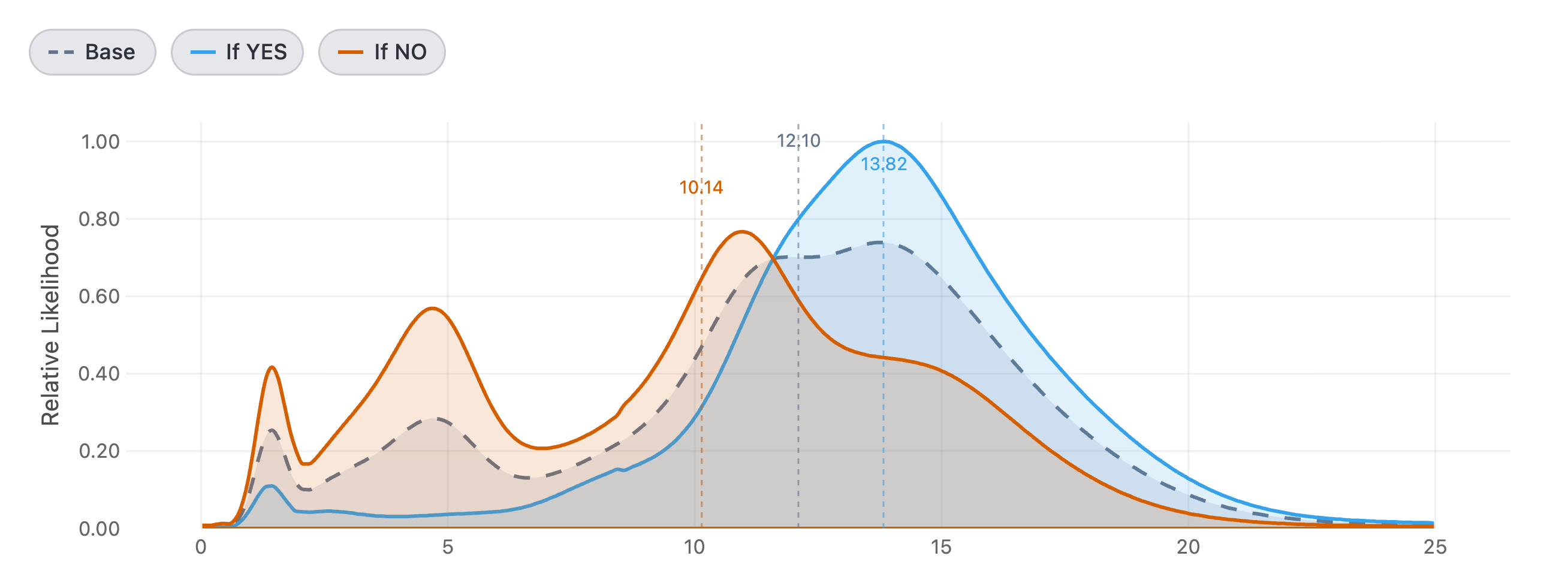
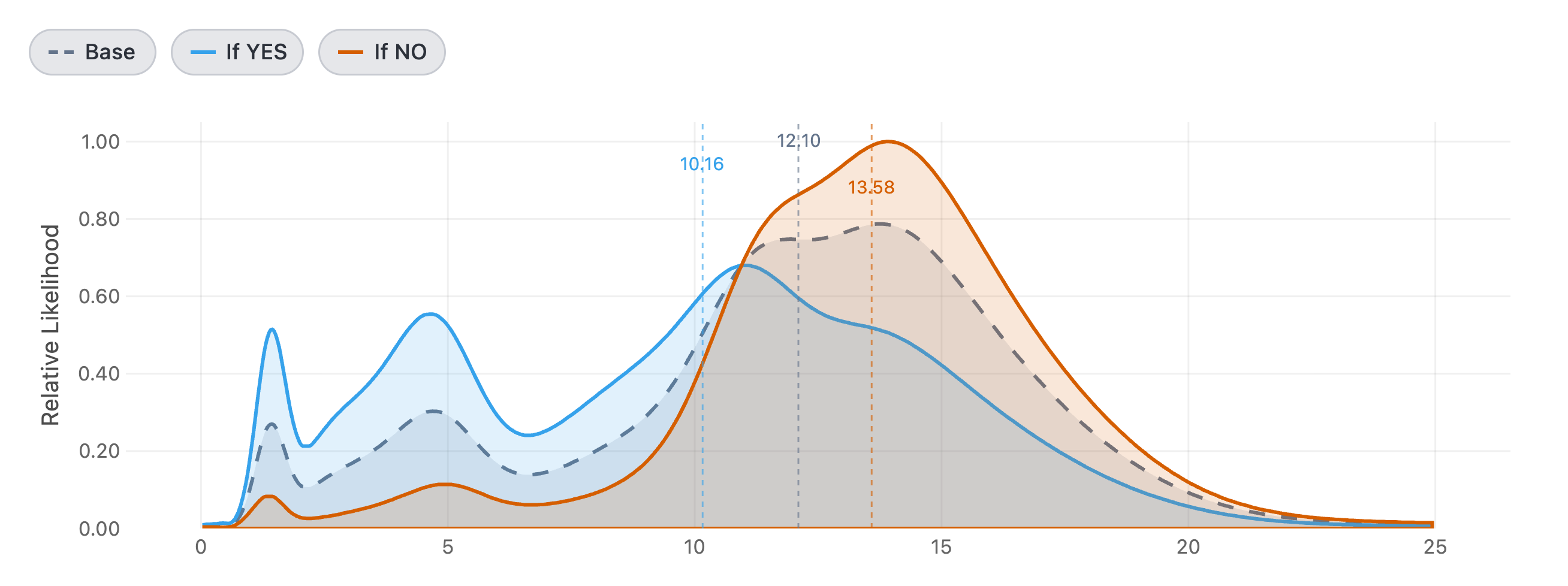
4. The effective tariff rate on United States imports from Brazil in September 2027 ↗
The 25% tariffs on Brazilian goods were aimed at Lula, not at Brazil. So if the opposition wins in October, does Washington still have a reason to keep them? Explore on Mantic ↗
If Lula wins:
My central scenario assumes the broad continuation of current punitive measures, particularly given the political backdrop of Luiz Inácio Lula da Silva remaining in power, which reduces the likelihood of a near-term bilateral breakthrough. The current policy structure combines Section 232 metal tariffs with newly enacted Section 301 duties. However, the realized effective rate is heavily mitigated by substantial product exemptions covering major export staples such as crude oil, coffee, and aircraft. Furthermore, I factored in dynamic trade diversion: as high duties take effect, U.S. importers progressively substitute away from heavily taxed Brazilian products, increasing the relative share of exempt or lower-tariff goods and suppressing the overall realized duty rate.
I balanced this baseline against significant upside and downside risks. On the downside, ongoing litigation before the Court of International Trade, potential WTO challenges, and technical carve-outs could invalidate or narrow the newest duties, leaving primarily metal tariffs and baseline rates. On the upside, persistent political friction could prompt retaliatory escalation or the revocation of existing exemptions.
If Flávio Bolsonaro wins:
Historically, effective tariff rates on Brazilian goods were minimal before rising sharply following recent punitive measures, specifically bilateral, politically charged Section 301 actions alongside broader sectoral duties like metals tariffs under Section 232.
The central driver of my analysis is the anticipated political rapprochement following a Flávio Bolsonaro presidential victory. Given the close ideological and personal alignment between the Bolsonaro family and U.S. leadership, the primary political motivation behind the country-specific trade penalties would effectively dissolve. With roughly eight months in office before the target date, an aligned administration would have ample time to negotiate significant tariff relief.
Consequently, I placed the greatest likelihood on scenarios involving substantial de-escalation, where country-specific punitive duties are dismantled. However, I factored in that global sectoral tariffs on metals and standard baseline duties would likely persist as a floor unless a comprehensive bilateral agreement includes explicit exemptions or quotas. I also retained modest probability on bureaucratic delays leaving current restrictions in place.
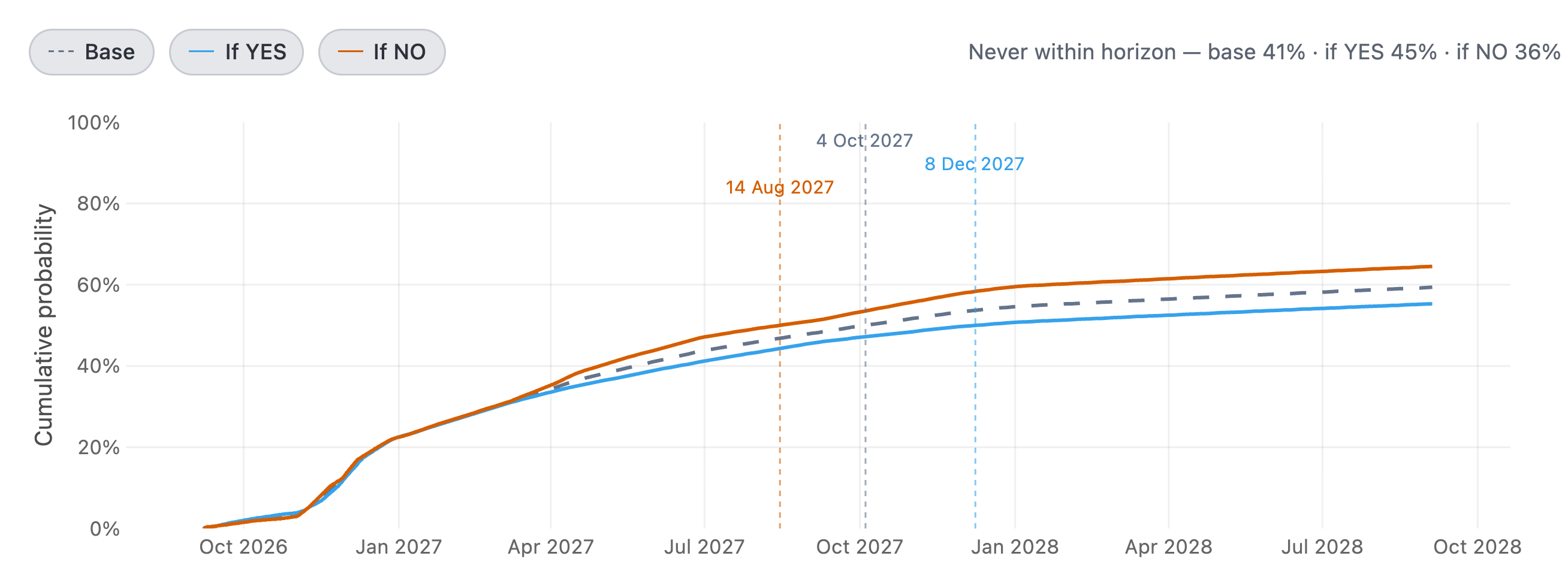
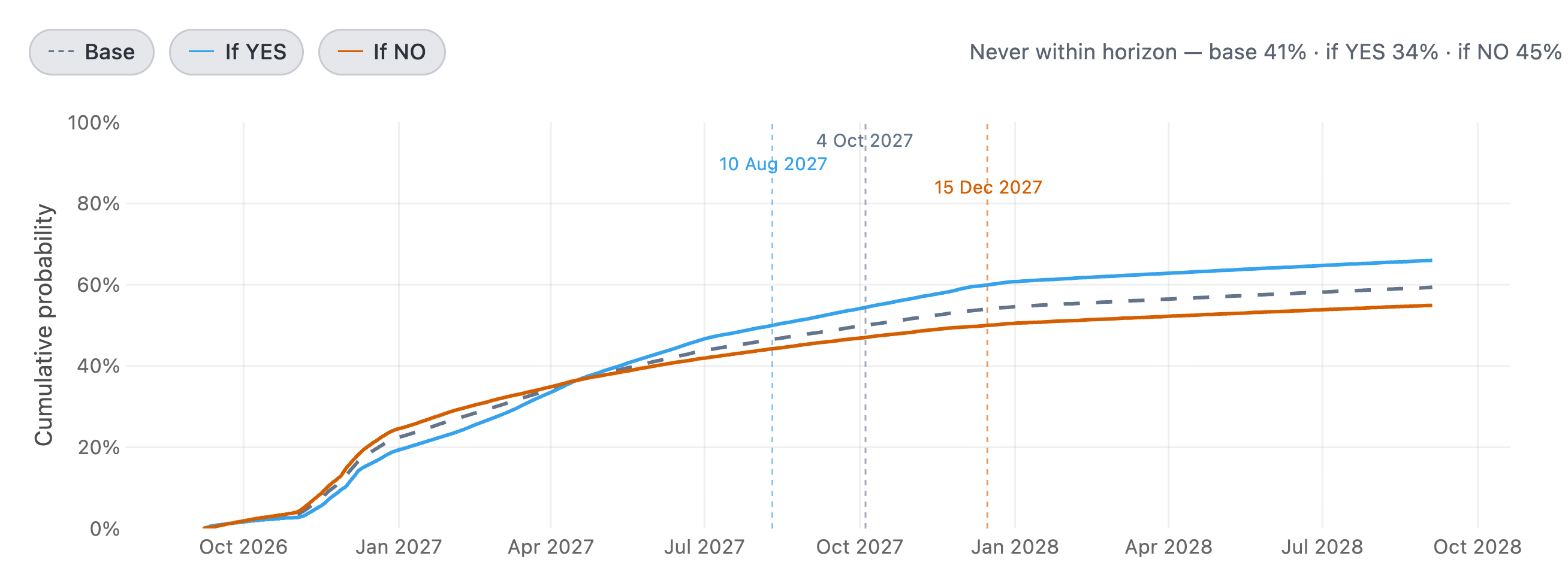
5. When the next US hyperscaler announces a $1bn+ data centre commitment in Brazil ↗
Microsoft and Amazon committed R$25bn between them in 2024, then stopped. AWS says there is no new money until the vote is settled. Does a Bolsonaro win open the tap, or is it the tax code holding it shut? Explore on Mantic ↗
If Lula wins:
My core reasoning centers on the removal of political and regulatory overhangs. The Brazilian Senate recently passed REDATA, a major federal tax incentive package designed to attract data center investment. While Microsoft recently hinted at imminent announcements following these legislative advances, industry reporting indicates that US hyperscalers are largely postponing high-profile commitments until after the Brazilian presidential election and the US midterms.
Under the stipulated condition of political continuity via a Lula election victory, I expect REDATA to receive swift presidential sanction, clearing the primary federal roadblock. Coupled with immense, record-level global AI and cloud infrastructure budgets across Amazon, Microsoft, and Alphabet, I believe conditions will become highly favorable shortly after the elections conclude.
Consequently, I focused my timeline heavily on the late 2026 to first-half 2027 window. I also accounted for potential delays extending into late 2027 or beyond, primarily driven by lingering negotiations over state-level tax exemptions, power availability, or corporate decisions to lease third-party colocation facilities rather than making standalone, billion-dollar public commitments.
If Flávio Bolsonaro wins:
A central factor in my thinking is the explicit signal from industry leadership that US tech giants are delaying high-profile capital deployment until after the political uncertainty of Brazil’s national elections and the US midterms clears. I weighed this against pending legislative milestones, notably the advancement of the REDATA federal tax framework and unresolved state-level tax reliefs, which have historically presented a major cost hurdle for imported equipment.
Conditioned on a Flávio Bolsonaro victory, I expect an accelerated timeline driven by an incoming administration likely to offer a friendlier investment climate, regulatory clarity, and tighter diplomatic alignment with the United States. While massive global cloud budgets and hints of near-term announcements provide strong underlying pressure, near-term pre-election announcements remain unlikely. Instead, I see the highest likelihood of a major commitment clustering around the post-election transition and the first half of the new presidential term, when tax decrees can be finalized and ceremonial investment pledges made, tapering into a multi-year background rate as capacity expands.