

Friday Forecasts is a weekly series showcasing 5 forecasts directly from Mantic, which you can explore on the Mantic platform with the direct link in the question titles.
1. The next sworn-in prime minister of Israel ↗
Eizenkot leads Netanyahu 45%–33% in preferred-PM polling, but winning the coalition talks is another matter. Arab seats and conscription disputes could decide who takes office. Explore on Mantic ↗
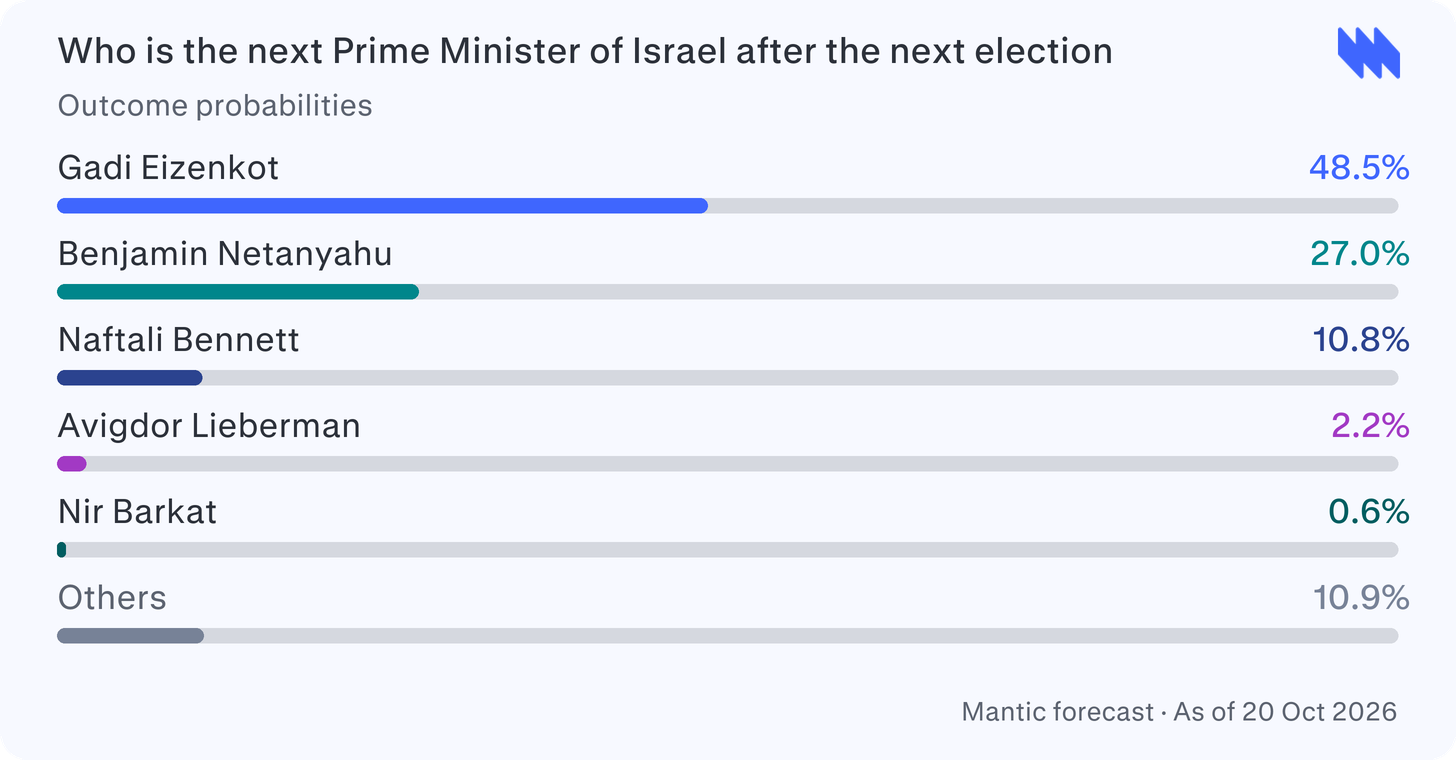
Channel 12’s 19 October poll gave Eizenkot a 45%–33% lead over Netanyahu for preferred prime minister. I therefore favour Eizenkot, but neither bloc polled a majority.1
Lieberman rejected a minority government, and the Reservists party and ultra-Orthodox parties set conflicting conscription conditions. I therefore limit Eizenkot’s ability to turn his polling lead into a government.2
I modestly increase Netanyahu’s prospects on The New Arab’s unconfirmed proposal for him to lead a unity government first. I also allow Bennett and Lieberman to win through compromise bargaining.3
I allow coalition vetoes to persist across repeat elections. That raises “Other” mainly through the risk that no prime minister is formally sworn in by 31 December 2027.
How Arab-list seats change the result
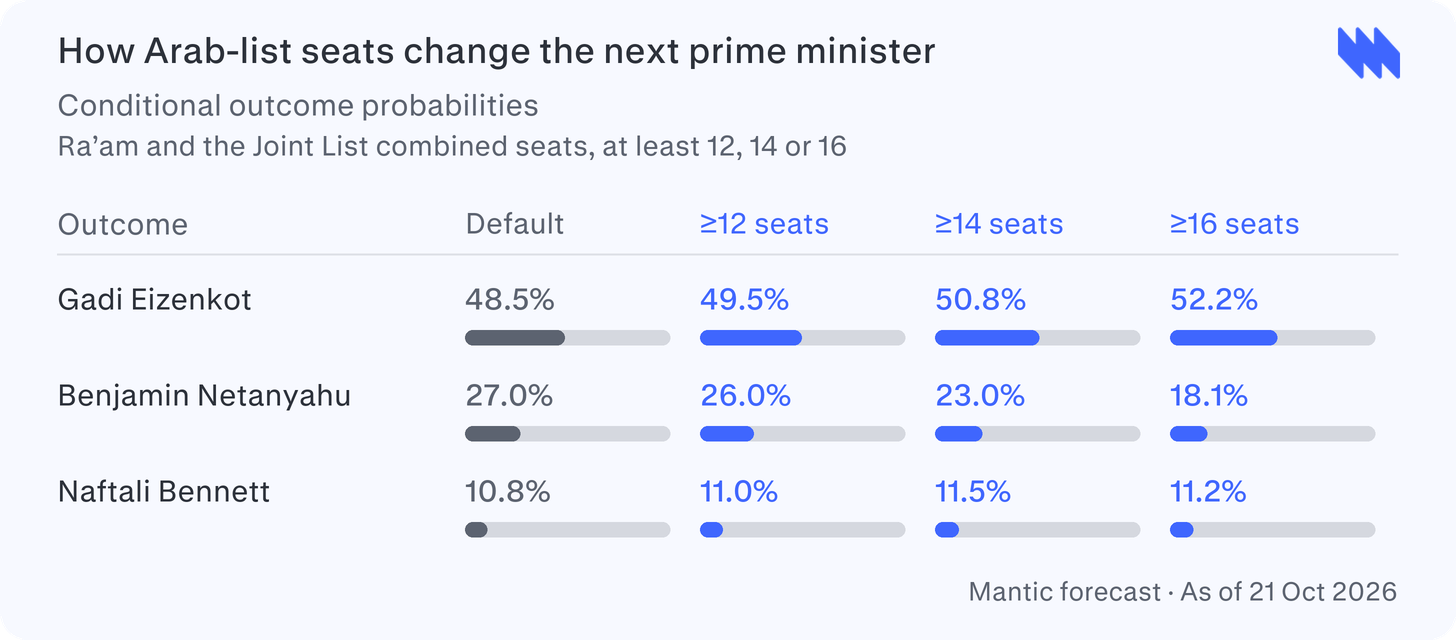
Winning at least 12 seats rules out scenarios where low Arab turnout or threshold failures expand Jewish-party representation, which is Netanyahu’s best route to a 61-seat majority.
Preserving a substantial Arab seat count keeps open the option of an opposition-led minority government supported or enabled by Arab party abstentions, supporting Eizenkot’s path to office.
Opposition government formation remains difficult because Avigdor Lieberman refuses to back a minority government relying on Arab or Haredi parties. Shas and United Torah Judaism may also withhold endorsements.
2. Development of the E1 settlement in the West Bank on 1 January 2030 ↗
E1’s 3,401 approved homes could become a building site or stay on paper. Netanyahu backs the project while Eizenkot has called it a mistake. Explore on Mantic ↗
If Netanyahu is the next prime minister
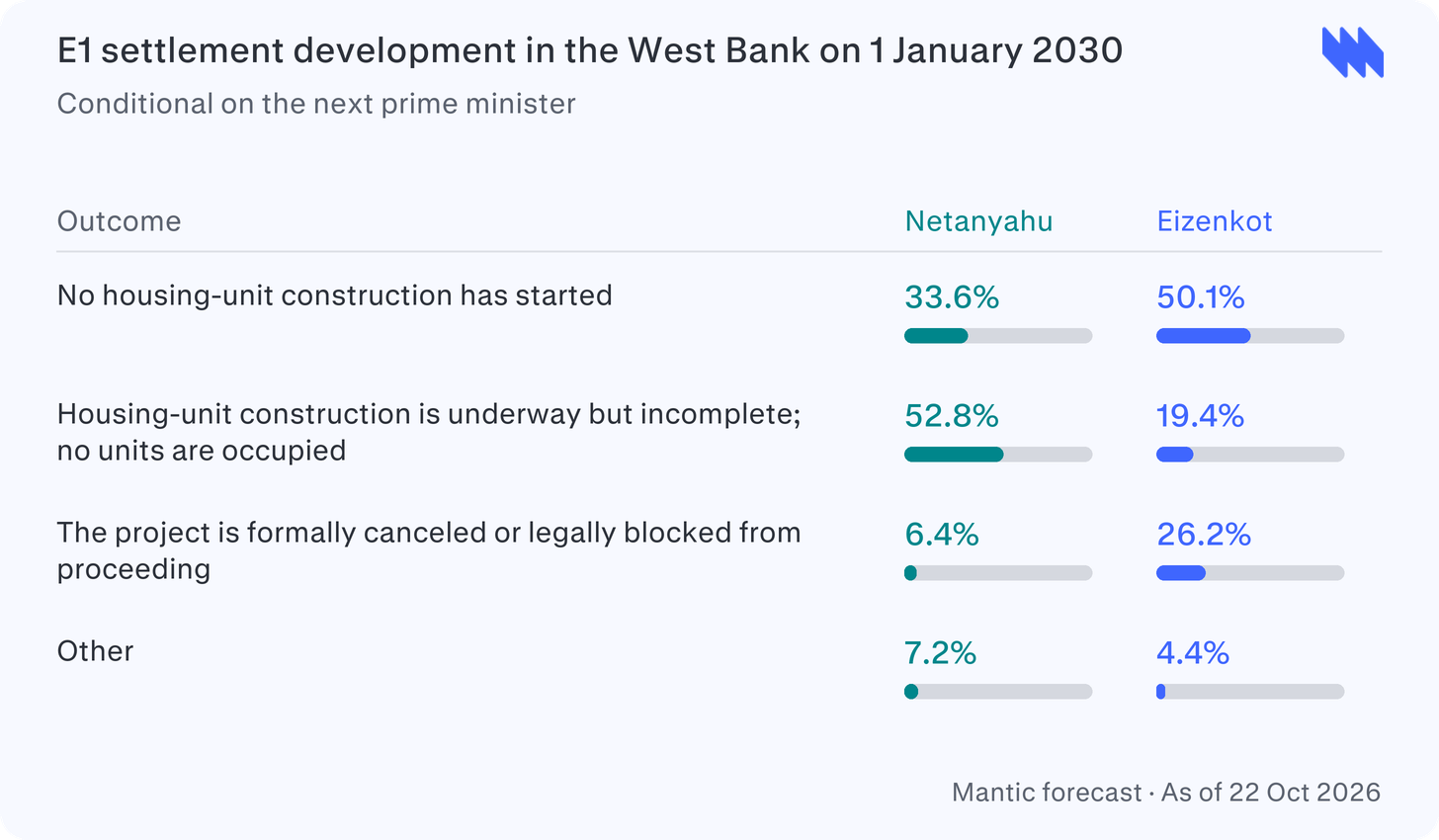
If Benjamin Netanyahu is the next Prime Minister of Israel after the next election, I raise the probability that housing construction is underway without occupied units to 53%, up 20 points from 33%. I lower the probability of no construction starting to 34%, down 11 points from 45%, and formal cancellation or a legal block to 6%, down 11 points from 17%.
Under Netanyahu, strong government backing makes formal cancellation or an intentional freeze unlikely. Without this assumption, the possibility of an opposition-led government accounts for substantial cancellation and freeze risk.
With approved plans and tenders issued for over 3,400 units, alongside NIS 3 billion allocated for infrastructure, building work is likely to advance. Because contracting, permits and site preparation take two to three years after tender awards, active construction is far more likely by 2030 than completed housing.
I still put a 34% probability on no residential construction starting. Sanctions powers created by the UK, EU warnings, bank financing reluctance, and pending court petitions could still delay building past 2030.
If Eizenkot is the next prime minister
If Gadi Eizenkot is the next Prime Minister of Israel after the next election, I put the probability that no housing construction has started at 50%, up 5 points, and formal cancellation or a legal block at 26%, up 9 points, while construction being underway falls 14 points to 19%.
Without this assumption, the election was open among several candidates. Eizenkot has publicly described E1 as a mistake and reportedly favoured cancelling construction, so assuming his premiership overrides expectations of active government promotion.4
Bids for over 1,200 units were submitted in October 2026, but the bid opening was postponed until after the election. Because contracts are not yet awarded, an incoming government can freeze procurement quietly, leaving no residential construction started.5
A formal cancellation requires an explicit government decision or a binding ruling on pending court challenges. Meanwhile, UK and European Union sanctions warnings further discourage developers and banks from proceeding.6
3. When Israel next strikes Iranian oil or gas facilities ↗
Iranian energy facilities are already proven targets. Netanyahu offers continuity in strike planning; Eizenkot could favour restraint, with oil prices a US concern. Explore on Mantic ↗
If Netanyahu is the next prime minister
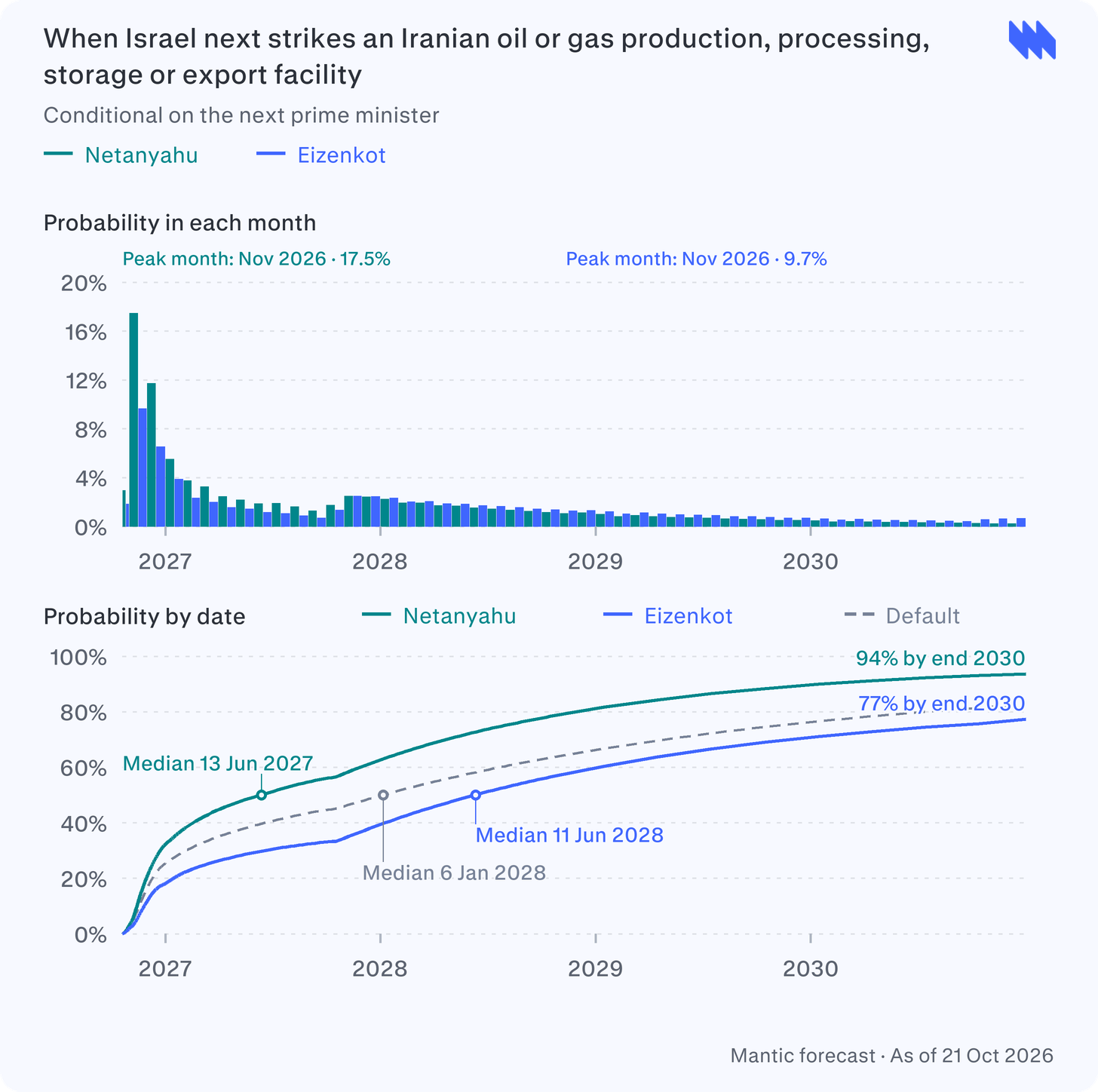
If Benjamin Netanyahu is the next Prime Minister of Israel after the next election, I put the median date at 13 June 2027, 207 days earlier than 6 January 2028, and the probability of a strike by 6 October 2036 rises by 4 points to 98%.
Netanyahu retaining office removes the prospect of leadership turnover, preserving continuity in offensive military planning and raising the likelihood of renewed strikes after the elections.
Deliberate targeting of commercial energy infrastructure is a demonstrated precedent from the 2026 war, when Israel struck fuel storage and South Pars gas facilities.7
Restraint before the 3 November US midterms suppresses immediate action, while Iranian retaliation threats and US concerns over oil prices preserve paths where fighting avoids commercial energy facilities.8
If Eizenkot is the next prime minister
If Gadi Eizenkot becomes the next prime minister of Israel after the next election, I put the median date at 11 June 2028, 157 days later than 6 January 2028. The probability of a strike by 6 October 2036 rises by 1 point to 95%.
An Eizenkot government taking office after coalition negotiations is expected to align more closely with US preferences and avoid strikes on commercial energy infrastructure, lowering strike rates from 2027.
Netanyahu would remain caretaker prime minister during coalition talks until mid-to-late December 2026. While reported post-election plans include energy targets, a transition government is expected to exercise restraint.9
Prior strikes on South Pars confirm that energy infrastructure remains an actionable target. The assumption delays action rather than eliminating the threat, keeping the ten-year probability high compared to scenarios with lasting diplomatic deals.10
4. When Israel launches a new brigade-scale offensive into Hamas-held Gaza ↗
Both candidates want Hamas disarmed, but Netanyahu’s coalition favours coercion; Eizenkot offers diplomacy more time, with another offensive still a fallback. Explore on Mantic ↗
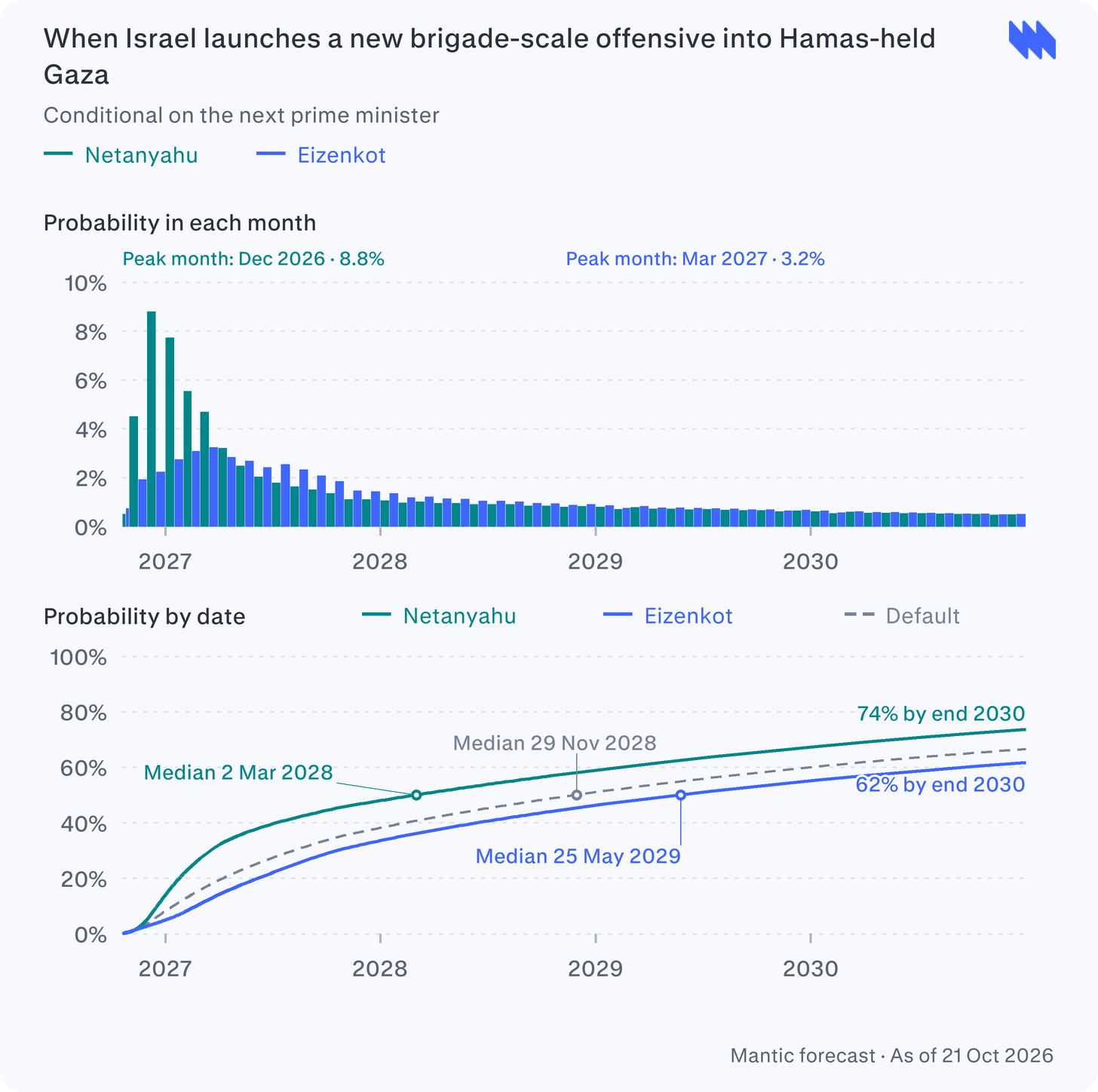
If Netanyahu is the next prime minister
If Benjamin Netanyahu is the next Prime Minister after the election, I put the median date at 2 March 2028, 272 days earlier than 29 November 2028. The probability of an offensive by 6 October 2036 rises by 8 points to 91%.
Netanyahu staying in office locks in a hawkish coalition that insists on complete Hamas disarmament before any Israeli withdrawal. This shifts the focus towards coercive ground operations rather than diplomatic roadmaps.
Israeli defence assessments indicate that Gaza is closer to escalation than reconstruction as Hamas rearms. This increases the likelihood of renewed military operations once a government is established.11
An immediate ground campaign is restrained by a full year of ceasefire holding without full-scale operations, coalition-building delays, and diplomatic understandings with the United States regarding reconstruction.12
If Eizenkot is the next prime minister
If Gadi Eizenkot is the next Prime Minister of Israel after the next election, I put the median date at 25 May 2029, 177 days later than 29 November 2028, and the probability of an offensive by 6 October 2036 falls by 5 points to 78%.
An Eizenkot premiership widens the opening for the US-backed peace plan, shifting focus towards reconstruction, an international stabilisation force and weapons-handover talks instead of an immediate ground war.13
Coalition negotiations and initial policy reviews would take months, suppressing near-term escalation while Benjamin Netanyahu remains caretaker Prime Minister.
Eizenkot pledged to end Hamas rule within 18 months through diplomacy or creative military operations. Under his leadership, a qualifying offensive remains a delayed contingency if disarmament talks fail.14
5. When Israel and Saudi Arabia establish diplomatic relations ↗
After significant progress until the October 7 attacks, normalisation now looks like a far away prospect. Both candidates reject Palestinian statehood, so replacing Netanyahu is not a complete game changer. Explore on Mantic ↗
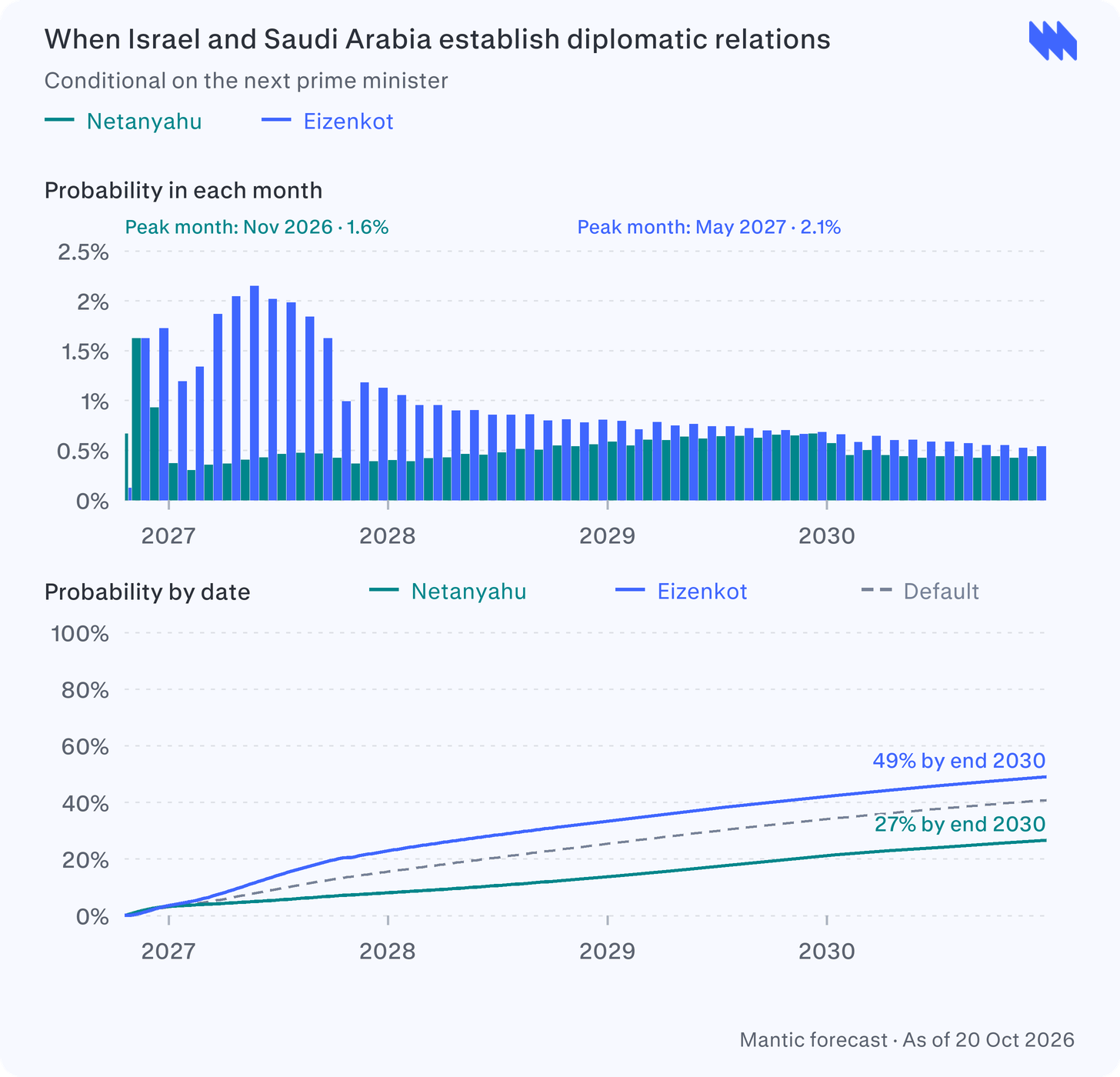
If Netanyahu is the next prime minister
If Benjamin Netanyahu is the next prime minister after the next election, the probability of establishing diplomatic relations by 6 October 2036 falls by 11 points to 49%.
Saudi Arabia continues to condition diplomatic relations on an independent Palestinian state and Israeli withdrawal from Gaza. Another Netanyahu-led coalition makes concessions toward Palestinian statehood very unlikely.15
Reuters reported that Israel controls about two-thirds of Gaza and the disarmament roadmap has stalled. That deadlock extends the expected political blockage before any diplomatic agreement can occur.16
The United States submitted a civil nuclear-cooperation pact to Congress that depends on Saudi normalisation with Israel. That leverage preserves a modest probability of a security-driven agreement.17
If Eizenkot is the next prime minister
If Gadi Eizenkot is the next Prime Minister of Israel after the next election, I put the median date at 28 February 2031, 657 days earlier than 16 December 2032, and the probability of diplomatic relations by 6 October 2036 rises by 7 points to 67%.
An Eizenkot premiership removes a Netanyahu government as an obstacle and creates a more viable opening for negotiations. US pressure linking a civil nuclear agreement to normalisation provides additional momentum.
However, Saudi Arabia continues to condition diplomatic relations on a credible path to Palestinian statehood and Israeli withdrawal from Gaza. Eizenkot has also publicly rejected a Palestinian state, so this obstacle remains.
In addition, the Gaza disarmament roadmap remains stalled. The time required to form a coalition and implement an agreement keeps most of the likelihood beyond the near term.
Source: en.wikipedia.org
Source: al-monitor.com
Source: thehindu.com
Source: al-monitor.com
