

Friday Forecasts is a weekly series showcasing 5 forecasts directly from Mantic, which you can explore on the Mantic platform with the direct link in the question titles.
1. Marine Le Pen’s vote share in the second round of the 2027 French presidential election ↗
After her judgement was overturned, Marine Le Pen said she would be the presidential candidate for the Rassemblement National. Explore on Mantic ↗
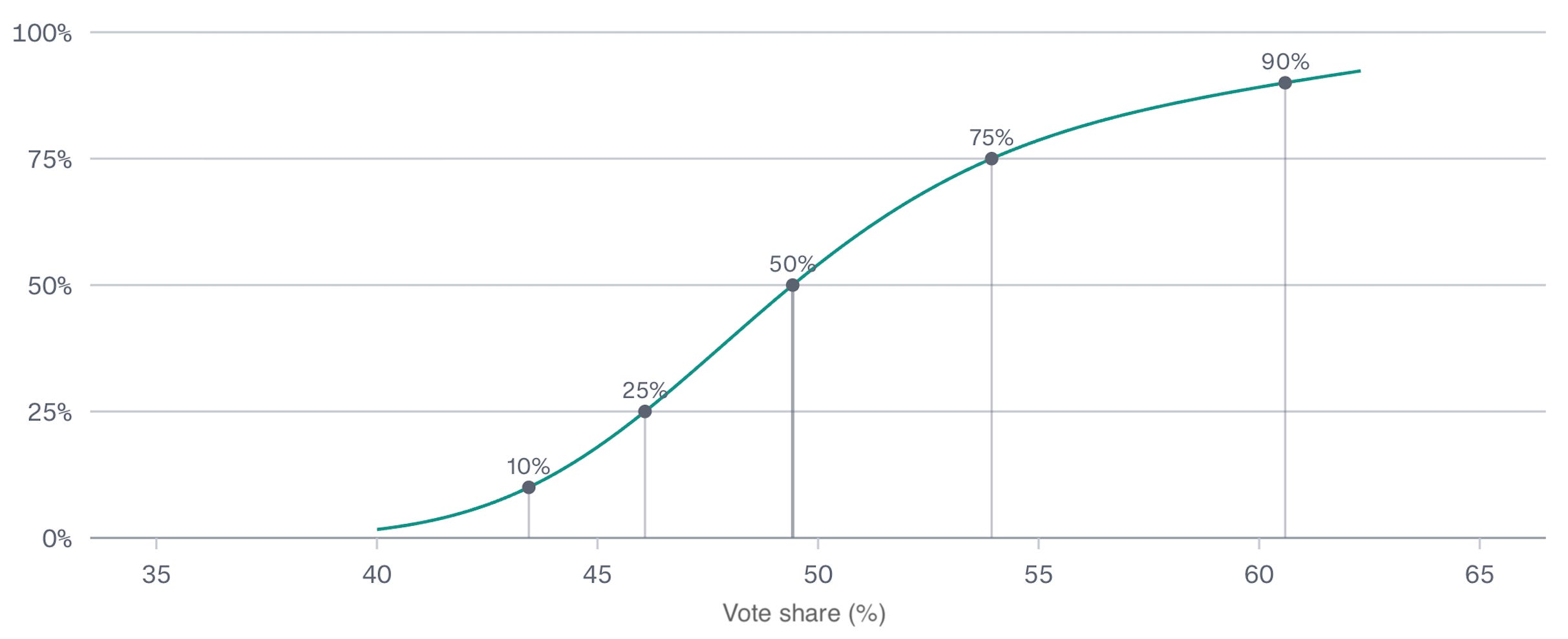
I observe that current polling consistently places her in a winning position against centrist opponents at 51% to 54%, supported by expansion into historically resistant retiree and executive demographics.
I incorporate a significant fade factor because the ‘republican front’ consolidation typically triggers a late decline for the far-right, aligning with Polymarket’s lower implied win probability.
Structural dissatisfaction remains a primary driver, as 84% of voters distrust political parties and economic anxiety persists among middle-class voters.
I highlight critical risks including a pending Cour de Cassation ruling on her eligibility and potential campaign financing failures.
2. Marine Le Pen’s vote share in the second round of the presidential election conditional on her opponent ↗
Marine Le Pen’s score shifts depending on her opponent in the second round of the presidential election. Below are Philippe, Mélenchon and Attal. Explore on Mantic ↗
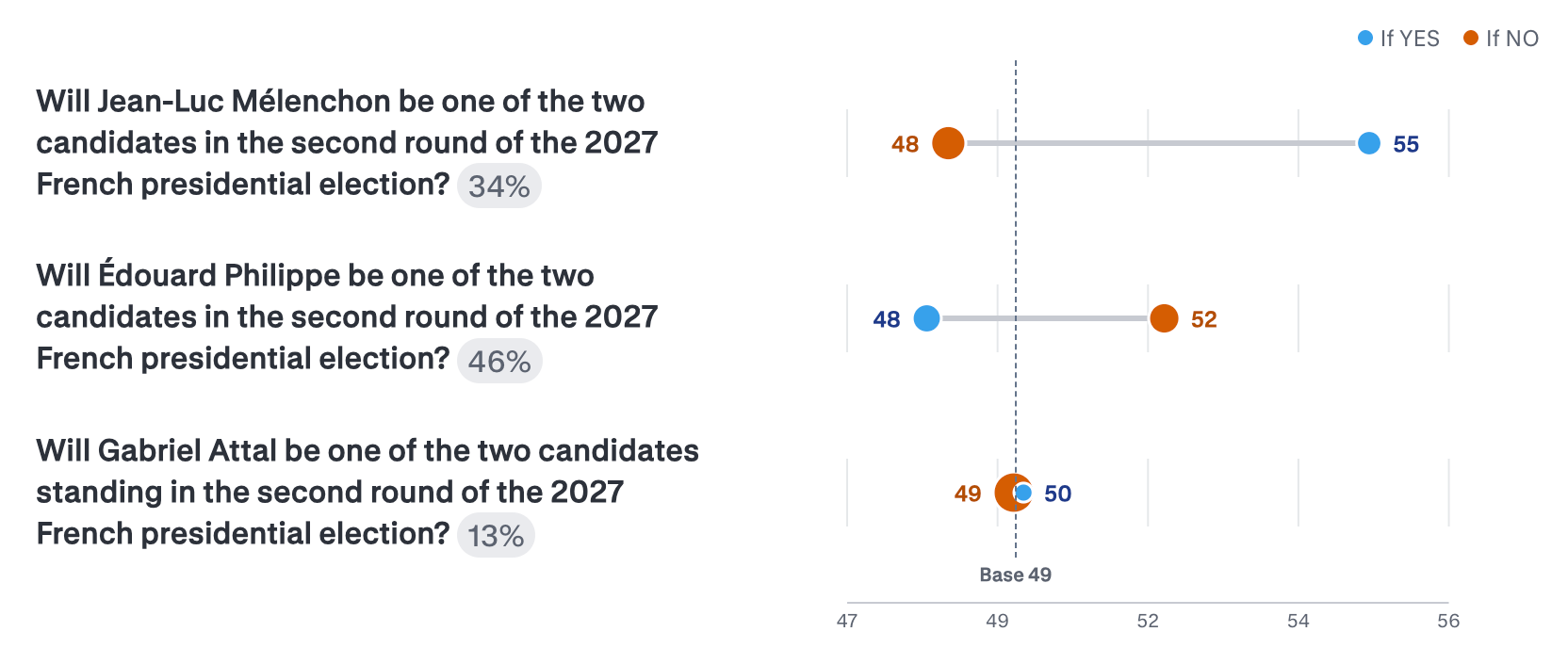
Le Pen v Mélenchon: Le Pen 55%
The most critical factor in my thinking was the expected breakdown of the traditional “republican front”—the historical tendency for mainstream voters to unite against the far-right. In a contest against the far-left, my research suggests this defensive alliance would likely collapse.
I found that many centrist and right-wing voters, who previously voted to block Le Pen, now view her opponent with equal or greater skepticism. In this specific pairing, these voters are much more likely to abstain or switch their support to Le Pen rather than back a far-left candidate.
Le Pen v Philippe: Le Pen 48%
I relied heavily on polling from mid-2026, which shows Le Pen in a significantly stronger position than in previous election cycles, often leading her opponent in hypothetical matchups. This reflects a “rising floor” of support fueled by widespread political distrust, economic dissatisfaction, and the normalization of her party.
Because Philippe is viewed as a relatively popular, stable centrist, I anticipated he would be more effective at attracting tactical votes from the left and center-right than other potential candidates.
Le Pen v Attal: Le Pen 50%
I considered the “normalization” of the National Rally and a clear upward trajectory in Le Pen’s previous second-round performances. Current head-to-head polling shows her in a significantly stronger position than in previous cycles, fueled by high levels of political distrust and economic dissatisfaction.
I adjusted for the historical “polling fade” observed in past French elections. I accounted for the likely reactivation of the “Republican Front”—the traditional mobilization of voters from the left and center-right to block the far-right in the final round.
3. When the next US government shutdown begins ↗
Federal funding expires at the end of September, but with the midterms only weeks away neither party wants to own a shutdown. Is that enough to avoid it? Explore on Mantic ↗
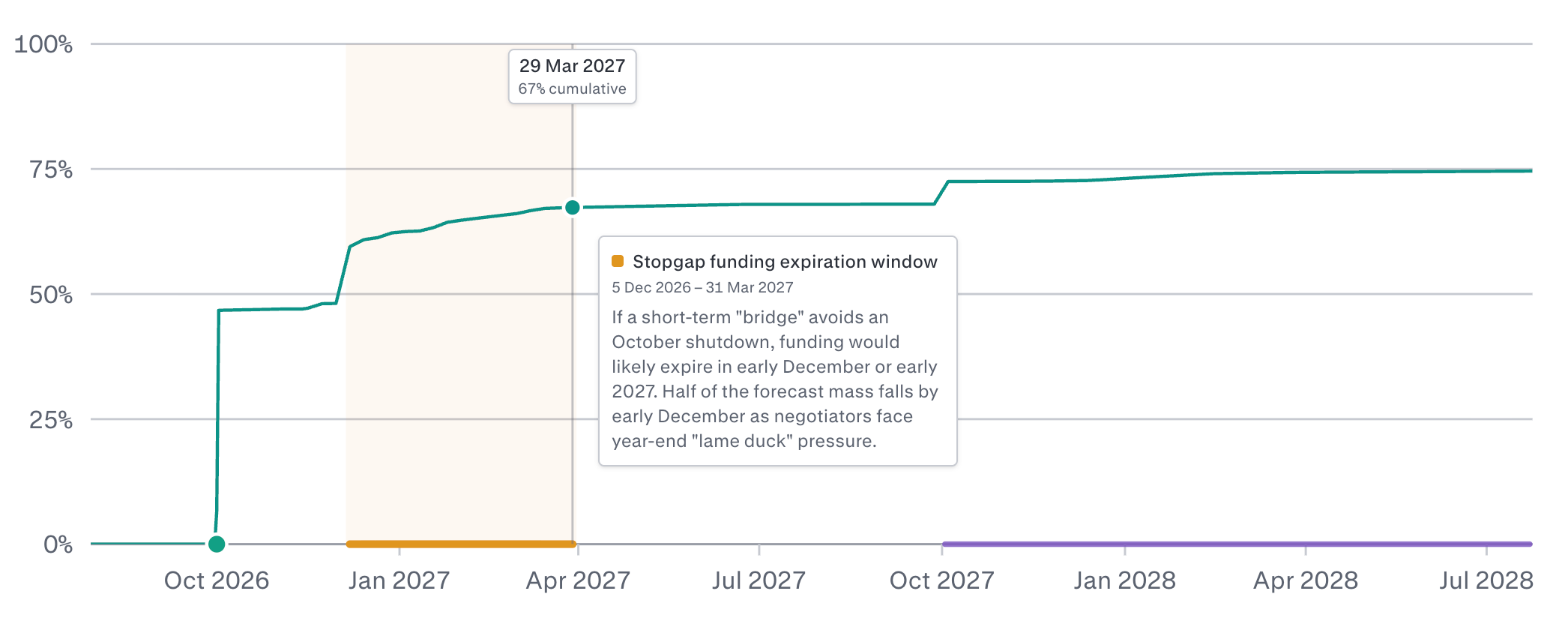
My median prediction for the next US government shutdown to begin is December 1, 2026.
While federal funding is scheduled to expire at midnight on September 30, 2026, I anticipate a short-term bridge will be passed to avoid political backlash before the November midterm elections. However, the House-passed continuing resolution only extends through December 4, meaning the highest risk of a lapse occurs during the post-election lame duck session when partisan leverage increases.
I identify the primary legislative deadlock as the demand for the SAVE America Act and disputes over defense supplemental funding. With only 11 overlapping session days remaining in September, there is insufficient time to resolve these fundamental policy differences permanently.
This forecast is supported by the 119th Congress’s historical propensity for funding lapses, including a 43-day shutdown and a 76-day partial shutdown earlier in this session. The lack of 50 votes for a Senate GOP reconciliation fallback further limits the paths to averting a December closure.
4. The EU aggregate gas storage fill level on 1 November 2026 ↗
Europe went into the summer with tanks at a record-low 28% and the refill has been slow ever since, with the Hormuz disruption halving Middle Eastern LNG. Brussels has already cut its target to 80%, so where do the tanks actually land on 1 November? Explore on Mantic ↗
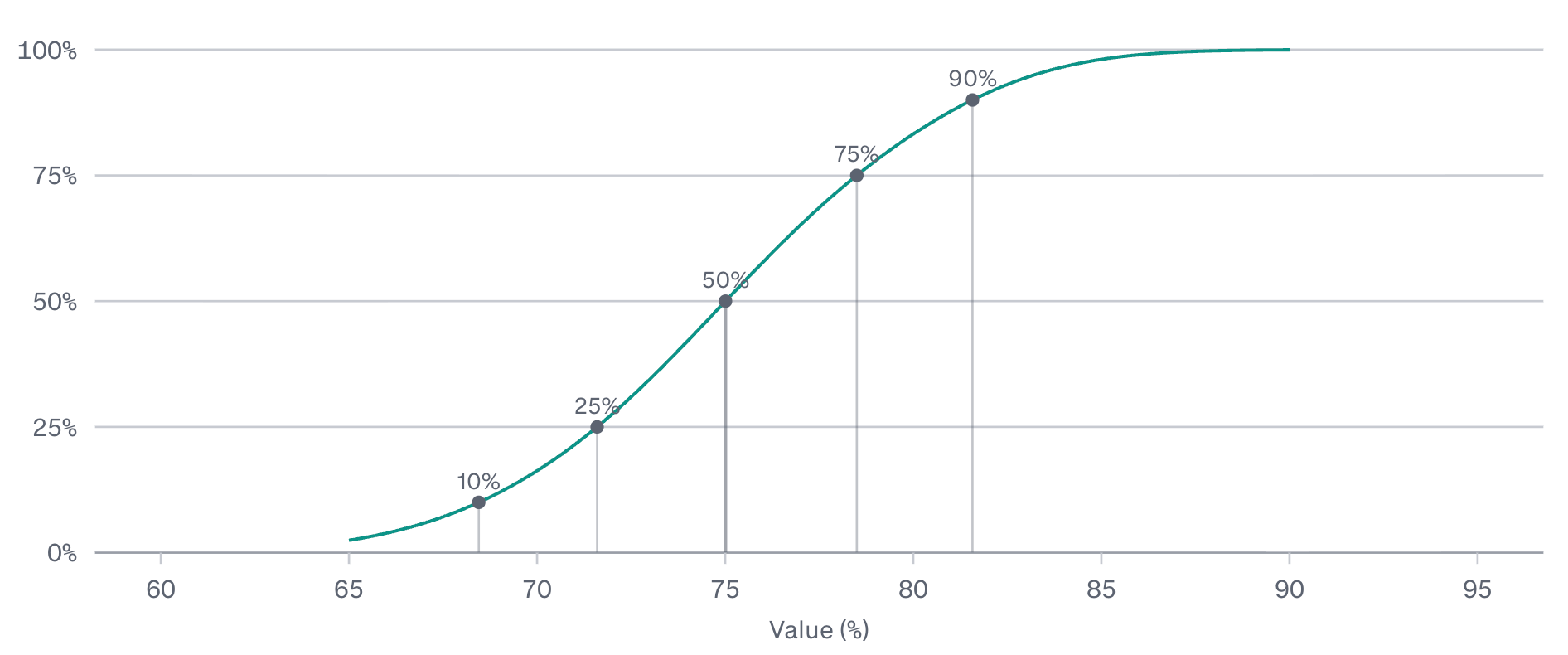
I predict the most likely EU aggregate gas storage fill level on 1 November 2026 is 74.82%, with a 50% chance of falling between 71.62% and 78.12%.
This projection is based on the current fill level of 55%, which is significantly behind the pace needed for traditional targets due to a record-low 28% starting level in April 2026. Supply disruptions from the Strait of Hormuz crisis have halved Middle Eastern LNG imports, and while Qatar began resuming shipments on 31 July 2026, infrastructure damage limits recovery speed.
I find that deep market backwardation and high Asian demand for US LNG have removed commercial incentives for storage, leaving replenishment dependent on state mandates. Consequently, the European Commission has lowered its target to 80%, aligning with analyst forecasts from HSBC and Wood Mackenzie that cluster in the low-to-mid 70s.
My analysis assumes that while Norwegian pipeline flows remain reliable, the required injection rate to hit 90% is unattainable under current scarcity premiums, where daily injection needs exceed historical peaks.
5. The composition of the Swedish government in office on 31 December 2026 ↗
Sweden's September election looks likely to hand the Social Democrats the largest bloc, but forming a government is a separate problem. Explore on Mantic ↗

I predict a Social Democrat-led government will be in office by 31 December 2026 with a combined probability of 72%.
Polling from June 2026 indicates a decisive lead for the center-left opposition at 55.2%, compared to 42.6% for the incumbent bloc, with the Social Democrats serving as the dominant power center at 33.9%.
The governing coalition path to a majority is severely compromised as the Liberal Party polls at 1% to 2.5%, well below the 4% threshold, while 9.9% unemployment erodes voter support for Prime Minister Kristersson.
Friction remains a 15% risk factor if Sweden Democrat demands for cabinet seats or Left Party ministerial aspirations extend negotiations past the year-end deadline.