



Friday Forecasts is a weekly series showcasing 5 forecasts directly from Mantic, which you can explore on the Mantic platform with the direct link in the question titles.
1. Lula’s first-round vote share and his chances of reelection ↗
Lula polls at 43–46% in the first round, below an outright majority. Even if he finishes first, he may struggle to find the extra votes needed to win, as smaller candidates’ voters are expected to favor Flávio in the runoff. Explore on Mantic ↗
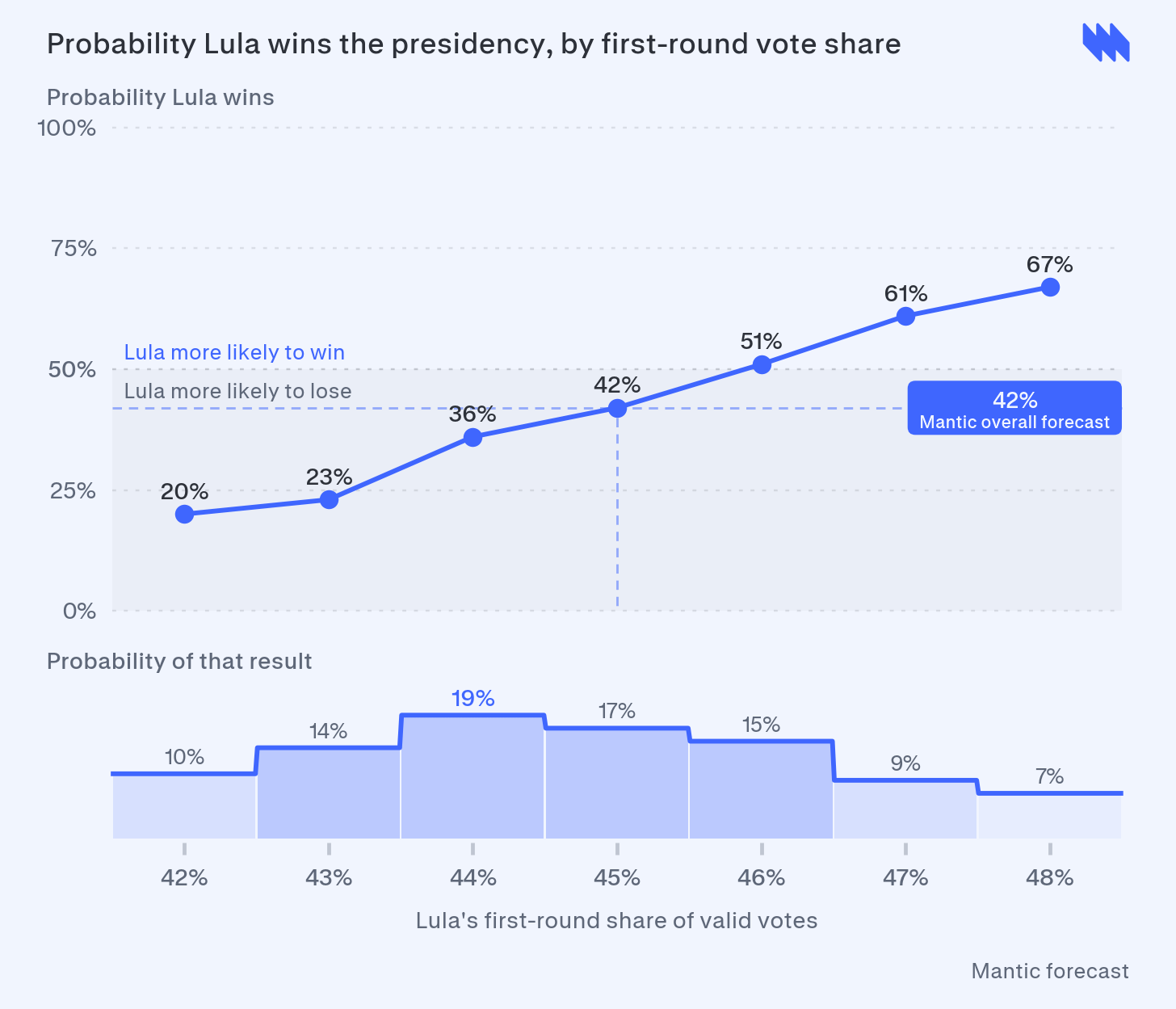
42%. A substantial underperformance against polling suggests weaker underlying support or adverse polling error carrying into the runoff. Right-leaning minor-candidate voters make recovery harder, although campaign changes leave a comeback possible.
43%. This remains below the polling-based baseline. The models carry part of that disappointment into the runoff and allow Flávio to consolidate eliminated candidates’ voters. Polling uncertainty and subsequent campaigning preserve a recovery path.
44%. A smaller polling disappointment leaves Lula competitive but disadvantaged. Models link the result to weaker runoff support and estimate that most minor-candidate transfers favor Flávio.
45%. Roughly matching polling provides little evidence of a collapse or surge. With an outright Lula victory ruled out, the decisive factors are Flávio’s support, voter transfers, turnout and the runoff campaign.
46%. Matching or slightly exceeding expectations improves inferred electoral strength. That makes the runoff approximately even, but the rightward tilt of minor-candidate transfers prevents a strong Lula advantage.
47%. Stronger-than-baseline performance positively updates Lula’s underlying support. Some strength may reflect consolidation of both leading candidates rather than gains against Flávio, so transfers and campaigning remain consequential.
48%. A clear polling outperformance supports a persistent strength or turnout advantage. The models also invoke the 2022 precedent. Close runoff polling, uncertain transfers and incomplete persistence keep defeat plausible.
2. Democratic Senate wins in states Trump carried by at least 10 points ↗
Democrats are competitive in several states Trump won by at least 10 points in 2024. These races can move together, and a favorable national swing could deliver several major Senate wins to make the Congress fully Democrat. Explore on Mantic ↗
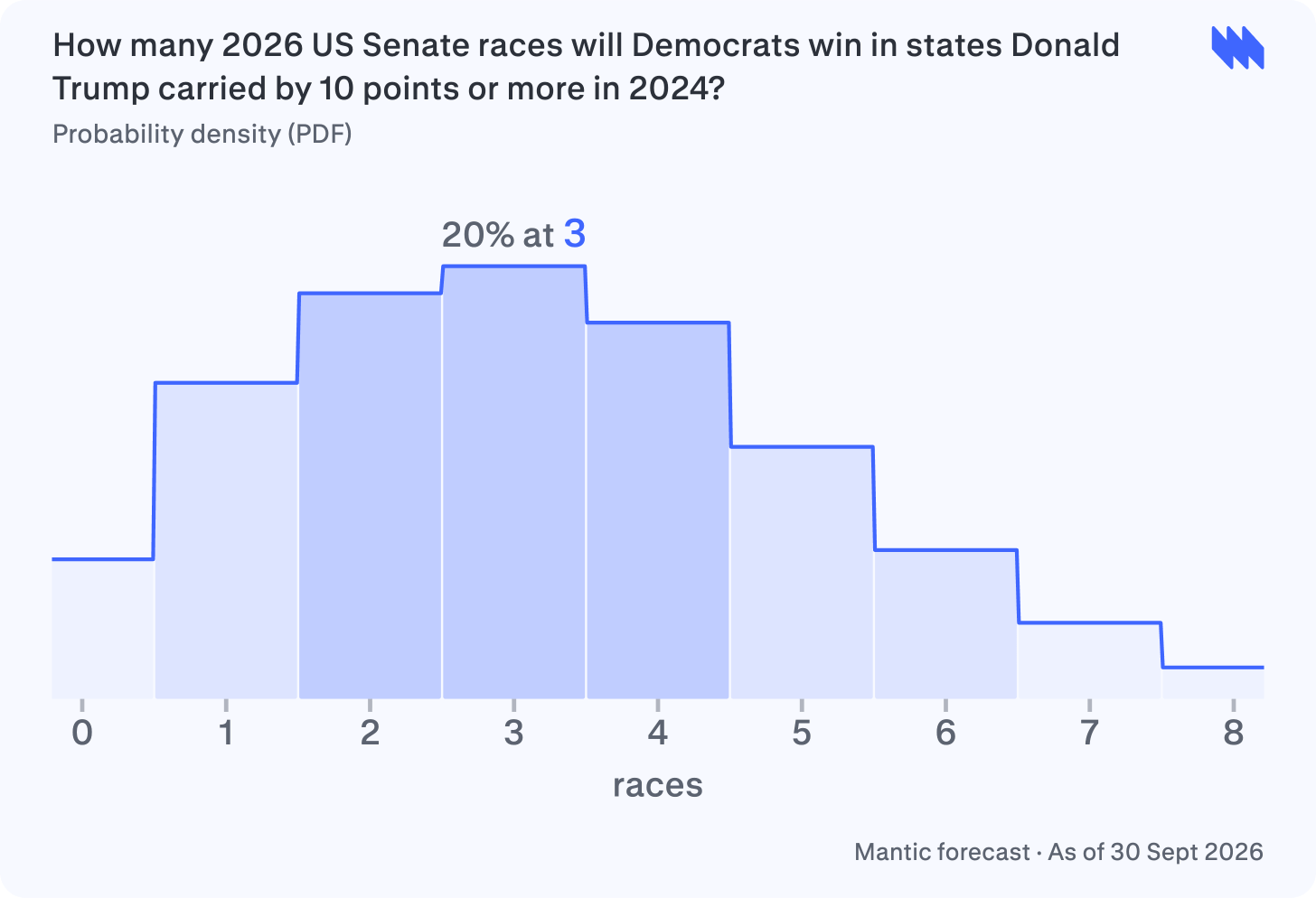
Favorable September polling across five key battlegrounds (Alaska, Ohio, Texas, Iowa, and Kansas) was weighed against prediction market odds that favored Republicans in Iowa and Kansas, anchoring my expectations around three wins.
Potential independent victories in Nebraska and Montana contribute little to the count, as both candidates explicitly rejected party affiliation and are unlikely to fulfill the requirement to caucus with Senate Democrats.
Accounting for shared national polling error rather than treating races as independent widens the outcome spread, accommodating both multi-seat Democratic waves and near-total Republican sweeps.
My forecast is right-skewed, with an 80% range of 1 to 5 wins and a 90th percentile of 6 wins, as long-shot upsets in deep-red states like Florida and South Carolina stretch the upper tail.
The main remaining uncertainty is whether late Republican consolidation and systematic polling errors across red states will emerge over the closing weeks to erase narrow Democratic leads.
3. The far-right’s combined first-round vote share in France ↗
The far-right bloc polls near 40%, but early polls overstated it by 2–5 points in past races. What will be their actual share on election day? Explore on Mantic ↗
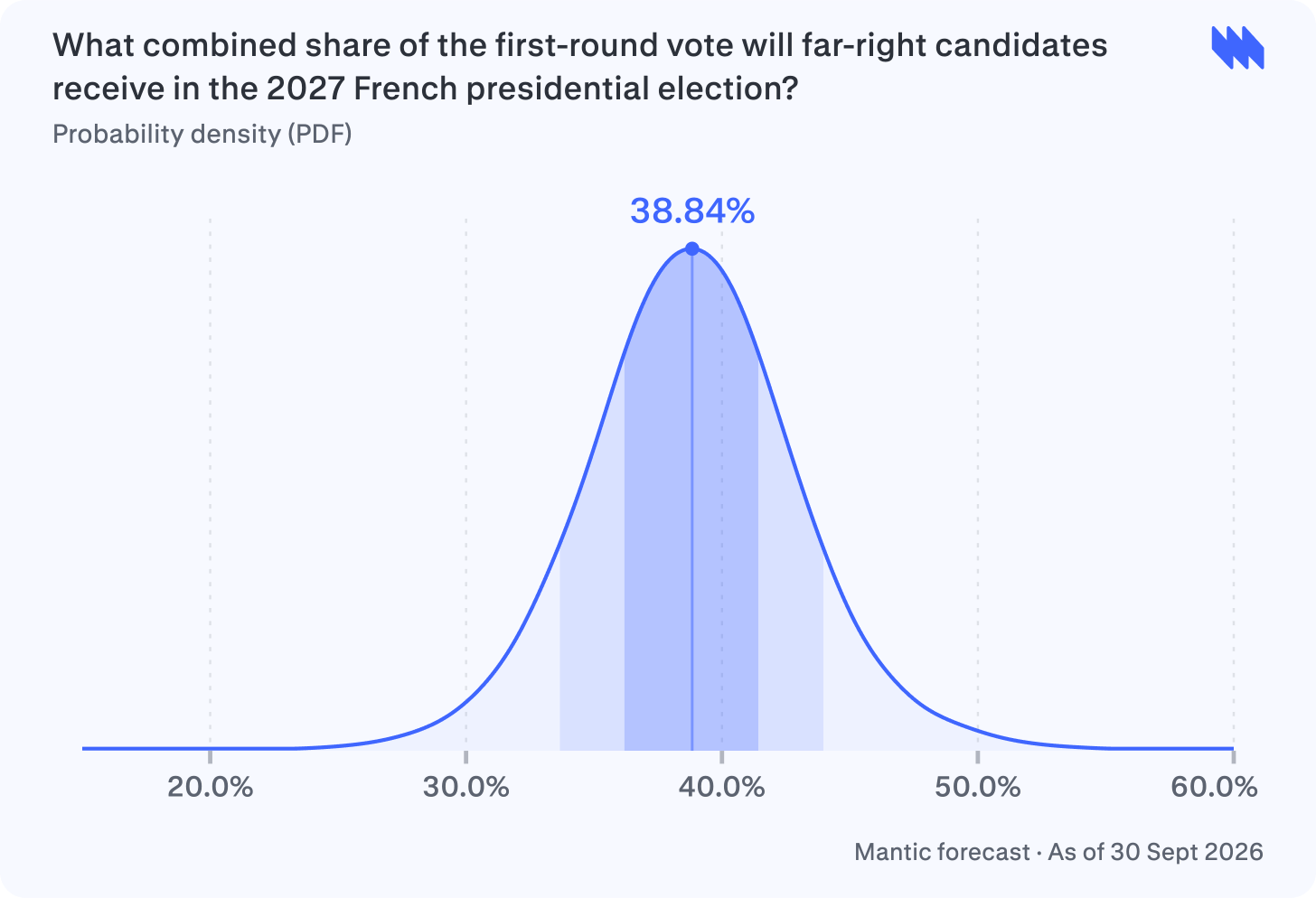
September 2026 surveys across seven polling organizations put the combined far-right bloc near 40%, led by Marine Le Pen after a July 2026 court ruling restored her eligibility.
I reduced this baseline by nearly two points rather than projecting polls directly, as early surveys overestimated the far-right bloc by two to five points in 2007, 2017, and 2022.
While minor candidates face signature hurdles to reach the ballot, I deducted only a fraction of a point for ballot attrition because most of their supporters transfer to other qualifying candidates.
My distribution is roughly symmetric around 38.8%, with an 80% range from 33.5% to 44.0%, allowing for tail risks from a major campaign setback to a late surge.
The primary remaining uncertainty is how candidate momentum and polling error evolve over seven months of campaigning, alongside Le Pen’s pending appeal before the Court of Cassation and potential replacement by Bardella.
4. Who Israel’s president first tasks with forming a government ↗
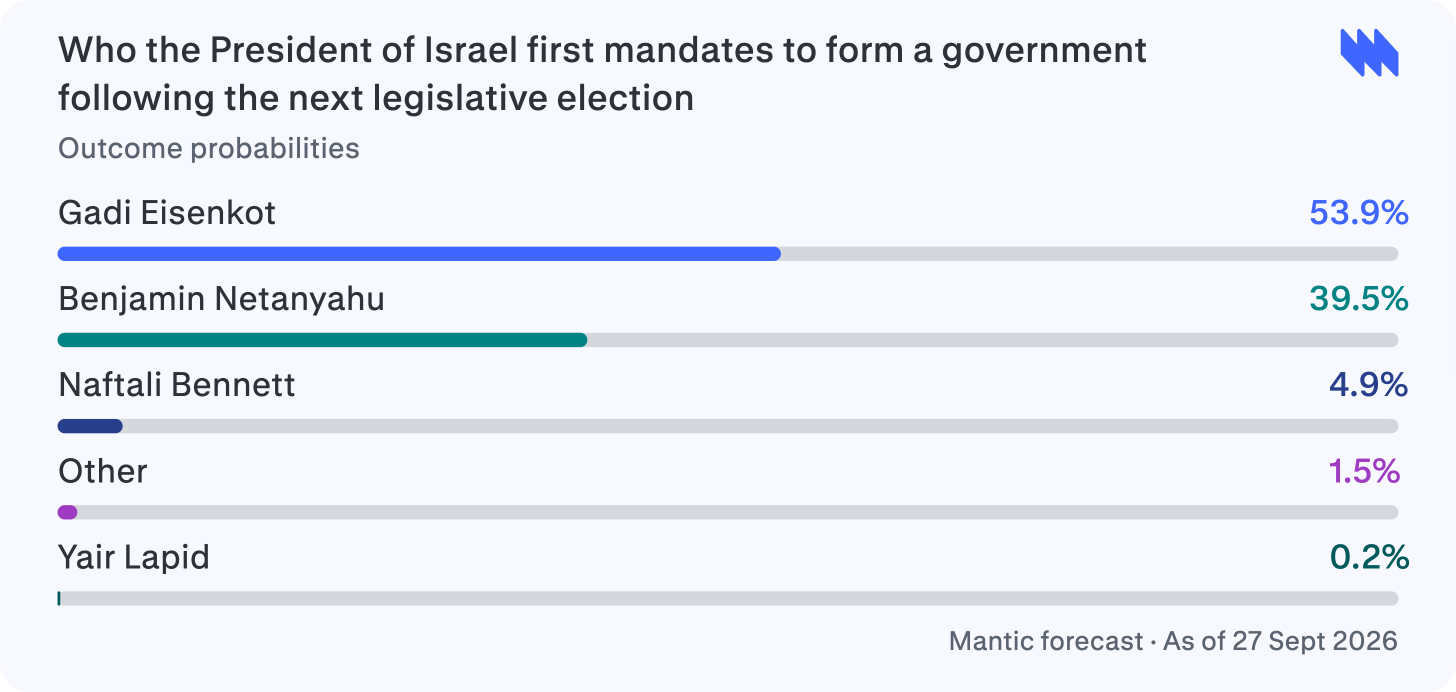
In 2021 Netanyahu received the first mandate with 52 recommendations, yet Bennett became prime minister. The opposition’s pact may unify its votes, but winning the first invitation still differs from winning power. Explore on Mantic ↗
Mainstream polling puts the Zionist opposition slightly ahead with Yashar leading Likud at 22 to 23 seats, though right-leaning polls show the governing coalition reaching 60 to 63 seats.
Opposition leaders signed a cooperation pact making a unified recommendation likely in roughly 79% to 82% of scenarios, but disagreements between Eisenkot, Bennett and Lieberman over candidate selection keep fragmentation possible.
Because the first mandate depends on initial recommendations rather than the ability to pass a confidence vote, Netanyahu retains a consequential 40% probability while Bennett is largely relegated to later coalition talks.
The forecast is heavily concentrated on Eisenkot (54%) and Netanyahu (40%), with Bennett holding 5% and Lapid and other contenders assigned small residual chances.
Remaining uncertainty turns on whether Arab party disqualifications are overturned on appeal, whether Arab factions endorse Eisenkot, and whether small swing lists cross the electoral threshold.
5. A runoff in Nigeria’s 2027 presidential election ↗
Nigeria has held seven presidential elections since 1999 without a runoff. Will this be the election to break the streak? Explore on Mantic ↗
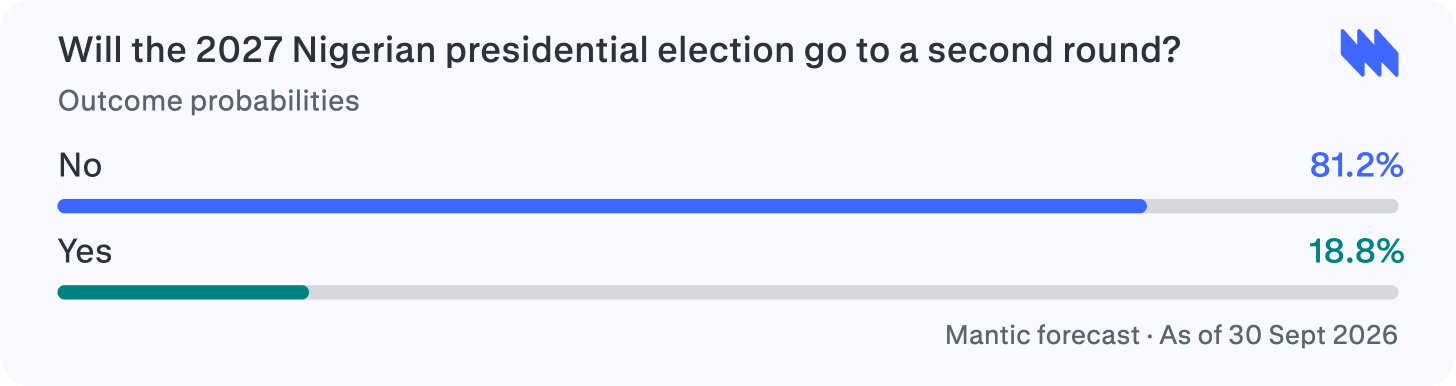
With the ruling party controlling 31 of 36 governorships and Bola Tinubu having reached 25% across roughly 30 states in 2023, an incumbent plurality almost certainly meets the constitutional spread rule, weighing heavily against a runoff.
A fractured opposition makes a runoff possible, but that outcome hinges almost entirely on Peter Obi winning a national plurality without sufficient geographic spread, after clearing the 25% threshold in only 16 to 19 jurisdictions in 2023.
The models diverged on opposition strength: one predicted a 15% runoff chance by treating Tinubu as an 80% plurality favorite, whereas the other saw a 23% chance by modeling a tighter race where Obi captures nearly 33% of the first-ballot vote.
My forecast leans decisively toward a first-round victory, but preserves a 19% chance of a runoff to capture the scenario where an opposition plurality lacks sufficient geographic spread.
Key uncertainties center on whether Rabiu Kwankwaso’s northern base transfers cleanly to Obi, how effectively APC governors deliver their states, and whether the electoral commission requires 24 or 25 qualifying jurisdictions.