

With the U.S. midterms on 3 November, I asked Mantic to look at who controls Congress and how the results of the election could shape US policy in the years ahead.1
The linked Mantic stamps also include the scenario in which Republicans win both chambers.
1. The balance of power in the next Congress ↗
Democrats need only three House gains but four Senate pickups. The same national polling miss could overturn several close races at once. Explore on Mantic ↗
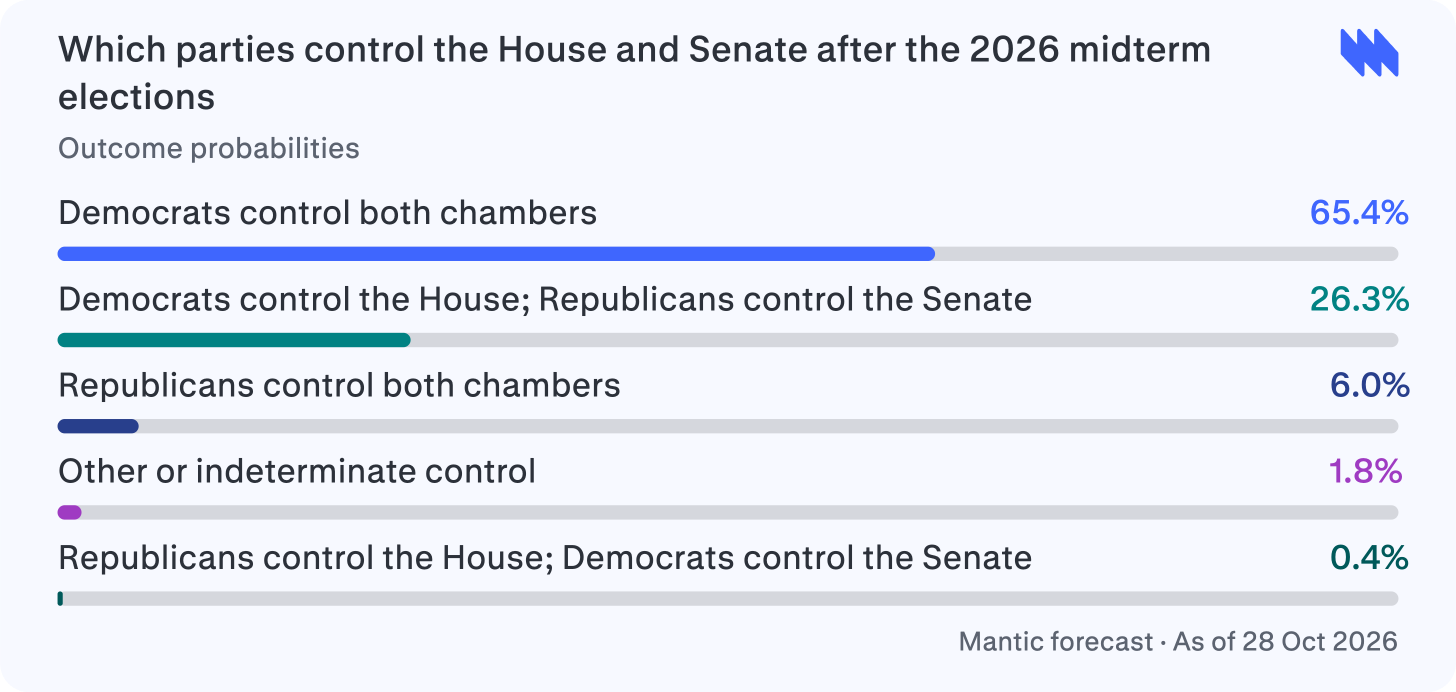
I give a 65% probability to Democratic control of both chambers, 26% to a Democratic House and Republican Senate, 6% to Republican control of both, and 2% to other or indeterminate control.
Polymarket priced Democratic Senate control at about 67%.2 I temper that with Decision Desk HQ’s cautious race assessments3 and the risk of several narrow Democratic leads failing together.
I strongly favour a Democratic House because national polling gave Democrats an 8–9-point lead and Crystal Ball rated 225 seats at least leaning Democratic.4
I let national electoral shifts affect both chambers together. That makes Republican control of both chambers much more likely than a Republican House paired with a Democratic Senate.
I include an indeterminate result because Osborn and Bodnar pledged not to caucus with either party.5 An independent holding the balance could leave neither party with a Senate majority.
2. When the Senate passes an Iran War Powers resolution ↗
The last Iran War Powers resolution fell 49–50. A Democratic sweep clears the path to Senate passage, which alone does not make the resolution law. Explore on Mantic ↗
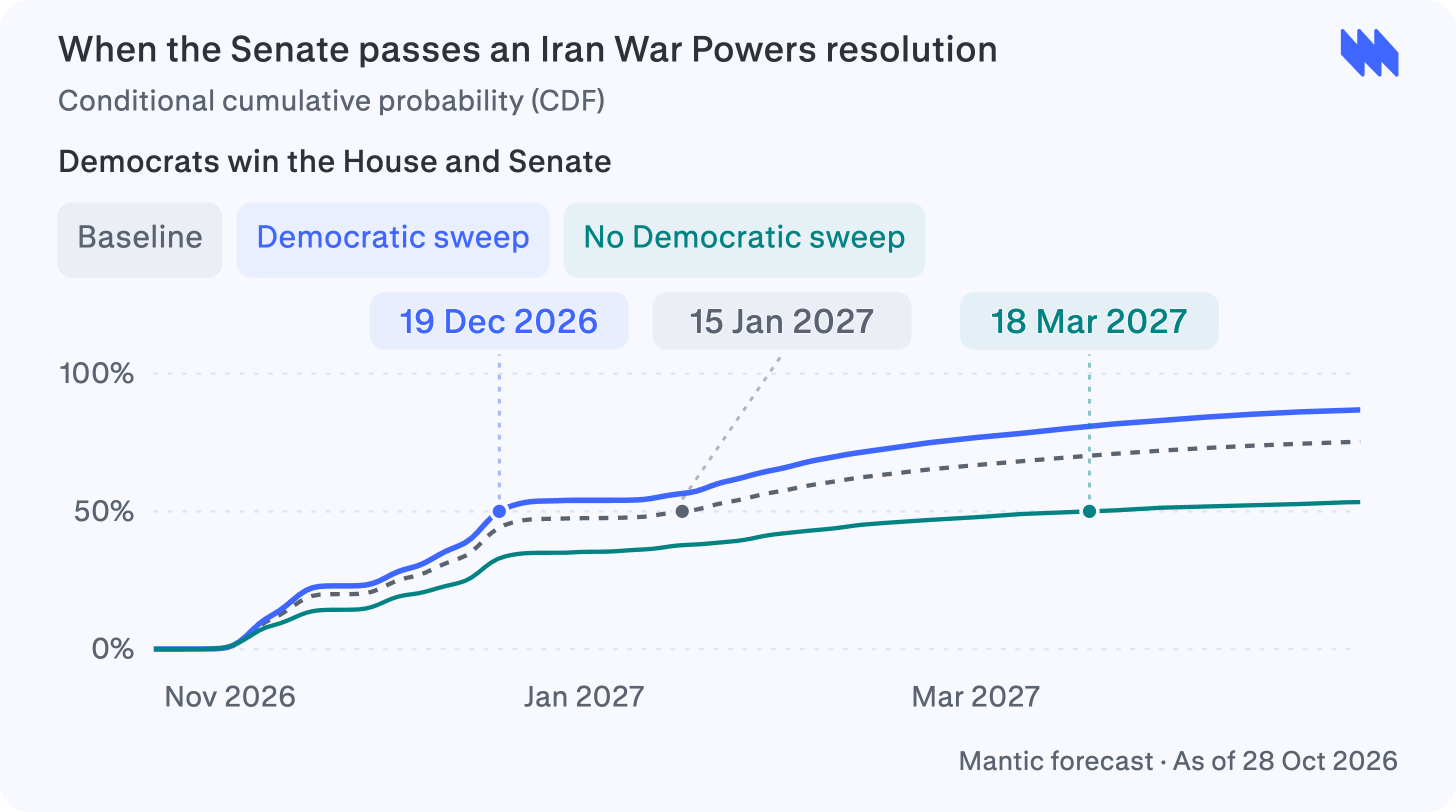
If Democrats control both chambers after the 2026 midterm elections, I put the median date at 19 December 2026, 27 days earlier than 15 January 2027. The probability of passage by 21 October 2030 rises by 11 points to 94%.
Democratic control of the Senate in 2027 provides agenda control. Combined with existing Republican supporters, that majority makes passage early in the new Congress highly likely.
A Democratic sweep also strengthens the likelihood that Sherrod Brown wins the Ohio special election. Senator Jon Husted’s term ends on 15 December6. Seating Brown would give the coalition 51 votes during the final lame-duck week.
Reports that the United States warned Gulf countries of a campaign against Iran after the midterms7 and pending House-passed measures8 also encourage early forced votes in November.
If Democrats do not control both chambers after the 2026 midterm elections, I put the median date at 18 March 2027, 62 days later than 15 January 2027. The probability of passage by 21 October 2030 falls by 21 points to 62%.
This assumption makes Republican control of the Senate in 2027 much more likely. Passage then depends on a very narrow seat margin and Republican cross-party votes rather than guaranteed Democratic scheduling.
On 24 September, a War Powers resolution failed 49 to 509. If Republicans hold 52 or more Senate seats in 2027, that coalition falls short at full attendance.
Lower odds of a Democratic win in Ohio also reduce the chance of gaining a seat after Senator Jon Husted’s term ends on 15 December10.
Passage remains plausible because pending resolutions11 and reported plans for post-midterm US military strikes12 will still prompt floor votes during the lame-duck session.
3. Supreme Court retirement announcements by July 2028 ↗
Senate control changes the prospects of confirming conservative successors. Even with a Democratic House, a Republican Senate can preserve the incentive for justices to retire. Explore on Mantic ↗
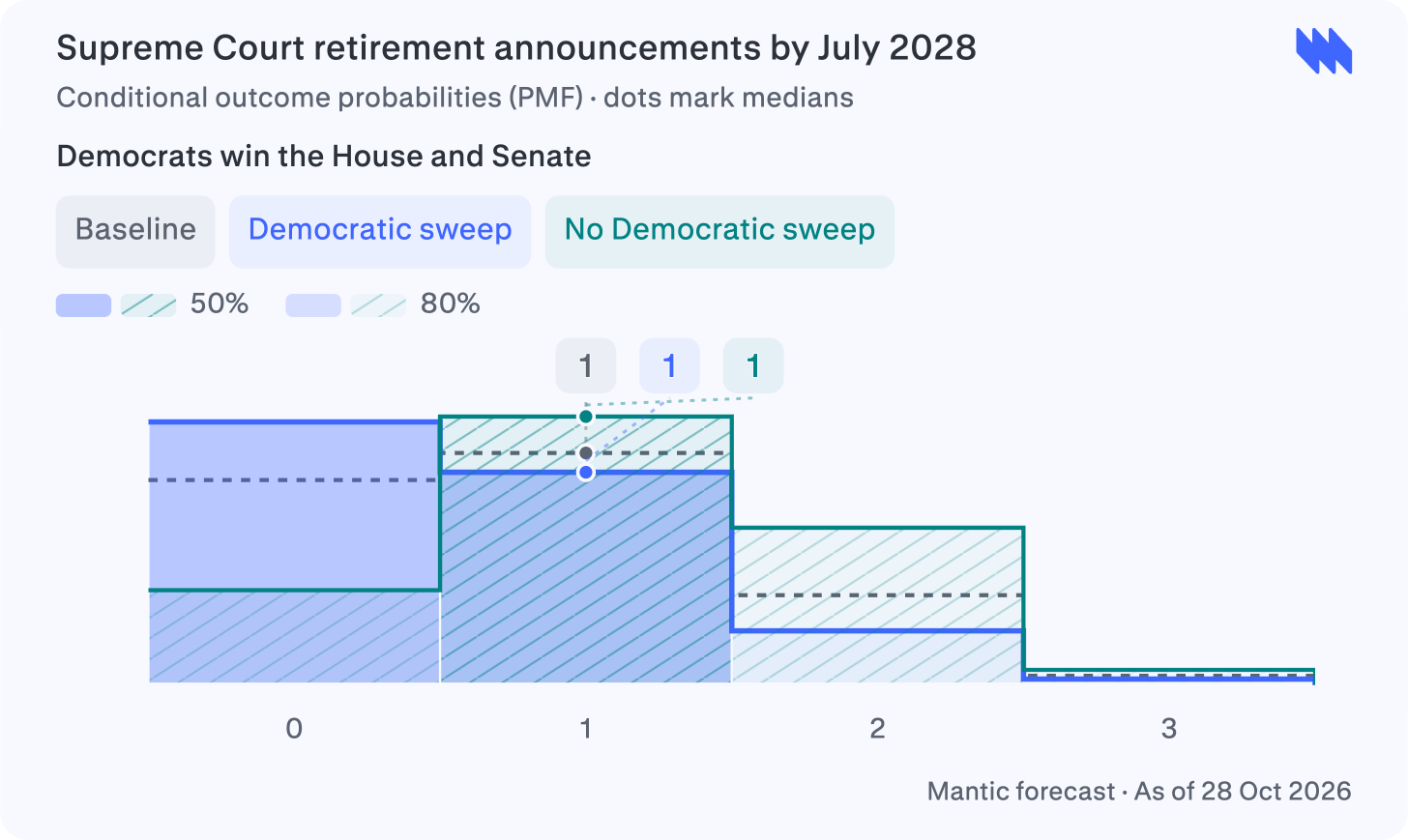
If Democrats control both chambers after the 2026 midterm elections, I keep the median at 1.
Justice Samuel Alito confirmed that he considers retirement every term and will reconsider in 202713. Announcements conditional on a successor still count, so he remains the most likely justice to step down.
Alito also stated that he would not retire during the lame-duck period even if Democrats won14. That rules out an immediate exit and pushes any potential timing toward later term ends.
Justice Clarence Thomas has shown no plans to retire soon15. He approaches the Supreme Court length-of-service record on 20 May 202816.
If Democrats do not control both chambers after the 2026 midterm elections, I keep the median at 1.
Ruling out unified Democratic control makes a Republican Senate the dominant outcome17. A Republican majority provides a receptive path for confirming judicial nominees.
Justice Samuel Alito confirmed that he considers retirement each term and will reconsider in 202718. With a favourable Senate in place, an Alito announcement is the central scenario.
Justice Clarence Thomas has not indicated plans to retire19. He approaches the Supreme Court tenure record on 20 May 202820, keeping a second retirement less likely than one.
4. When federal law preempts state AI regulation ↗
A narrow digital-replica law can override state rules without a sweeping AI framework. The scenarios below use the 28 October baseline. Explore on Mantic ↗
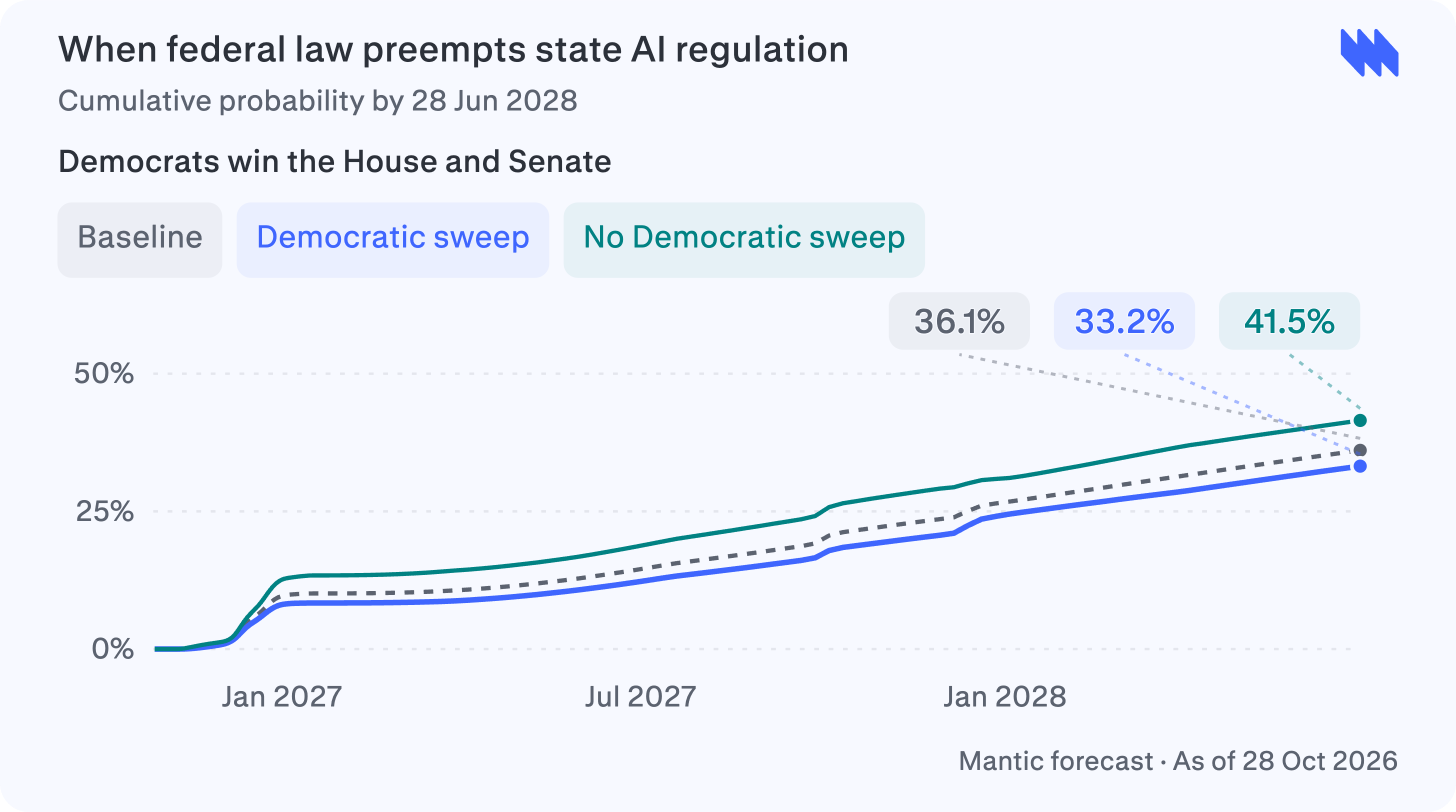
If Democrats control both chambers after the 2026 midterm elections, I put the median date at 8 November 2029, 86 days later than 14 August 2029. The probability of enactment by 6 October 2036 falls by 1 point to 69%.
Democratic leaders oppose displacing state AI authority, and Senator Cantwell’s framework omitted preemption entirely21. Many Democrats view the FRONTIER Act as a non-starter because of its preemption language22, which weakens the prospect of a broad compromise in 2027 or 2028.
Early enactment relies mainly on narrow legislation like the NO FAKES Act, which explicitly preempts state digital-replica claims23. Senator Cruz blocked unanimous consent on 30 September over free-speech concerns, but proposed further staff negotiations24.
A short 2026 lame-duck session with only 24 to 25 legislative days and a 11 December funding deadline limits the chance of year-end preemption riders25,26.
Compared to a scenario where Republicans hold at least one chamber, unified Democratic control creates greater resistance to federal preemption, shifting the overall probability of enactment slightly lower.
If Democrats do not control both chambers after the 2026 midterm elections, I put the median date at 2 February 2029, 193 days earlier than 14 August 2029. The probability of enactment by 6 October 2036 rises by 1 point to 71%.
Without a Democratic sweep, Republicans control the Senate, the House, or both chambers. Republican control in at least one chamber gives more leverage to industry preemption demands, making a compromise in 2027 or 2028 more feasible than under full Democratic control.
The NO FAKES Act contains explicit preemption of state digital-replica claims27, while the FRONTIER Act would bar states from imposing new developer obligations28. Bipartisan negotiations on narrow preemption create several viable routes in the next Congress29.
Although Senator Cruz blocked immediate Senate passage of NO FAKES on 30 September 2026 over parody and speech concerns, he proposed further staff negotiations30. The 60-vote Senate threshold and state-level resistance still prevent immediate enactment31.
A crowded 2026 lame duck with 24 to 25 legislative days and a 11 December funding deadline limits near-term action32,33. Compared to a Democratic sweep, however, Republican leverage in the subsequent Congress pulls the median enactment date earlier.
5. ACA marketplace premium tax credits expand ↗
Congress can make restoring Affordable Care Act (ACA) subsidies a priority, but Trump keeps his veto until January 2029. Whether Democrats also win the Senate changes their room to negotiate. Explore on Mantic ↗
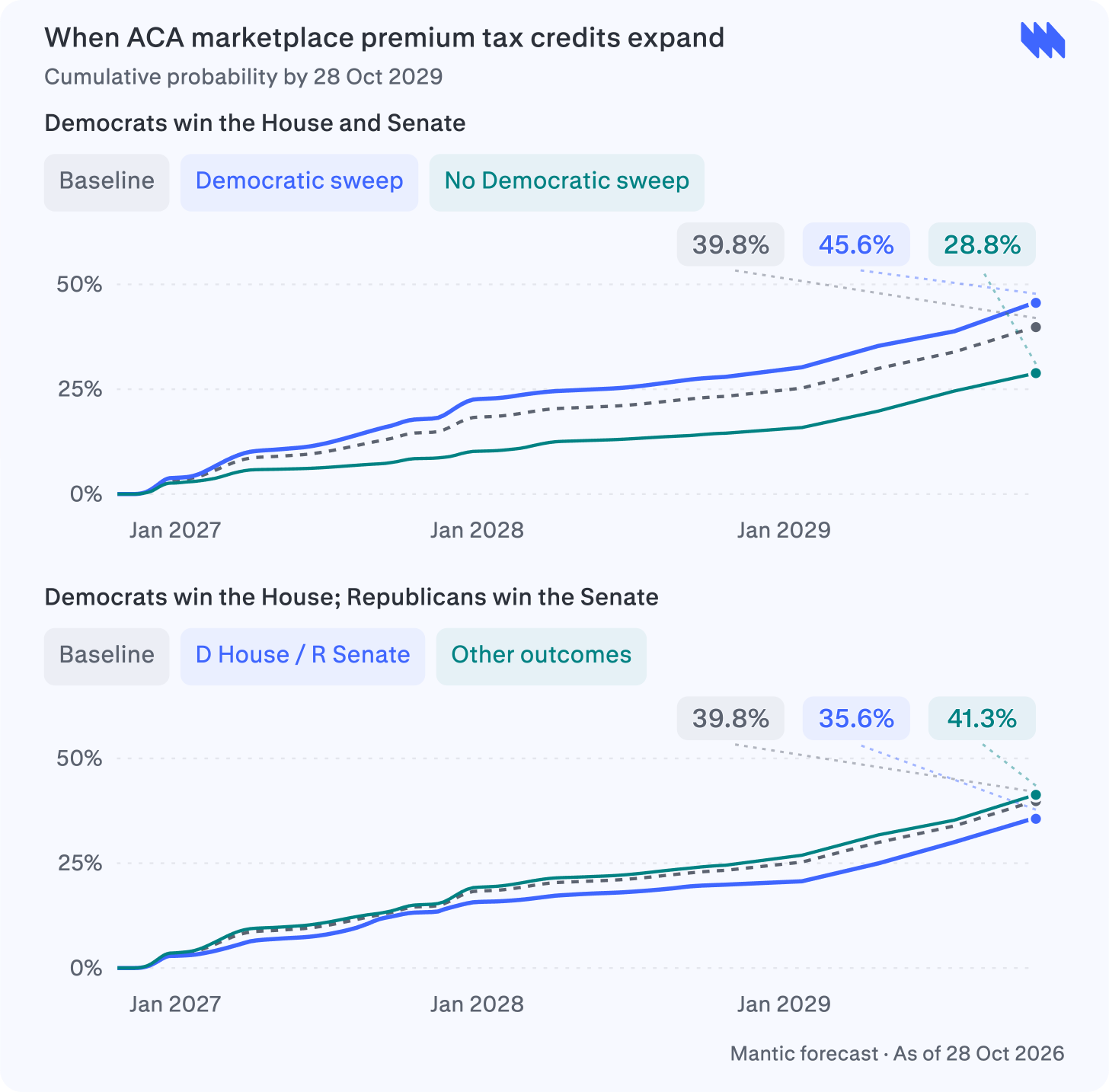
If Democrats control both chambers after the 2026 midterms, I put the median date at 26 February 2030, 322 days earlier than 14 January 2031. The probability of enactment by 13 October 2036 rises by 6 points to 62%.
Controlling both chambers gives Democrats full agenda power to prioritise restoring the credits, building on the House-passed extension34. It strengthens their bargaining leverage during upcoming funding and debt-limit negotiations.
President Trump has threatened to veto an extension35. Analysts at Brookings also consider major healthcare changes unlikely during his term36, while his administration is actively restricting credits37.
Public support of 76%, including 60% among Republicans38, preserves the chance of a partial compromise before 2029. Even so, the largest concentration of enactment probability remains after the 2028 presidential transition39.
If Democrats control the House and Republicans control the Senate after the 2026 midterm elections, I put the median date at 24 May 2034, 1,226 days later than 14 January 2031, and the probability of enactment by 13 October 2036 falls by 4 points to 52%.
A Republican-controlled Senate adds a procedural barrier alongside President Trump’s veto threat40. Analysts at Brookings and The Hill note that major Democratic healthcare legislation has little chance of becoming law while Trump remains in office4142.
Although 76% of voters support restoring the subsidies43 and 17 House Republicans backed H.R. 183444, Trump’s preference for direct payments outside section 36B diminishes the chances of a qualifying near-term compromise45.
Under divided government, enactment before 2029 is unlikely. That pushes the primary legislative opportunity to a potential Democratic presidential and congressional victory after 20284647.
Because the alternative midterm outcomes include full Democratic control of Congress, assuming a divided legislature reduces overall legislative leverage and leaves the ten-year probability of enactment lower than under those alternative paths.